
A Simple Model for Handwriting
Proceedings of the Fifth International Joint Conference on Artificial Intelligence. Applications. Pages 881--1.
© 1977 International Joint Conferences on Artificial Intelligence
Abstract
- Koster, W.G., and]. Yredenbregt [1971): Analysis and Synthesis of Handwriting. Medicine and Sport, vol. 6 : Biomlclaantcs II; pp. 77-82. Applications-1: Hollerbach
References were extracted automatically from the PDF and may contain errors.
Full text extracted automatically from the PDF; figures, tables and equations may differ. The PDF is the version of record.
A Simple Model for Handwriting
by John M. Hollerbach Artificial Intelligence Laboratory Massachusetts Institute of Technology Cambridge, Massachusetts 02139
An understanding of the human motor system, though interesting as a facet of intelligence, would also have application for computer controlled manipulation. To enhance this understanding, handwriting is appropriate for study because of Its commonality, Its susceptibility to measurement, and the possibility of its simulation with a manipulator.
A theory of handwriting has been developed and Implemented on a 6-joint manipulator, the MIT YICARM. The theory views handwriting as a constrained modulation of an underlying oscillation pattern. This pattern, chosen from a repertoire of carrier waves such as sawteeth or g.arland chains, is established by programming of horizontal and vertical actuators. The two actuators assume different roles: the vertical actuator drives the movement with rhythmic down-up movements. The horizontal actuator, acting within time constraints imposed by the vertical rhythm, produces letter shapes. The choice of underlying oscil1ation pattern restricts the shapes the horizontal actuator can produce, and is the primary factor Influencing writing style.
A simple set of constraints on actuator force patterns, derived In part from an analysis of some handwriting measurements, imposes a certain structure on the handwriting programs:
I. a basic time quantum in which force is constant
- synchronous joint activation
3. force magnitude restriced to a few levels.
The basic time quantum for the YICARM, representing a compromise among such factors as speed of response and jerkiness, was chosen as 24 msec.
A cycle of the carrier is a down-up movement comprised of several time quanta. The fastest cycle consists of one quantum acceleration-deceleration bursts by the vertical actuator, resulting in a four quantum down-up cycle of 96 msec. When coupled with a horizontal pattern that rounds the bottoms of the oscillation, a smoothed sawtooth results (Ia below). Horizontal (H) and vertical (Y)

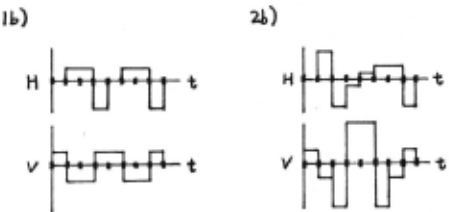
acceleration profiles corresponding to two cycles of Ia are Indicated in lb. The abscissa is marked off in single time quantum units. Simple amplitude modulation of the bursts in this pattern and a slight alteration to incorporate a left movement in the {produces the cursive rendering of" vial (2a); the acceleration profiles for the two cycles forming the { are shown in 2b. These accelerations are actually modified to take into account the frictional characteristics of the YICARM before they are applied to the arm. In a sense they may be viewed as idealized force patterns; as such they are more readily synthesized than forces incorporating system idiosyncracies.
Slower oscillation patterns allow the horizonta I actuator more time to shape letters, in particular more time to Incorporate leftward movements. With an 8-quantum cycle, a garland chain with leftward movement and more rounded bottoms can be set up (3a). When modified, the garland chain becomes the vial in 3b. A feature of this modification is hesitation at sharp corners such as the !, where the top loop of the garland is aborted. The hesitation is required to keep the writing In phase with the oscillation.

The constraints on force patterns lead to a small set of allowable horizontal rounding patterns. Coupled with restrictions on how these rounding patterns overlap with the down-up motion, there arises a vocabulary of corner shapes that range from rounded to sharp, symmetric to asymmetric. With this vocabulary an oscillation train is readily shaped, subject of course to time and stylistic limitations imposed by the choice of oscillation. As an illustration of the ability to manufacture different letter shapes, four ~·s drawn by different human subjects (taken from [Koster and Yredenbregt]) appear below paired with their VICAR M facsimiles, the former on the left and the YICARM writing on the right. The first two a's are derived from an 8quantum cycle, the last two !!:S fr~m a 12-quantum cycle.

An experimental apparatus has been built to make accurate acceleration measurements during handwriting, providing a test of this theory. Results from this apparatus are not available as of this writing. Potential applications of this work include signature verification, a cursive script more suited to speed, and new ideas for machine reading of handwriting.
@inproceedings{ijcai1977p207,
  title     = {A Simple Model for Handwriting},
  author    = {Hollerbach, John M.},
  booktitle = {Proceedings of the Fifth International Joint Conference on
               Artificial Intelligence, {IJCAI-77}},
  publisher = {International Joint Conferences on Artificial Intelligence},
  editor    = {Raj Reddy},
  pages     = {881---1},
  year      = {1977},
  note      = {Applications},
  url       = {https://ijcai.org/proceedings/1977/207},
}
TY - CPAPER TI - A Simple Model for Handwriting AU - Hollerbach, John M. T2 - Proceedings of the Fifth International Joint Conference on Artificial Intelligence, IJCAI-77 PB - International Joint Conferences on Artificial Intelligence PY - 1977 SP - 881 EP - -1 UR - https://ijcai.org/proceedings/1977/207 ER -Copied
Machine-readable versions of this paper, for tools and AI agents:
 Welcome
 Future Conferences
 AI Journal Division
 IJCAI Proceedings
 About IJCAI
 IJCAI Awards