
EXAMINER: A System Using Contextual Knowledge for Analysis of Diagnostic Behavior
Proceedings of the Fifth International Joint Conference on Artificial Intelligence. Specialized Systems. Pages 814-817.
© 1977 International Joint Conferences on Artificial Intelligence
Abstract
An approach to the use of machine generated contextual knowledge for the analysis of diagnostic behavior in medicine has been developed. The approach is illustrated by ref erence to EXAMINER,a system whose contextual knowledge is derived through us e of the INTERNIST data base and diagnostic system[l] . EXAMINER acquires a us e r's characterization of a medical case in light of this contextual knowledge and analyzes . it to gene rate commentary r egar ding notable aspects of the user ' s characterization.
- Pople, H.E., Myers, J.D., & Miller, R.A., "The DIALOG Model of Diagnostic Logic and its use in Internal Medicine", Proc. 4, IJCAI, Tbilisi, USSR, September 1975.
- Pople , H.E., "The Formation of Composite Hypotheses in Diagnostic Problem Solving - An Exercise in Synthetic Reasoning", Proc. 5, IJCAI, Cambridge, MASS, August 1977. SpP.cinl izerl Systems-3: Oleson IJCAI
References were extracted automatically from the PDF and may contain errors.
Full text extracted automatically from the PDF; figures, tables and equations may differ. The PDF is the version of record.
1. Introduction
internal medicine. The second process elicits from the user his characterization of the disease processes present in the case . The third process presents the analysis in the form of commentary regarding the characterization.
2.1.1 . Case Specification
The specification of the medical information from the case to be analyzed may occur in one of two modes. The first provides cases with which the user has had no previous experience . These cases have been defined by medical people who have access to all information regarding the case. A program which elicits and stores this inform ation in machine readable form is used. When the case is· selected for use, it is brought into core and the relevant findings of the case are indicat ed to the user.
The second mode allows the user to specify a case with which he is familiar. The positive and negative findings from the case are entered by the user and used as the basis for analysis.
2 .1. 2. Characterization
The characterization phase requires the user to indicate his perception of the important aspects of the case. The process generates a data structure to be used by the next phase .
A number of types of information were found to be of interest in the characterization of a case and primitives were developed to allow the user to express the information he considered critical without burdening him with undue detail. A description of the meanings of these primitives is now given:
The PRIMARY-PROBLEM primitive is used to indicate the disease or type of disease which is considered to be the likely cause of the important aspects of the case. If alternatives are con sidered equally likely, they may be specified by the OR primitive here and elsewhere .
If any of the diseases indicated are generic disease, the specific disease or diseases con sidered most likely may be indicated by the primitive SPECIFICALLY .
The RELATED-POSSIBILITY primitive is used to indicate diseases which are considered by the user to be possibly present and which are linked to diseases already indicated as possible in the case. The related possibilities should include those diseases which are linked to other mentioned diseases either causally, systemically, or by simple co-occurence.
ANOTHER-INDEPENDENT-PROBLEM is a primitive used to indicate a disease process which appears to have no connection to the primary problem or other previously mentioned problems.
ACCOUNTING-FOR is the primitive used to specify manifestations which the antecedent disease explains .
Through use of these primitives, the user is expected to indicate his perception of the case. The representation of this characterization then serves as the basis for the analysis that is undertaken.
2 .1. 3 . Commentary
The commentary is made in the form of scripts relating to the observations attendant upon the user's characterization. Indications of the manifestations and diseases pertinent to the comment are put out as appropriate inserts in the context of the scripts.
2 . 2 Representation
The four types of data requlrlng special representation in the system are now described.
THE MEDICAL CASE: A pre-stored case is represented as a list of positive and negative findings. These are printed for the user and kept in core for use by the analysis programs.
Similarly with user defined cases, the truth values for the known manifestations are specified by the user and stored as lists for use by the programs .
STATIC MEDICAL KNOWLEDGE: A large data base of medical knowledge is accessable for use by the system. This is the INTERNIST data base. It contains bidirectional pointers between the diseases and manifestations in the domain of internal medicine as described in [1].
CHARACTERIZATION OF A CASE: The represent ation of a characterization of a case uses the structure developed by Pople [2] to specify the general disease processes of a case, their com petitors, and the manifestations for which each might account. In addition internal structures represent whether individual processes are med ically related to one another or independent. The individual processes are represented as co-routines and the co-routines are associated according to certain relations. (e.g. TYPE-OF, COMPLEMENT-OF, LINK-OF, ALTERNATIVE-OF etc .). The characterization structure is used to accomodate the user's characterization as well as the alternatives to it generated by the system. An example of the generation and use of these characterizations is given in section 2 .4.
MAXIM-PREDICATES: The principles of internal medicine (called maxims by the system) are represented as LISP functions which take the various data structures as arguments and return values with respect to the case and the knowledge embodi ed by the maxim. The maxims include principles confined solely to fixed medical knowledge (e.g. the user should associate mani festations with diseases which are medically related), principles confined to the case and
the user's characterization of it (e.g. the important manifestations should be accounted for by the user's characterization of the case), and principles which depend upon comparison between the user's characterization and alternative char acterizations of the case (e.g. if there is a characterization which is simpler than the user·· s characterization, it should be considered a better explanation of the case) . The maxims are ident ified through recognition of the principles inherent in the INTERNIST system and by analyzing critiques of it and other examples of diagnostic behavior which are provided by Myers [1) and other expert practitioners in internal medicine.
2.3 Process
Given the maxim-predicates, the evaluation algorithm is simple: apply the maxim-predicates to the user's characterization of the case. Each of the maxim-predicates involves a separate algorithm. But certain general types of behavior are identifiable as used by many of the maxim predicates. These types of behavior may be con sidered under the generic heading: "processes which make use of the medical data base ."
The first of these types of process makes direct use of the data base. This is often done to check the validity of assertions. For instance, it may be asserted that hepatic con gestion is a type of liver disease or that proteinuria occurs in pneumonia. These tasks require only simple processing, but they are often required in the specification of more complex processes.
Another type of process makes inference based upon a user's characterization of a case by invoking simplifying assumptions about the user's characterization. This approach is often used when the system is taking a "best fit" or "benefit of the doubt" approach to the user's characterization. For instance, if the user has made no indication of the correlation between the manifestations of the case and the diseases which he has specified, the system may infer associations based on best potential coverage and then evaluate the characterization on those terms for some of its predicate-maxims.
The third common type of process generates alternative characterizations of the case on the basis of some specified criteria. The specified criteria are intended to induce characteristics which are in some sense optimal. These alter native characterizations are then used as a basis for comparison. They are generated by the INTERNIST diagnostic process using the medical data base.
2.4 An Example of System Performance
2 .4.1 Case Run
(EXAMINER)
TEST CASE? NEJMV290Pl071
AGE 26 TO 55
SEX MALE DYSPNEA EXERTIONAL HEART OUTPUT DECREASED HEART CATHETERIZATION LEFT VENTRICLE END DIASTOLIC PRESSURE INCREASED HEART FAILURE CONGESTIVE HX PRESSURE ARTERIAL SYSTOLIC LESS THAN 90 THROMBOPHLEBITIS LIVER ENLARGED MODERATE EKG PREMATURE ATRIAL CONTRACTION (S) EKG PREMATURE VENTRICULAR CONTRACTION (S) EKG HEART BLOCK FIRST DEGREE EKG LEFT BUNDLE BRANCH BLOCK EKG LOW VOLTAGE EKG ATRIAL FIBRILLATION COUGH TACHYCARDIA PRESSURE VENOUS CENTRAL GTR THAN 10 PRESSURE VENOUS INCREASED INSPECTION RHONCHI DIFFUSE HEART SOUND (S) SUMMATION GALLOP LEFT VENTRICULAR HEART PERCUSSION LEFT BORDER LATERAL DISPLACEMENT HEART IMPULSE APICAL FORCEFUL ABDOMEN TENDERNESS RIGHT UPPER QUADRANT HEART XRAY LEFT VENTRICLE ENLARGEMENT HEAR'r XRAY RIGHT VENTRICLE ENLARGEMENT WBC 14000 TO 30000 PLATELET (S) 50000 TO 200000 CHEST XRAY LUNG (S) CONGESTED CHEST XRAY PLEURAL EFFUSION (S) URINE OUTPUT LESS THAN 400 CC PER DAY UREA NITROGEN BLOOD 30 TO 60 BILIRUBIN CONJUGATED BLOOD INCREASED SGOT GTR THAN 400 LDH BLOOD INCREASED CPK BLOOD INCREASED ABDOMEN FLANK (S) BULGING BILATERAL ABDOMEN FLANK ( S) HEAVY BILATERAL ABDOMEN DULLNESS SHIFTING PROTHROMBIN TIME INCREASED CALCIUM BLOOD DECREASED PHOSPHATE BLOOD INCREASED ELECTROPHORESIS SERUM ALBUMIN DECREASED ALKALINE PHOSPHATASE INCREASED UP TO 2 TIMES NORMAL
URINE SEDIMENT RBC
(CHARACTERIZATION)
PRIMARY-PROBLEM *CARDIOVASCULAR DISEASE
RELATED-POSSIBILITY
- *HEPATIC CONGESTION
ACCOUNTING-FOR
- *ABDOMEN TENDERNESS RIGHT UPPER Ql.JADRANT
- *LIVER ENLARGED MODERATE
- *ALKALINE PHOSPHATASE INCREASED UP TO 2 TIMES NORMAL
- *SGOT GTR THAN 400
- *ELECTROPHORESIS SERUM ALBUMIN DECREASED
- *PLATELET (S) 50000 TO 20000
- *CHEST XRAY PLEURAL EFFUSION (S)
*GO
DONE
(COMMENTARY)
- 1: WHILE HEPATIC CONGESTION DOES EXPLAIN:
ABDOMEN TENDERNESS RIGHT UPPER QUADRANT LIVER ENLARGED MODERATE ALKALINE PHOSPHATASE INCREASED UP TO 2 TIMES NORMAL SGOT GTR THAN 400 ELECTROPHORESIS SERUM ALBUMIN DECREASED IT IS NOT KNOWN TO ACCOUNT FOR: PLATELET (S) 50000 TO 200000 CHEST XRAY PLEURAL EFFUSION (S)
- 2: IT WOULD SEEM THAT CARDIOVASCULAR DISEASE COULD BE INDICATED MORE SPECIFICALLY SINCE THE FOLLOWING ARE QUITE SPECIFIC FOR HEART FAILURE:
HEART CATHETERIZATION LEFT VENTRICLE END DIASTOLIC PRESSURE INCREASED HEART SOUND (S) SUMMATION GALLOP LEFT VENTRICULAR
PRESSURE VENOUS CENTRAL GTR THAN 10
- 3: AN ALTERNATIVE CHARACTERIZATION OF THE CASE INVOLVING A KIDNEY DISEASE COMPONENT MIGHT SEEM PREFERABLE SINCE THE FOLLOWING ARE NOT ACCOUNTED FOR BY THE ORIGINAL CHARACTER IZATION:
UREA NITROGEN BLOOD 30 TO 60 PHOSPHATE BLOOD INCREASED URINE SEDIMENT RBC
2.4.2. Discussion
The maxim-predicate which generated the first comment above simply checked the relationship between hepatic congestion and the indicated manifestations against the corresponding relation ship in the medical data base. The results of that comparison were then output in the context of the script format.
The maxim-predicate giving rise to the second comment is somewhat more complicated. It involves determining which manifestations from the case can be assigned to the cardiovascular problem. Within this subset, the predicate evaluates the manifestations for specificity and finds that a number of the manifestations are quite specific for heart failure. Since heart failure is also rather strongly supported by the other findings, the comment is made.
The maxim-predicate associated with the third comment requires that determination be made of the set of manifestations which could not be explained by the user's characterization. This set was then evaluated to determine whether some disease process seemed indicated. Since many of the unexplained manifestations indicated renal dys function, a complementary renal component was suggested as an additional active component of the characterization .
Figures l and 2 indicate the user's char acterization and the alternative machine gener ated characterization of the case respectively. When the user indicated cardiovascular disease, the characterizer set up a cardiovascular co routine to represent the problem. The
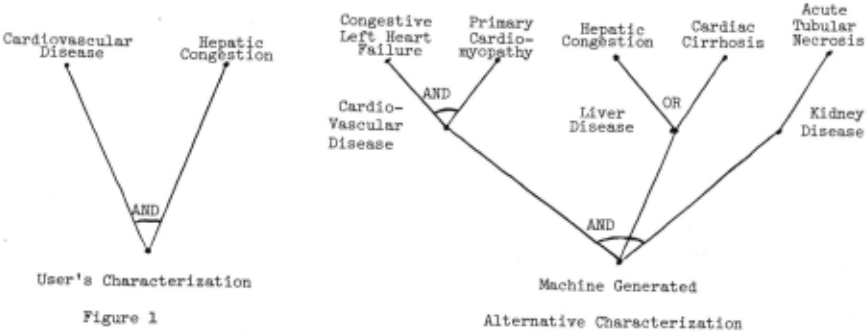
"RELATED-POSSIBILITIES" command caused a second complementary co-routine to be generated and a LINK-OF relation to be asserted. The'~CCOUNTIN� FOR"command caused the ensuing manifestation list to be associated with hepatic congestion .
The system's characterization was developed in somewhat greater detail. It set up a cardio vascular co-routine as well, but the characterizer then further specified the problem by setting up conjunctive co-routines to represent heart failure and myocardial disease. It also specified the liver problem, but here it indicated a dis junctive choice between hepatic congestion and cardiac cirrhosis . Lastly the system recognized the need for the renal component and set it up as
an additional co-routine.
3. Summary
We have presented an approach to the problem of analyzing a person's diagnostic behavior. The approach entails the development of specialized structures for the purpose of representing a person 's view of a complex environment. The approach requires the use of sophisticated tools of representation and process taken from the INTERNIST system to provide accurate medical knowledge. The approach also requires that the methodological principles which distinguish good diagnostic behavior from bad be represented in such a way that they can be used to evaluate a user's behavior in light of the medical knowledge . Although much remains to be learned regarding implementation of this approach - especially with respect to the representation of the principles of diagnosis; we hope our description and examples have demonstrated that the approach may be capable of producing interesting behaviors.
The work described here only sets the stage for a system capable of interactive investigations of the type described in the opening paragraph. Many issues involved in the implementation of such a system have not been addressed . Critical among these is the issue of how to direct an interactive investigation. Methods which generate expectations on the basis of the user's initial behavior and then interact with the goal of confirming or disconfirming the expectations seem potentially fruitful here. But time will tell. These issues are the subject of the ongoing work with respect to the system.
@inproceedings{ijcai1977p195,
  title     = {EXAMINER: A System Using Contextual Knowledge for Analysis of Diagnostic Behavior},
  author    = {Oleson, C. E.},
  booktitle = {Proceedings of the Fifth International Joint Conference on
               Artificial Intelligence, {IJCAI-77}},
  publisher = {International Joint Conferences on Artificial Intelligence},
  editor    = {Raj Reddy},
  pages     = {814--817},
  year      = {1977},
  note      = {Specialized Systems},
  url       = {https://ijcai.org/proceedings/1977/195},
}
TY - CPAPER TI - EXAMINER: A System Using Contextual Knowledge for Analysis of Diagnostic Behavior AU - Oleson, C. E. T2 - Proceedings of the Fifth International Joint Conference on Artificial Intelligence, IJCAI-77 PB - International Joint Conferences on Artificial Intelligence PY - 1977 SP - 814 EP - 817 UR - https://ijcai.org/proceedings/1977/195 ER -Copied
Machine-readable versions of this paper, for tools and AI agents:





