
Computation of Immediate Texture Discrimination
Proceedings of the Fifth International Joint Conference on Artificial Intelligence. Vision. Pages 708--1.
© 1977 International Joint Conferences on Artificial Intelligence
Abstract
- Julesz, B., et.al., 1973. Inability of humans to discriminate between visual textures that agree in second-order statistics -revisited. Perception 2: 99H05.
- Marr, D., 1976. Early processing of visual information. Plallosop!Ucal Trans. Royal Socttt7 London (Strtts B) 275: i83-52i. also MIT AI Lab memo 9i0.
- Schatz. B.R.. l!m. The computation of Immediate texture discrimination. MIT AI Lab memo i26. Vision-9: Sch a t7.
References were extracted automatically from the PDF and may contain errors.
Full text extracted automatically from the PDF; figures, tables and equations may differ. The PDF is the version of record.
COMPUTATION OF IMMEDIATE TEXTURE DISCRIMINATION
Bruce R. Schatz
M.I.T. Artificial Intelligence Laboratory Cambridge, Massachusetts 02139
The computation of immediate texture discrimination involves finding boundaries betw~een regions of differing texture. This paper describes two operators which together appear necessary and probably sufficient to accomplish this.
Texture can be regarded as the structural property of surfaces with respect to their constituents. The formation of texture crucially depends on small, fairly similar elements repeated fairly regularly over a large area. The problem examined here Is how to compute texture discrimination, how to separate regions on the basis of Immediate texture differences. The class of differences considered will be those in which the shape and location of an Inner texture can be perceptually recognized in 200 milliseconds (i.e. not allowing directed eye movements). It will be assumed that the Input Is a processed version of the image consisting of Information concerning such objects as edges, blobs, and lines (e.g. the primal sketch- Marr[1976D.
A restricted subclass of textures will be examined. Color will be black/white, no motion will be allowed, and no depth Information used. Only differences In texture elements will be considered. This does not include, for example, the continuous case of region separation by edges. Spatial frequency differences will be ignored by assuming constant density of points. The spacing between elements will also be large enough to avoid interaction effects. Finally, the elements will consist of lines and points (and not, say, of blobs). ,,,,,,,,,,,,
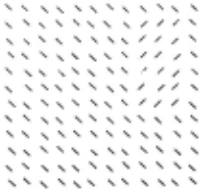
The problem then is to define operators which distinguish between texture elements only when the textures generated by these elements are immediately discriminable. Consider the basic properties of lines: length, orientation, and position. Orientation differences clearly can produce immediate discrimination (c.f. fig 1). Length must be considered as well since gross differences in length can cause discrimination (even when the orientations are the same). Thus an operator which accounts for these necessary features is
(I ) Len&th 1nd orient1tion of linn.
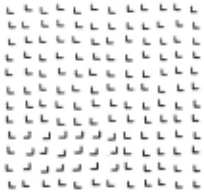
However, this Is not enough. In textures such as fig 2, the length and orientation of the lines Is the same for both generating elements yet the textures are discriminable. This appears to be due to the fact that the lines are arranged differently. As suggested by such textures as fig I with dotted lines, one solution Is to Introduce vtrtwll lines. Imaginary lines drawn between points which behave as though physically present (albeit somewhat more weakly). By using local virtual lines (connecting each point to .all points within some small neighborhood), one can account for the local positional geometry.
But this can produce a computationally unfeasible number of virtual lines. (There are an infinite number between two nearby lines, for instance.) So one should connect only ·special· points. A logical choice is to use ttrmtnators, which ·average· out all others. These include Isolated points, endpoints of lines, and corners. Thus the second operator is
(2) Lenath and orientation of lonl virtual linn betw .. n'terminators. The corners are needed since the end of a line should be a terminator whether or not there Is another line attached to it.
These two operators appear to be necessary (by example) In this texture class. But are they sufficient? For instance, grouping into elements or more complex shape descriptors might be needed . The sufficiency claim is based on Julesz's[l973] conjecture that two textures are indlscriminable If they have the same second order statistics. As these statistics can be calculated by comparing the length and orientation of dipoles In the image runes· connecting points), the operators here can be considered as providing a feasible computation which mimics the dipole statistics. All of the physically present dipoles and a subset of the virtual ones are used. It is conjectured that all of the information (psychologically) available to the dipole statistics has been captured and thus, assuming Julesz is correct, that the operators are sufficient.
The computation can be implemented by moving a window of proper size over the image and asserting a boundary whenever there has been a sufficient change in the operators between adjacent windows (i.e. essentially comparing adjacent elements). For a comparison, the orientations are considered in equivalence classes of ±10 degrees where for each class, a crude histogram of the lengths is considered. A boundary occurs when (l: Difference) I (l: Total) > Threshold . This ratio Is needed since the elements must differ by a sufficient amount to cause discrimination.
Thus it appears that comparison of the length and orientation of actual and of local virtual lines between terminators can predict human immediate texture discrimination of the type considered. While the mechanism of the comparison is not completely settled, these operations appear to be necessary and, it is conjectured, sufficient. A more complete exposition can be found in Schatz09m
Acknowledgements: David Marr, Whitman Richards, and especially Shimon Ullman provided helpful discussion. The author was supported by an NSF graduate fellowship and by the Advanced Research Projects Agency under contract NOOOli· '15-C-o6i!.
@inproceedings{ijcai1977p170,
  title     = {Computation of Immediate Texture Discrimination},
  author    = {Schatz, Bruce R.},
  booktitle = {Proceedings of the Fifth International Joint Conference on
               Artificial Intelligence, {IJCAI-77}},
  publisher = {International Joint Conferences on Artificial Intelligence},
  editor    = {Raj Reddy},
  pages     = {708---1},
  year      = {1977},
  note      = {Vision},
  url       = {https://ijcai.org/proceedings/1977/170},
}
TY - CPAPER TI - Computation of Immediate Texture Discrimination AU - Schatz, Bruce R. T2 - Proceedings of the Fifth International Joint Conference on Artificial Intelligence, IJCAI-77 PB - International Joint Conferences on Artificial Intelligence PY - 1977 SP - 708 EP - -1 UR - https://ijcai.org/proceedings/1977/170 ER -Copied
Machine-readable versions of this paper, for tools and AI agents:
 Welcome
 Future Conferences
 AI Journal Division
 IJCAI Proceedings
 About IJCAI
 IJCAI Awards