
A 'Recognition Cone' Perceptual System: Brief Test Results
Proceedings of the Fifth International Joint Conference on Artificial Intelligence. Vision. Pages 597--1.
© 1977 International Joint Conferences on Artificial Intelligence
Abstract
- Uhr, L;, Layered 'recognition cone' networks that preprocess, classify and describe. IEEE Trans. Computers, 1972, 21, pp. 758-768.
- Uhr, L., A model of form perception and scene description. Comp. Sci. Dept. Tech. Rept. 231, Univ. of Wisconsin 1974.
- Uhr,L., and R. Douglass, A parallel-serial "recognition cone" system for perception; so!':'c test results. Comp. Sci.Dept. Tech. Rept. 292, University of Wisconsin, 1977•
- 0hlander, R. B., Analysis of Natural Scenes, Unpubl. PH.D. Diss., Carnegie-Mellon Univ., Pittsburgh, 197 §. Vislon-2: lJhr
References were extracted automatically from the PDF and may contain errors.
Full text extracted automatically from the PDF; figures, tables and equations may differ. The PDF is the version of record.
A "RECOGNITION CONE" PERCEPTUAL SYSTEM: BRIEF TEST RESULTS*
Leonard Uhr, Robert Douglass, University of Wisconsin
This paper presents some preliminary testre sults of a "recognition cone" vision system. (See l-3 for fuller descriptions). A recognition cone uses a parallel-serial layered architecture that successively reduces the image as each layer processes it. EAch layer contains a set of probabilistic "transforms" that combine diverse sources of contextually related information. Each transform looks at specified regions of the array and, if the combined weights of information found exceed the transform's threshold, then the trans form implies a set of names and transforms to apply.
A number of variant systems have been coded in Snobol, to explore perception of binocular images, motion over time, and learning by dis covery and induction. The long-term goal is to develop a relatively general model of living perceptual systems, one that perceives avariety of different kinds of scenes. The presentresults were obtained with a Simula-Fortran program that made possible tests with large input arrays.
Test Results (see 3)
A 10-layer cone was used to process a 600 by BOO color TV picture (a house screened by trees, see 4 for the original).
Transforms were iterated throughout each layer, to assess the following information: Layer 1: averages; 2: hue, saturation, intensity; 3: gradients; 4: short edges, texture; 5: long edges, compounds; 6: higher-level compounds; 7: still-higher-level compounds; 8-10 averages.
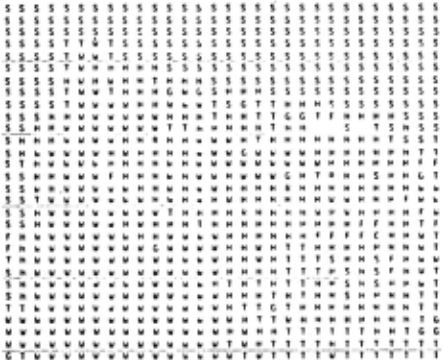
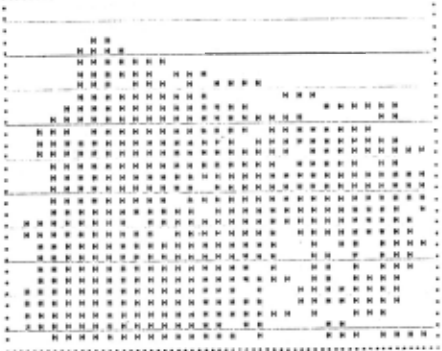
Figures 1-2 indicate some of the descriptive labels achieved.
Figure 1 shows the single most highly im plied thing output to each cell by Layer 6 (F = Window, G = Grass, H = .House, S Sky, T Tree, W Wall).
| 5 5 55 5. 5 5 5 |
| 5 |
| 5 5 5 ' |
| 5 5 5 5 5 5 |
| . ~_ .$__$ _5 T $ . ' |
| _T_ W . • . SSSSTWHHHH s |
| $55 WH HH HH SSSS S |
| SSS WW HHHGW SH H 5 |
| SSS WWVWHHW"' TS TTH H~ SSSS |
| $$HMWWWWWWH THHT G lf HHHS |
| $ $ H H ~ W W W W W W 1 h H H H H h H T |
| -SH H H W W W w H H R 11 H "' k W H f - H H H H H H H 1 |
| $ H ~ W W W W H W H H H • W W G W H H H H H t4 H 1 1 |
| $ 1 H W ~ ~ ~ H H H ~ H W W W W W W H H H H H H f f |
| $ S H H W W W f H H ~ H W W H W W W T R H H H H L T |
| $ $ H . ~ W W W W H H W H "' W H H H H k H H H H H H H H ~ ~ |
| $ $ W W W W "' ~ W H W H • H W H H H H H H W W H H H f W ~ |
| s- - ·- HWWWWWWWWT HH~HhWHWHW H Iii |
| $ HWWWWWHWHH HHHH HHHH f f |
| fHW'-IWWWWWHHWW"'WHHtt Ff f(HHWT |
| f H ~ W W W W W W W G W W W H H W H H H H H H H W T |
| H W W W • W W W W W W W W H H W H 1 T T H H ~ f H W |
| __ H W _ .w _ W _ W _ ~ . W. W W_ . W W. _W W Ill H H H H T T T H S H S f H W T |
| W W W W ~ W W W W W H. l H T H T 1 H H 5 H S H H W T |
| W W |
| W W W W W w W W W W w ~ W H T T H H $ H ~ H H T ~ W W W W W W W W W W G H H H H H H H H T |
| ~ W W W W W W W W w H T T W H W H ~ H H T ~ |
| W W W W W W W W W W W W W H W H H T l 1 T T H T G |
| W W W W W W W W W W W W W W W T W H l T T 1 H T T T T 1 1 T |
| ,,- .,- ,r ·w ·-w·-·w--w -w- w· -.,·-w -~-~- ww-r-wT-,-- , -·-, --w;-, --1-,--,- , · |
| r |
*This research was partially supported by the National Science Foundation (grant MCS76-07333) and the University of Wisconsin Graduate School.
Figure 2 shows those cells into which House was most highly implied by Layer 7. Note how higher-level compounds have turned many of the local "Wall" and other labels into "House " ....................................................... ·' ...... ..
······A· ·4:.J:ay·e:r: ·cone· t!la.;:· c"cirii:"ciii:iea: ·e;;s"enti~1i;; -~ sub-set of the transforms in layers 3 and 4 was used to describe 20 by 48 line drawings of place settings of forks, knives, spoons and plates, where objects sometimes touched and overlapped. The system was also used to recognize lettersand symbols that were severely distorted,by rotations, rubber sheet stretchings and large gaps.
Discussion
This kind of system can be evaluated onlyby far more extensive tests. But the use of many configurational transforms, each sensitive to contextually interrelated information,seems appropriate for handling a variety of unantici pated types of scenes. The use of weights means that parts can be gapped, distorted or missing. The layering gives speed and efficiency. It allows hierarchies of transforms to be built from common simpler transforms, as when edges build to angles to windows to walls to houses.
These transforms can easily be added, re placed, reweighted, adjusted and learned, without hurting the larger program. So it should be possible to make continuing improvements. The transforms are reminiscent of synapsing neurons, and the serial layering of many parallel processes reflects the overall structure of living visual systems.
@inproceedings{ijcai1977p137,
  title     = {A 'Recognition Cone' Perceptual System: Brief Test Results},
  author    = {Uhr, Leonard and Douglass, Robert J.},
  booktitle = {Proceedings of the Fifth International Joint Conference on
               Artificial Intelligence, {IJCAI-77}},
  publisher = {International Joint Conferences on Artificial Intelligence},
  editor    = {Raj Reddy},
  pages     = {597---1},
  year      = {1977},
  note      = {Vision},
  url       = {https://ijcai.org/proceedings/1977/137},
}
TY - CPAPER TI - A 'Recognition Cone' Perceptual System: Brief Test Results AU - Uhr, Leonard AU - Douglass, Robert J. T2 - Proceedings of the Fifth International Joint Conference on Artificial Intelligence, IJCAI-77 PB - International Joint Conferences on Artificial Intelligence PY - 1977 SP - 597 EP - -1 UR - https://ijcai.org/proceedings/1977/137 ER -Copied
Machine-readable versions of this paper, for tools and AI agents:
 Welcome
 Future Conferences
 AI Journal Division
 IJCAI Proceedings
 About IJCAI
 IJCAI Awards