
Theorem Proving by Covering Expressions
Proceedings of the Fifth International Joint Conference on Artificial Intelligence. Theorem Proving. Pages 541-541.
© 1977 International Joint Conferences on Artificial Intelligence
Abstract
- Gilmore, P. c., "A Proof Method for Quantifi- cation Theory: Its Justification and Realizatiol\" IBM Journal of Research and Develop., 1960, 28-35.
- Henschen, L. J., "Theorem Proving by Covering Expressions," Available from Dept. of Comp. Sci.
- Prawitz, D., "Advances and Problems in Mechan- ical Proof Procedures," Machine Intelligence 4 1969. ,
References were extracted automatically from the PDF and may contain errors.
Full text extracted automatically from the PDF; figures, tables and equations may differ. The PDF is the version of record.
THEOREM PROVING BY COVERING EXPRESSIONS L. J. Henschen W. M. Evangelist Northwestern University Evanston, Illinois 60201
Motivation
This paper describes work in progress to develop methods that search directly for unsatis fiable instances of unsatisfiable clause sets (i.e. Herbrand methods) rather than deduce con tradictions from such sets. Such approaches attack two serious disadvantages, in the authors' opinion, of resolution. First, resolution is a deduction-oriented rule, and there are generally vastly more inferences that can be deduced from a set of clauses than are used in the refutations produced, even when very restrictive strategies are used; we point to the low penetrance factors cited in the literature. Second, while the sep aration of variables insures that the general resolvent will subsume families of resolvents of instances, such generality puts the inference in a strictly local context -- aside from possible future resolutions, there is no connection with any other deduction performed in the search so far.
Herbrand methods generally have three parts -1. form some set of replicas of clauses, 2, mate the literals in the replicas, and 3. test for truth-functional unsatisfiability--typically performed in the above order. It is the authors' opinion that the first two of these are the cru cial ones; unfortunately, most Herbrand methods reported in the literature have concentrated on the third. For example, Prawitz [3] suggests that when matrix reduction on a set of replicas fails, one should add another replica of each input clause and try again. Cilmore's technique [1] suffers from the additional problem that a dis junctive normal form is calculated before any literals are even mated, This leads to disjunc tions that are extremely long. We propose that the three parts above can work together, and that, in particular, the results of the unsatisfiability test can provide significant information about how additional replicas should be chosen. We also propose that it is useful for the three operations to be interspersed, because steps of the unsatis fiability test can often suggest profitable liter al matings. This will also reduce the size of the
intermediate formulae.
We describe a Herbrand method based on a notation which allows fast, efficient testing for unsatisfiability and easy extraction of informa tion when the test fails, In the ground case each clause yields a cover expression. These expres sions are combined to form a cover for the set. Each clause is used once, and the clauses can be taken in ~ ordpr, There is no wrong order or wrong pair of clauses to use in resolution-based methods. In the general case, we start with some replicas and calculate the cover, then compare this cover with the input clauses to find promis ing new replicas and literal matings. A more detailed presentation of the method can be found in [2].
Ground Case
We now describe the truth functional test and related notation. Theorems will be stated without proof. The proofs are straightforward. Let S be a set of ground clauses over n atoms, Pl, · · ·, Pn·
Theorem 1. S is unsatis fiable iff S subsumes each of the 2n clauses ql v ··· v qn where each qi is Pi or -Pi·
A cover term is a sequence of n symbols, each of which is +, -, or 0, The symbols + and - are determined symbols. A cover expression is a set of cover terms. A cover term t containing k determined symbols represents the 2n-k clauses whose ith literal has the same sign as position i of t for the posit~ons containing determined symbols and ±Pi for 0 positions. For example, 0+0- represents the 4 clauses ±Pl +P2 ±P3 -P4·
We use terms in a way very similar to Gil more's disjunctive normal forms. Consider the clause Pl v P2 v -p 3 = C. Gilmore would form a DNF of -c, -p1 v Pl-P2 v PlP2P3; for a set of clauses Gilmore forms such a DNF for each clause and translates the conjunction of those DNFs to DNF, deleting contradictory conjuncts, We formu late a cover expression for each clause; for the above clause, COV(C) consists of the three terms -00, +-0, and+++, analogous to Gilmore's DNF. However, we interpret the terms as disjuncts, i. e. clauses, not as conjuncts. In general, if C- Pi 1 v ··· v Pik' then COV(C) has k terms. The jth term has the same symbol in position im as the sign of Pi form< j, the opposite symbol as the sign o£ffipij in position ij, and 0 every where else. The reason for our 1nterpretation as disjunctions is given by
THEOREM 2, COV(C) represents the set of clauses not subsumed by C.
We then "multiply" the covers for the clauses together. If t and s are terms, then t and s are compatible if there is no position in which they contain opposite determined symbols; in this case the product, t*s, is the term whose symbol in position k for any k is given as fol lows: if either s or t (or both) contain a deter mined symbol in position k, then the symbol in position k of t*s is that determined symbol, otherwise it is 0 (see example below). The E!Q duct of two expressions is the union of the products of compatible pairs of terms from the individual expressions.
THEOREM 3. If S is a set of ground clauses, then the product of the covers of clauses in S repre sents the set of clauses not subsumed by S,
Example. LetS contain Pl P2, Pl-P2, and -p1 -P2· Then we have The term -- represents -pl -p2, just the clause needed to make S unsatisfiable. If that clause were present, its cover is +0 -+ and the cumula tive cover would be empty.
| clause | clause cover | cummulative cover |
|---|---|---|
| Pl P2 | -0 +- | -0 +- |
| Pl -p2 | -0 ++ | -0*-0 -0 |
| -pl P2 | +0 | -0*-- |
General Case
THEOREM 4. Let S be an unsatisfiable set of clauses. There exists a setS' of replicas of clauses ins, a partition p of literals ins', and a simultaneous unifier a of the atom set of the partitions of P such that the cover of S 1 a is empty.
We rely heavily on the cover of a tentative set of replicas to determine what matings and new replicas to add. In the interactive program now in use, multiplication and various other clerical details are performed automatically. The most important interactive command is SGST, N, M. This causes the program to find instances of input clauses which contain an instance of cover literal N and in which all but M of the literals in the input clause are paired with instances of cover literals. SGST uses only cover literals that have the same sign in all cover terms in the cover, limiting suggested new instances to those that have interaction with all cover terms. SGST rejects suggestions that are tautologies or are subsumed b~ unit input clauses. We now illustrate with the x = e problem, not because it is a hard problem but because it is a fimiliar one. We use the standard P formulation with demodulators f(e,x) = x, f(x,e) = x, f(x,x) = e, and f(a,b) =c. The criterion for chosing new instances involved high weight for interaction with the hypotheses and denial of conclusion, i.e., the set of support and low weight for use of closure. User input is in upper case; because of space limitations, comments and the computer's responses will be abbreviated except for the SGST command.
READ 21
computer responds with clauses, literals, etc of the problem.
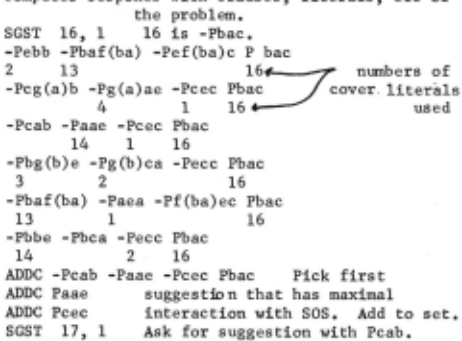
ADDC -Pcce -Pcba -Pebb Pcab
ADDC Pcce
ADDC Pebb Again pick sug gestion with max imal SOS literals.
computer responds that the clause
-Pabc -Pbbe -Paea Pcba
an instance of associativity, is represented in all terms of the remaining cover.
ADDC -Pabc -Pbbe -Paea Pcba
ADDC Pbbe
ADDC Paea
computer responds that the proof is completed.
Future Research
While we have not yet experimented extensive ly, we believe our work so far indicates that covering is potentially useful in both fully automatic and interactive uses. The first step is to experiment with our interactive program until we have developed some heuristics for the method. Some of the parameters under considera tion are 1. literal weights, 2. number of instances of an input clause used so far, 3. set of support, and 4. semantic information. The notation seems amenable to most of the standard problem solving approaches because the individual terms of the cover represent subproblems to b·e solved.
We also want to investigate application areas. The method seems suited to problems where the user can apply semantic information to the suggestions obtained from SGST. Such an area is invariant finding in program verification. Here, suggestions like "if 1 is less than 0 then a = b" can be rejected by the user.
A third area of interest is to determine how equality can be incorporated, perhaps in a way similar to paramodulation. Experiments in which we used equality axioms were not generally successful.
@inproceedings{ijcai1977p123,
  title     = {Theorem Proving by Covering Expressions},
  author    = {Henschen, Lawrence J. and Evangelist, W. M.},
  booktitle = {Proceedings of the Fifth International Joint Conference on
               Artificial Intelligence, {IJCAI-77}},
  publisher = {International Joint Conferences on Artificial Intelligence},
  editor    = {Raj Reddy},
  pages     = {541--541},
  year      = {1977},
  note      = {Theorem Proving},
  url       = {https://ijcai.org/proceedings/1977/123},
}
TY - CPAPER TI - Theorem Proving by Covering Expressions AU - Henschen, Lawrence J. AU - Evangelist, W. M. T2 - Proceedings of the Fifth International Joint Conference on Artificial Intelligence, IJCAI-77 PB - International Joint Conferences on Artificial Intelligence PY - 1977 SP - 541 EP - 541 UR - https://ijcai.org/proceedings/1977/123 ER -Copied
Machine-readable versions of this paper, for tools and AI agents:
 Welcome
 Future Conferences
 AI Journal Division
 IJCAI Proceedings
 About IJCAI
 IJCAI Awards