
The Role of Preprocessing in Problem Solving Systems
Proceedings of the Fifth International Joint Conference on Artificial Intelligence. Problem-solving and Search. Pages 465-470.
© 1977 International Joint Conferences on Artificial Intelligence
Abstract
We describe REFLECT, a problem solver in simulated robot worlds. REFLECT has successfully solved a variety of non-linear problems described as a conjunction of subtasks, including most of those found in the literature. First, during a prep recessing phase, the system explores its capabilities in the environment it is presented with. Various intrinsic properties of the given operators are inferred, such as the unattainability of certain conjunctive tasks. Macro operators are built, again considering only the given operators. REFLECT is then ready to accept problems, and proceeds by conducting backward heuristic search on a variation of a regular . state-space graph termed a Goal-Ke mel graph. Attention is not focused on any one subtask in particular, so that a global view of the problem is always maintained.
- s. Fahlman. "A Planning System for Robot Construction Tasks." Artificial Intelligence, 2_, 1974.
- R. E. Fikes. "Monitored Execution of Robot Plans produced by STR.IPS." International Federation for Information Processing Congress l!, Ljubljana, 1971.
- R. E. Fikes, P. E. Hart and N. J. Nilsson. "Learning and Executing Generalized Robot Plans." Artificial Intelligence, 1. 1972.
- R. E. Fikes, P. E. Hart and N. J. Nilsson. "New Directions in Robot Problem Solving." In: D. Michie and B. Meltzer (Eds.) Machine Intelligence 1, Edinburgh University Press, Edinburgh, 1972.
- R. E. Fikes and N. J. Nilsson. "STRIPS: A New Approach to the Application of Theorem Proving to Problem-solving." Artificial Intelligence, 1, 189-208, 1971. IJCAI
- C. Green. "Application of Theorem-proving to Problem Solving." In: D. E. Walker and L. M. Norton (Eds.) Proc. International Joint Conference of Artificial Intelligence, 1969. IJCAI
- c. Hewitt. "How to Use What You Know." Fourth International Joint Conference on Artificial Intelligence. Tbilisi, 1975.
- B. Raphael. "The Frame Problem in Problem-solving Systems." In: N. V. Findler and B. Meltzer (Eds.) Artificial Intelligence and Heuristic Programming, American Elsevier, New York, 1971.
- E. Sace rdoti. "Planning in a Hierarchy of Abstraction Spaces." Third International Joint Conference on Artificial Intelligence, Palo Alto, 1973. IJCAI
- E. D. Sacerdoti. "The Non-Linear Nature of Plans." Fourth International Joint Conference on Artificial Intelligence, Tbilisi, 1975.
- L. Siklossy. "Some Issues in Problem-Solving in Modelled Worlds. Third International Congress of Cybernetics and Systems, World Organization of General Systems and Cybernetics, Bucharest, 1975 (printed 1977).
- L. Siklossy and J. D reussi. "An Efficient Robot Planner which Generates its own Procedures." Third International Joint Conference on Artificial Intelligence, Palo Alto, California, 1973. Prohl~M-Solvln~-3: nawsnn IJCAI
- L. Sikl6ssy and J. Dreussi. "Simulation of Executing Robots in Uncertain Environments." Proc. 1974 National Computer Conference, Chicago, 1974.
- L. Sikl6ssy and J. Roach. "Proving the Impossible is Impossible is Possible: Disproofs based on Hereditary Partitions." Third International Joint Conference .2£ Artificial Intelligence, Palo Alto, 1973. IJCAI
- L. Sikl6ssy and J. Roach. "Collaborative Problem-solving between Optimistic and Pessimistic Problem Solvers." Inte mational Federation for Info nnation Precessing Congress li. Stockholm, 1974.
- L. Sikl6ssy and J. Roach. "Model Verification and Improvement using DISPROVER." Artificial Intelligence, ~. 1975. PROBLEM l• (From [Warren-74].) Goal: (ON A B)(ON B C)(ON C D)(ON DE) _l_ PROBLEM 1.• (From [Sikl6ssy & Roach-73].) Goal: (DOORCLOSED DOOR) (ON ROB.OT BOX) BE] cw PROBLEM 1• (From [Sikl6ssy & D reussi-73].) Goal: (NEXTTO BOXl BOX2)(NEXTTO BOX2 BOX3) (NEXTTO BOX3 BOXl) Note : This problem is impossible given the axiomatization. PROBLEM !:!• Goal: (INROOM BOXl ROOMA)(INROOM BOX2 ROOMA) (INROOM BOX3 ROOMC)(INROOM ROBOT ROOMB) (NEXTTO BOXl LITESW)(NEXTTO BOXl BOX2) (DOORCLOSED DOORAB)(DOORCLOSED DOORBC) l 6 ~] 1 ° mel lnm •1 6 •: m cl
- PROBLEM .2_. (From [Waldinge r-75].) Goal: (ON A B)(ON B C) ~8Ac Iil[C] _tn_
- G. J. Sussman. A Computational Model of Skill Acquisition. MIT AI-TR-297, Cambridge, Mass., 1973.
- A. Tate. "Interacting Goals and The! r Use." Fourth Inte mational Joint Confe renee on Artificial Intelligence, Tbilisi, 1975.
- R. Waldinger. Achieving Several Goals Simultaneously. Artificial Intelligence Center, Technical Note 107, Stanford Research Inst., Menlo Park, 1975.
- D. H. D. Warren. WARPLAN: ! System for Generating Plans. Memo 76, Dept. of Computational Logic, u. of Edinburgh, 1974.
- T. Winograd. Procedures as .i! Representation for Data in .i! Computer Program for Understanding Natural Language. P reject MAC TR-84, MIT, Cambridge, Mass., 1971.
- PROBLEM ~. Goal:(NEXTTO BOXl BOX2)(NEXTTO BOX2 BOX3)(NEXTTO BOX3 BOX4)(NEXTTO BOX4 LSWIT)(NEXTTO BOXS LSWIT)
References were extracted automatically from the PDF and may contain errors.
Full text extracted automatically from the PDF; figures, tables and equations may differ. The PDF is the version of record.
THE ROLE OF PREPROCESSING IN PROBLEM SOLVING SYSTEMS
"An Ounce of Reflection is Worth a Pound of Backtracking"
Clive Dawson and Laurent Sikl6ssy Dept. of Computer Sciences University of Texas Austin, Texas 78712 USA
will be left open. It must be closed to achieve (CLOSED DOOR). To close the door, the ROBOT must go next to DOOR, which would destroy the already achieved (NEXTTO ROBOT BOX). If, on the other hand, we first achieve the second subtask, (CLOSED DOOR), we need do nothing since that property is true in the initial state. However, protecting this subtask prevents us from achieving (NEXTTO ROBOT BOX).
.!b._ Abstract
We describe REFLECT, a problem solver in simulated robot worlds. REFLECT has successfully solved a variety of non-linear problems described as a conjunction of subtasks, including most of those found in the literature. First, during a prep recessing phase, the system explores its capabilities in the environment it is presented with. Various intrinsic properties of the given operators are inferred, such as the unattainability of certain conjunctive tasks. Macro operators are built, again considering only the given operators. REFLECT is then ready to accept problems, and proceeds by conducting backward heuristic search on a variation of a regular. state-space graph termed a Goal-Ke mel graph. Attention is not focused on any one subtask in particular, so that a global view of the problem is always maintained.
h Int reduction
The literature on solving simulated robot problems, represented as a conjunction of subgoals G 1 , G 2 , ··· , Gn which must be simultaneously satisfied in the final state, has become extensive. A review can be found in [Sik16ssy-75). One of the principal difficulties in solving such problems has been called non-linearity, meaning that the problem cannot be solved by considering each subtask successively in some order Gp(l)· Gp(2)· ··· , Gp(n) where pis a permutation of (l, ··· ,n). As an extreme case, we can consider a solvable problem consisting of only two subgoals, G1 & G2· A solution to the problem may be unattainable if the sub goals are cons ide red successively in the order G1 G2 or in the order G2 G1, such that once a subgoal is achieved it is protected (i.e. its attainment cannot be
destroyed during subsequent problem solving).
One of the simplest examples, taken from [Sikl6ssy & Roach-73), will illustrate the difficulty. The world contains two rooms RMA and RMB which communicate through DOOR. DOOR, initially closed, can be opened or closed by the ROBOT, initially in RMA. To open or close a door, the ROBOT must be next to it. There is also a BOX, initially in RMB, which the ROBOT can go next to. Hence we have an INITIAL STATE of:
[(INROOM ROBOT RMA)(CLOSED DOOR)(INROOM BOX RMB)].
We wish to .achieve a FINAL STATE of:
[(NEXTTO ROBOT BOX)(CLOSED DOOR)).
If we first achieve (NEXTTO ROBOT BOX), the DOOR
In the next section, we review previous approaches to the design of problem solvers that attempt to solve non-linear tasks. All of these approaches seem to be characterized by the fact that the problem solver concentrates its efforts on certain sub tasks in particular, thereby temporarily ignoring the other subtasks. It appears that these problem solvers wear "blinders", and have no good global view of the problem to be solved. By contrast, REFLECT maintains an overall view of the problem, favoring no subtask with its attention. At each step, the solution to any subtask can be advanced, irrespective of which subtask was advanced on the previous step, depending on what seems to advance the total solution the most. No achieved subgoal needs to be protected. REFLECT draws its power from the results of its prep recessing stage, which serves to analyze the inherent capabilities of the robot as specified in the operators.
During one phase of preprocessing, the system deduces that certain sets of states a-re unattainable, due to the simultaneous presence of incompatible assertions such as (OPEN DOOR) and (CLOSED DOOR) or (INROOM ROBOT RMA) and (INROOM ROBOT RMB). During another phase, macro operators are built. These are combinations of the given operators which naturally fit together, and allow one new macro-step to advance a solution by several original steps. We call these macro operators BIGOPs, not to be confused with MACROPs in [Fikes et.al.-72). BIGOPs are based solely on the description of the original operators, whereas MACROPS are based on gene ralizations of particular solved problems. Therefore, BIGOPs rep resent the intrinsic properties of the problem domain, and do not depend on any judicious or accidental choice of problems.
Preprocessing is perfomed once for a domain (set of operators), and the results remain valid for any attempt at problem solving in that domain. Prep recessing is akin to what a good human problem solver would do when confronted with a new environment. Before solving a problem, he would take time to reflect upon the situation, examine the capabilities of his tools (operators), pethaps perfoming some small exploratory experiments.
REFLECT's operators are rep resented using a strictly declarative fomalism. The results of preprocessing, however, are used in a way similar to the strategic information found programmed into procedural representations of knowledge [Sussman-73]. REFLECT, therefore, reduces the differences between the declarative and procedural approaches to problem solving by showing that declarative style operators are not quite as devoid of imperative content as many may think.
l.!_ Previous Research
The conjunctive problem is easier if some permutation Gp( 1), Gp( 2)····· Gp{n) exists such that the problem can be solved left to right in the order given by the permutation of the subtasks. In [Fikes & Nilsson-71], some permutations of the initial ordering of the subtasks were attempted. In [Sikl6ssy & Dreussi-73], a hierarchy (hand input or computer gf'nerated) re-ordered the subtasks so that after solving Gp(i)· there remained sufficient liberty to solve tasks Gp(i+j) for j>O. A similar hierarchy scheme was developed in [Sacerdoti-73].
The problems become more difficult if interferences between subtasks are such that no permutation as above exists. In [Sikl6ssy & Roach-74], collaboration between a problem solver [Sikl6ssy & Dreussi-73] and a disprover [Sikl6ssy & Roach-73] (which attempts to show that the problem has no solution) solves some of these problems. In [Tate-75, Sacerdoti-75, Waldinger-75], basically, independent solutions are obtained for each subtask. These independent solutions are then postprocessed, and an attempt is made to mesh them together. In [Warren-74], the problem is attempted left-to-right in the order given. When the next subtask Gk cannot be achieved without destroying a previously achieved subtask, and when no further way exists to achieve this previous subtask, an attempt is made to insert a solution far Gk in the sequence of operators that achieved Gi, O<i<k. Statements similar to our incompatible assertions (Sec. 3.2) are input by hand to limit search space growth. In [Sussman-73], a procedure is built incrementally to solve a problem, and may include various modifications and patches on previous versions of the procedure. Non-linearity is also discussed in [Hewitt-75], where the applicability of backward search is noted.
The ubiquitous blocks world, made popular in [Winograd-71], has been used in most of these problem solvers. It should be mentioned that for simple stacking problems, such as those that have been considered, a simple hierarchy in the sense of [Sikl6ssy & Dreussi-73], exists: stack the blocks from bottom to top! More complicated block stacking problems, such as those solved by the specialized system described in [Fahlman-74], appear beyond the capabilities of any of the rna re general problem solvers mentioned.
In the next section, we choose a blocks problem to illustrate the behavior of REFLECT, mentioning en route the capabilities not directly touched on by the example.
~ ! Detailed Example
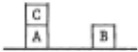
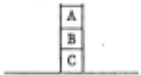
In keeping with the tradition established by [7,10,17,18,19,20], we will first describe how REFLECT handles the 3-block problem. (See Sec. 4 for other sample problems.) The world consists of a table and three blocks. The initial configuration and the desired final state are as follows:
The following four operators are initially given to REFLECT:
(BP=Binding Preconditions, PR=Preconditions, DS= Delete Set, AS=Add Set)
OP: Pickup ($B)
BP: (TYPE BLOCK $B)
PR: (ONTABLE $B)(CLEAR $B)(HANDEMPTY)
DS: (ONTABLE $B)(CLEAR $B)(HANDEMPTY)
AS: (HOLDING $B)
OP: Putdown ($B)
BP: (TYPE BLOCK $B)
PR: (HOLDING $B)
DS: (HOLDING $)
AS: (ONTABLE $B)(CLEAR $B)(HANDEMPTY)
OP: Stack ($B1,$B2)
BP: (TYPE BLOCK $B1)(TYPE BLOCK $B2)
PR: (HOLDING $B1)(CLEAR $B2)
DS: (HOLDING $) (CLEAR $B2)
AS: (HANDEMPTY)(ON $B1 $B2)(CLEAR $B1)
OP: Unstack ($B1,$B2)
BP: (TYPE BLOCK $B1)(TYPE BLOCK $B2)(0N $Bl $B2)
PR: (HANDEMPTY)(CLEAR $B1)
DS: (ON $B1 $)(HANDEMPTY)(CLEAR $B1)
AS: (HOLDING $B1)(CLEAR $B1)
(Binding Preconditions are used to determine whether the operator is applicable by supplying the necessary bindings for the variables. They will never be set up as subgoals.)
The initial state of the world is described by the following set of predicates:
(TYPE BLOCK A) (CLEAR B) (ONTABLE A)
(TYPE BLOCK B) (CLEAR C) (ONTABLE B)
(TYPE BLOCK C) (HAND EMPTY) (ON C A)
Our first attempt at the problem will be without the aid of BIGOPs, since this will serve to better illustrate the behavior of the problem solver itself. We will then reconsider the problem to illustrate the use of BIGOPs.
hl. Backward Searching and Goal Kernels
Before considering the preprocessing stage, we will briefly jump ahead to the actual problem solving. As previously stated, REFLECT employs backward heuristic search on a goal-kernel graph. Unlike a state-space graph, in which each node corrEsponds to a distinct state of the world, a goal-ke mel graph is composed of nodes which correspond to sets of states. Each such set is characterized by the fact that it contains all states in which the goal associated with the node is satisfied. A node labeled [(ON A B)(ON B C)), for example, corresponds to the set of all states in which these two assertions hold. (ON A B) and (ON B C) are called elements of the goal kernel. This node will serve as a start node for the problem solver. The aim is to find a node (goal-kernel) whose every element is contained in the initial state of the world.
A node is expanded by applying operators in reverse. We IEason this way: In order to arrive at some state in which (ON A B) and (ON B C) hold, we must have applied an operator such as Stack(A,B) or Stack(B,C). The application of irrelevant operators is automatically prevented, since they would not move us to a different goal-kernel. The goal-kernels for the new nodes can be gene rated by removing the assertions in the operator's ADD set, and adding the assertions in the operator's PRECONDITION set. We obtain the following graph:
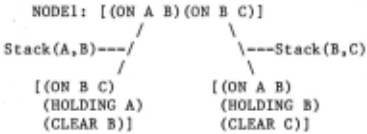
The whole idea should be a little more clear now. What we are saying is that given ANY state in which (ON B C), (HOLDING A), and (CLEAR B) are true, it is always possible to apply the operator Stack(A,B) to achieve our final state in which (ON A B) and (ON B C) are true. Similarly, given ANY state in which (ON A B), (HOLDING B) and (CLEAR C) hold, we will always be able to apply Stack(B,C) to achieve our final state.
But wait! Is there even one state in which (ON A B), (HOLDING B) and (CLEAR C) can be simultaneously true? The answer is clearly no, and this is precisely what REFLECT has alrEady deduced during preprocessing (Sec. 3. 2). In this case, (HOLDING B) and (ON A B) form the offending pair of incompatible assertions (I.A.'s). When the node expander notices this, it refuses to consider Stack(B,C) as a possible operator. The result of the expansion, then, is a single new node, NODE2, which makes our next choice very easy.
We now back up to consider how preprocessing is able to examine the operators and deduce pairs of incompatible assertions (I.A.'S). (Our discussion will, for the moment, not touch on larger sets of I.A.'s, such as triplets or quadruplets.) Given the four operators for the blocks world, REFLECT considers the five changeable predicates which appear: HANDEMPTY, HOLDING, ONTABLE, ON, and CLEAR. (TYPE is static and therefore not cons ide red.) Taking them one pair at a time, REFLECT conducts what could be termed "mini-experiments" to try and make both predicates true at the same time.
Some experiments are very easy. In particular, REFLECT assumes instant success if the two prEdicates appear together on the ADD set of some operator. Examples of this are (ONTABLE $X) and (CLEAR $X), (HANDEMPTY) and (ON $X $Y), as well as (HANDEMPTY) and (CLEAR $X). Other experiments are seen to fail rather easily. For example, (HANDEMPTY) and (HOLDING $X) can never be true simultaneously, since for every ADD set in which one appears, the other is found in the corresponding DELETE set.
These experiments are actually abst rae t problem solving sessions similar in structure to the example we are now considering. The main difference is that we do not have an initial world state, nor do we have bindings for the variables. Handling the variables can be tricky. The two-variable predicate (ON $X $Y), for example, is actually considered twice; first to deduce properties for variable $X and second to deduce them for variable $Y. Predicates are even paired with themselves. This allows us to deduce, for example, that (HOLDING A) and (HOLDING B) cannot be simultaneously true. We have developed a special notation to rep resent this, similar in spirit to the various prefix characters used by PLANNER, CONNIVER, and QA4. Given that $X rEpresents a variable, #X denotes a variable which can accept any binding except the currEnt binding of $X.
As REFLECT conducts the mini-experiments, it imposes a bound on the "depth" of the graph generated. If the bound is ever exceeded, the system abandons that particular pair and goes on to the next. In this way, the "obvious" I.A.'s are found quickly. These can then be used on subsequent passes to prove further pairs of incompatibilities. For example, in an experiment with Pl and P2, the system may achieve Pl; the achievement of P2, however, is found to requi IE P3, which has previously been proven to be incompatible with Pl. If a similar situation is found when trying the problem in reverse, then Pl and P2 have been proved incompatible. When a pass produces no new results, the depth bound is inc IEased, and REFLECT tries again. This process continues until all experiments have concluded or until some maximum depth is reached.
It is, of course, possible to construct a world in which it will take an a rbi t ra rily large amount of processing to deduce all possible pairs of I.A.'s. If an I.A. pair is not detected, the search space may become larger due to less effective pruning, but this does not affect the attainability of the solution.
It is also possible to "sabotage" the deduction procedure by introducing what we term a "Garden of Eden" initial state. Consider a situation wheiE REFLECT has just completed preprocessing, having proved that (HOLDING A) and (HOLDING B) can never be simultaneously true. It now smugly asks for its first problem, together with the initial state of the world. Sure enough, for some mysterious reason the initial state just as smugly asserts (HOLDING A) and (HOLDING B)!
This is an example of a "Garden of Eden" state , namely one which could not have been arrived at by any sequence of operators. In many cases, these states follow their historical counterpart and don't survive very long. (Note that any application of Putdown($B) will delete all HOLDING assertions, not just (HOLDING $B).)
REFLECT produces the following incompatible assertions for this version of the blocks world:
| [ (HANDEMPTY) (HOLDING $X)] [ (ONTABLE $X) (ON $X $Y)] |
| [(HOLDING $X) (HOLDING #X)] [(ON $X $Y) (ON $X #Y)] |
| [(HOLDING $X) (ON $X $Y)] [(ON $X $Y) (CLEAR $Y)] |
| [(HOLDING $X) (ONTABLE $X)] [(ON $X $Y) (ON #X $Y)] |
| [(HOLDING $X) (CLEAR $X)] [(ON $X $Y) (ON $Y $X)] |
hl Ancestors, troublemakers, and other details
We return now to the 3-block problem, where the next step is to expand NODE2, whose goal · kernel is [(HOLDING A) (CLEAR B) (ON B C)]. REFLECT first focuses on the subgoal (HOLDING A). NODE3 is produced by reverse application of the operator Pickup (A). The goal kernel [ (ONTABLE A) (CLEAR A) (HANDEMPTY) (CLEAR B) (ON B C)] is obtained by replacing (HOLDING A) with the preconditions of Pickup(A). When REFLECT considers the subgoal (ON B C), · the assertion (HOLDING B) required by Stack(B C) is found to be incompatible with (HOLDING A), which is already in the goal kernel. The final subgoal in NODE2, (CLEAR B), is already true in the initial state of the world, so it is not considered. (It is not always possible to ignore true assertions in this manner, as we shall see.) The graph now looks like this:
NODEl: [(ONAB)(ONBC)]
Stack(A,B)--1
NODE2: [(HOLDING A) (CLEAR B) (ON B C)]
Pickup(A)---1
NODE3: [(ONTABLE A)(CLEAR A)(ON B C) (HANDEMPTY)(CLEAR B)]
The expansion of NODE3 will illustrate various interesting rules used by REFLECT. We will describe this expansion by presenting a trace of REFLECT's activity.
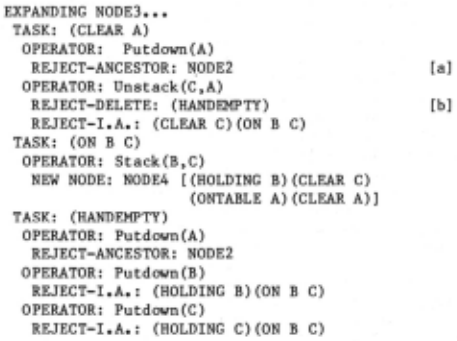
On line [a], we notice how REFLECT has avoided a loop by invoking the ancestor rule. This rule states that if the goal kernel under consideration is !i superset of one of its ancestors; we should discard it, since any operator applicable in the new goal kernel would have been equally applicable in the ancestor.
On line [b], REFLECT is trying to achieve (CLEAR A) using the operator Unstack(C,A). It rejects this, however, because even though Unstack(C,A) makes (CLEAR A) true, another element of the goal kernel, (HANDEMPTY), is made false! The applicable rule, known as the deletion rule, states that no operator can ever be applied whose DELETE set contains a member of the current goal kernel. This little failure has had an important consequence, however. Because of it, (HANDEMPTY) is branded as "troublesome". This label is given to assertions which hold in the initial state of the world, but which may have to be temporarily violated since they are interfering with the achievement of another subgoal. A troublesome assertion will always be cons ide red during expansion because, in our backward searching, this point might correspond to the time when the assertion (after having been temporarily false) needs to be reachieved. Even after Unstack (C ,A) is rejected, REFLECT checks for I .A.'s, since this could point to other "troublesome" assertions. The system now considers the next subgoal, (ON B C), and does succeed in producing a new node, using the operator Stack(B,C). Finally, (HAND EMPTY) (already true but labeled "troublesome"), is considered but produces no new nodes.
Expansion of NODE4 also produces a single new node when REFLECT applies Pickup(B) to achieve (HOLDING B). All other applicable operators lead to I.A.'s. When NODES is expanded, REFLECT generates two new nodes, as shown below:
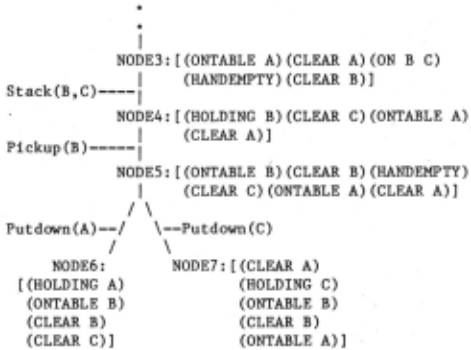
REFLECT finally has a choice to make! Since only one of NODE6's subgoals is not satisfied in the inital state, whereas two of NODE7's are not, the heuristic evaluation function reports that NODE6's goal kernel is "closer'' to the initial state .of the world than NODE7's is. The system therefore chooses NODE6 to expand next. The only applicable operator, Pickup(A), is rejected by the ancestor rule, however. REFLECT moves immediately to NODE?, which was the correct choice. When applying the operator Unstack (C ,A), the goal ke mel [(HAND EMPTY) (CLEAR C) (ONTABLE B) (CLEAR B) (ONTABLE A)] is produced. Problem solving halts, since all elements of this goal kernel are true in the initial state. The final graph for this solution of the 3 blocks problem is:
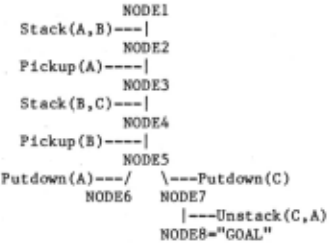
The final plan is travelling Putdown(C), Stack(A,B). back up to Pickup(B), obtained by simply the root: Unstack(C,A), Stack(B,C), Pickup(A),
We shall now consider the 3-block problem again. This time, we will make use of the results of another preprocessing phase: the construction of BIGOPs. The generation of these combined operators is accomplished by analyzing the inherent structure of the original operators provided to the system. The basic aim is to construct new operators which are made up of two or more primitive operators. This allows one arc in the goal kernel graph to take the place of several arcs, and results in as much as an order of magnitude decrease in the size of the search space. After the problem is solved, the solution is expanded back in terms of the original operators. Since BIGOPs can be thought of as generalized operators, the expansion process often is able to leave out certain unnecessary steps. For example, assume that we have preprocessed the operators in the STRIPS world of [Fikes B:ilsson-71] to obtain a BIGOP called "CLIMBOFF & GOTO & OPEN & GOTHRUDOOR" which gives the robot the ability to go into another room. The presence of each primitive operator is designed to achieve one of the preconditions which will ultimately be needed in order to go through a door. At expansion time, however, it may be found that one or more of the conditions are already true. For example, the ROBOT may already be on the floor, or the door may already be open. In this case, final expansion would leave out the corresponding operators, since they would be essentially no-ops.
Given the four initial operators in our version of the blocks world, REFLECT begins by considering ·which pairs of operators can be applied successively. Of the sixteen possible ordered pairs, it discovers that conflicting preconditions prevent eight of them from ever being adjacent in a plan: Pickup-Pickup, Pickup-Unstack, Putdown-Putdown, Putdown-Stack, Stack-Putdown, Stack-Stack, Unstack-Pickup, and Unstack-Unstack. These conflicts are all caused by the I.A. pair [(HOLDING $X) (HANDEMPTY)]. The remaining eight operator pairs are candidates for BIGOPs. The method of construction is simple. Let Pk, Dk, and Ak denote the Precondition set, Delete set, and Add set of operator OPk. Operators OPi and OPj may be combined into a BIGOP where
(+ and - are set union and difference).
Even though the ·above operation is theoretically possible on all the remaining operator pairs, REFLECT uses some additional criteria in deciding whether the combination should exist or not. It is important that the variables correspond properly. In a Pickup&Stack operation, for example, it is clear that the block which is picked up is the same block which will be stacked. In a Stack&Unstack operation, it is not so clear. The blocks may be different or they may be one and the same. Finally, in a Putdown&Unstack, it is clear that they have to be different blocks. REFLECT requires that at least one variable in both operators correspond at all times. This has proved to be a good measure of the "naturalness" of combining two operators, and helps eliminate combinations of operators which are semantically unrelated. This criterion eliminates Putdown-Pickup, Putdown-Unstack, Stack-Pickup and Stack-Unstack. Finally, REFLECT checks for combinations which would essentially be no-ops, and manages to discard Pickup-Putdown. We
are left with:
OP: Pickup&Stack($B1,$B2)
BP: (TYPE BLOCK $B1)(TYPE BLOCK $B2)
PR: (ONTABLE $B1)(CLEAR $B1)(HANDEMPTY) (CLEAR $B2)
DS: (ONTABLE $B1)(CLEAR $B2)
AS: (ON $B1 $B2)
OP: Unstack&Stack($B1,$B2,$B3)
BP: (TYPE BLOCK $B1)(TYPE BLOCK $B2)
(TYPE BLOCK $B3)(0N $B1 $B2)
PR: (HANDEMPTY)(CLEAR $B1)(CLEAR $B3)
DS: (ON $B1 $B2)(CLEAR $B3)
AS: (ON $B1 $B3)(CLEAR $B2)
OP: Unstack&Putdown($B1,$B2)
BP: (TYPE BLOCK $B1)(TYPE BLOCK $B2)(0N $B1 $B2)
PR: (CLEAR $B1)(HANDEMPTY)
DS: (ON $B1 $B2)
AS: (CLEAR $B2)(0NTABLE $B1)
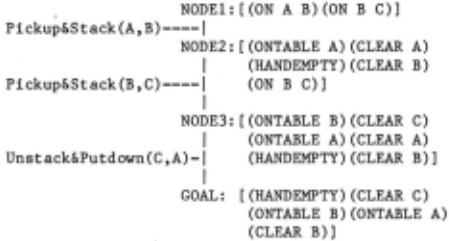
Let us now take another look at the 3-block problem given the presence of these BIGOPs. REFLECT is able to solve the problem with no wrong moves in less than one-third the time (1.7 s. vs. 5.9 s., interpreted LISP on a CDC6600) and produces the following graph:
~ Other sample problems
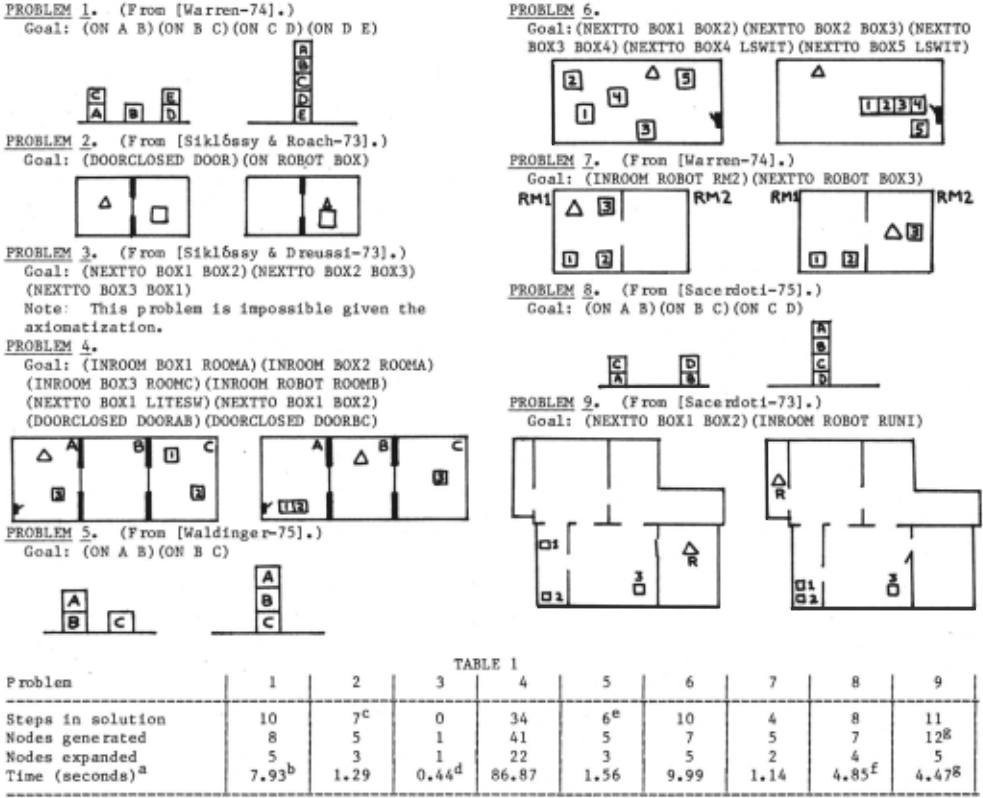
The figures at the end of this paper together with Table show some typical linear and non-linear problems solved by REFLECT. Many have been chosen from the literature. The order in which the subtasks of a problem are given to REFLECT 'is irrelevant, while it may be crucial to other systems. Although we provide comparative execution times when available, comparisons on this basis are tenuous at best. As workers in this area know well, slight changes in the axiomatization of operators can cause large differences in the behavior of these systems.
~ Conclusions and Further Work
REFLECT has successfully solved problems typified by the samples given. These problems have often been solved only with difficulty by other problem solvers. The success of REFLECT can be attributed to a combination of preprocessing results and the goal-kernel backwards search, which has proved adequate for handling tasks up to several dozen steps long. However, the preprocessing heuristics currently in use are not sufficiently powerful to prevent a combinatorial explosion when REFLECT attempts tasks which are several hundred steps long (within the capabilities of LAWALY [12)). We can attribute this to several reasons. First, REFLECT has essentially put aside the linearity principle in order to maintain a global view during problem solving. If particular worlds are not strongly enough constrained to provide a good set of !.A.'s, then the lack of effective pruning becomes evident quickly. Linearity is, obviously, an extremely powerful heuristic when used appropriately. Rather than using other heuristics to overcome the problems of linearity, as almost all previous systems have done, it is our aim to develop heuristics that tell us when to take advantage of linearity. Along these lines, a hierarchy scheme implemented for backward search seems promising.
Another area which is being implemented is the extension of I.A. pairs to triplets, quadruplets, etc. An analysis of goal-kernels generated by the present system shows that I.A. triplets arise in substantial numbers, but go undetected. This means that the system is working on tasks which are doomed to failure. Detection of new I.A. 's during preprocessing could be carried as far as desired; there is presumably a point of diminishing returns, beyond which it would be more profitable to start the problem solving itself.
Finally, an area that needs a lot . of work is the use of preprocessing techniques to gene rate good heuristic evaluation functions. REFLECT currently generates a very crude evaluation function during preprocessing by counting the average number of preconditions needed to achieve a given assertion. This could use substantial improvement.
~ Acknowledgements
We would like to acknowledge the influence provided by many long and fruitful discussions on this subject with Daniel Chester, Joseph Dreussi, and John Roach.
b References
- s. Fahlman. "A Planning System for Robot Construction Tasks." Artificial Intelligence, 2_, 1974.
- R. E. Fikes. "Monitored Execution of Robot Plans produced by STR.IPS." International Federation for Information Processing Congress l!, Ljubljana, 1971.
- R. E. Fikes, P. E. Hart and N. J. Nilsson. "Learning and Executing Generalized Robot Plans." Artificial Intelligence, 1. 1972.
- R. E. Fikes, P. E. Hart and N. J. Nilsson. "New Directions in Robot Problem Solving." In: D. Michie and B. Meltzer (Eds.) Machine Intelligence 1, Edinburgh University Press, Edinburgh, 1972.
- R. E. Fikes and N. J. Nilsson. "STRIPS: A New Approach to the Application of Theorem Proving to Problem-solving." Artificial Intelligence, 1, 189-208, 1971.
- C. Green. "Application of Theorem-proving to Problem Solving." In: D. E. Walker and L. M. Norton (Eds.) Proc. International Joint Conference of Artificial Intelligence, 1969.
- c. Hewitt. "How to Use What You Know." Fourth International Joint Conference on Artificial Intelligence. Tbilisi, 1975.
- B. Raphael. "The Frame Problem in Problem-solving Systems." In: N. V. Findler and B. Meltzer (Eds.) Artificial Intelligence and Heuristic Programming, American Elsevier, New York, 1971.
- E. Sace rdoti. "Planning in a Hierarchy of Abstraction Spaces." Third International Joint Conference on Artificial Intelligence, Palo Alto, 1973.
- E. D. Sacerdoti. "The Non-Linear Nature of Plans." Fourth International Joint Conference on Artificial Intelligence, Tbilisi, 1975.
- L. Siklossy. "Some Issues in Problem-Solving in Modelled Worlds. Third International Congress of Cybernetics and Systems, World Organization of General Systems and Cybernetics, Bucharest, 1975 (printed 1977).
- L. Siklossy and J. D reussi. "An Efficient Robot Planner which Generates its own Procedures." Third International Joint Conference on Artificial Intelligence, Palo Alto, California, 1973.
- L. Sikl6ssy and J. Dreussi. "Simulation of Executing Robots in Uncertain Environments." Proc. 1974 National Computer Conference, Chicago, 1974.
- L. Sikl6ssy and J. Roach. "Proving the Impossible is Impossible is Possible: Disproofs based on Hereditary Partitions." Third International Joint Conference .2£ Artificial Intelligence, Palo Alto, 1973.
- L. Sikl6ssy and J. Roach. "Collaborative Problem-solving between Optimistic and Pessimistic Problem Solvers." Inte mational Federation for Info nnation Precessing Congress li. Stockholm, 1974.
- L. Sikl6ssy and J. Roach. "Model Verification and Improvement using DISPROVER." Artificial Intelligence, ~. 1975.
- G. J. Sussman. A Computational Model of Skill Acquisition. MIT AI-TR-297, Cambridge, Mass., 1973.
- A. Tate. "Interacting Goals and The! r Use." Fourth Inte mational Joint Confe renee on Artificial Intelligence, Tbilisi, 1975.
- R. Waldinger. Achieving Several Goals Simultaneously. Artificial Intelligence Center, Technical Note 107, Stanford Research Inst., Menlo Park, 1975.
- D. H. D. Warren. WARPLAN: ! System for Generating Plans. Memo 76, Dept. of Computational Logic, u. of Edinburgh, 1974.
- T. Winograd. Procedures as .i! Representation for Data in .i! Computer Program for Understanding Natural Language. P reject MAC TR-84, MIT, Cambridge, Mass., 1971.
- --------------------------------------------------------------------------------------------------------- [a] Interpreted LISP, CDC6600 (includes garbage collection).
[b] WARPLAN time: 52 sec. (PROLOG, IBM 360/67).
[c] LAWALY [12] failed to solve this problem.
(d] Time needed to dete nnine impossibility. (LAWALY found no solution after 4 7 sec. DISPROVER [ 14] found a disproof in 7 sec.)
- [e] [19] can solve as (ON B C)(ON A B) but not in opposite order.
[f] NOAH [10] time: 41 sec. (Compiled QLISP, DEC-lO).
- [g] ABSTRIPS [9] generated 60 nodes, using 328 sec. (Compiled LISP, DEC-10). STRIPS [5] time: >1640 sec.
@inproceedings{ijcai1977p105,
  title     = {The Role of Preprocessing in Problem Solving Systems},
  author    = {Dawson, Clive and Siklóssy, Laurent},
  booktitle = {Proceedings of the Fifth International Joint Conference on
               Artificial Intelligence, {IJCAI-77}},
  publisher = {International Joint Conferences on Artificial Intelligence},
  editor    = {Raj Reddy},
  pages     = {465--470},
  year      = {1977},
  note      = {Problem-solving and Search},
  url       = {https://ijcai.org/proceedings/1977/105},
}
TY - CPAPER TI - The Role of Preprocessing in Problem Solving Systems AU - Dawson, Clive AU - Siklóssy, Laurent T2 - Proceedings of the Fifth International Joint Conference on Artificial Intelligence, IJCAI-77 PB - International Joint Conferences on Artificial Intelligence PY - 1977 SP - 465 EP - 470 UR - https://ijcai.org/proceedings/1977/105 ER -Copied
Machine-readable versions of this paper, for tools and AI agents:





