
The Description And Control Of Changing Pictures..
Proceedings of the Fourth International Joint Conference on Artificial Intelligence. A.I. Software. Pages 569-573.
© 1975 International Joint Conferences on Artificial Intelligence
Abstract
DALI (Display Algorithm Language Interpreter) is a special-purpose programming language extension for the creation and control of changing pictures. DALI pictures are composed of elements called picture modules. These are analogous to procedural activations or processes, . and contain arbitrary event-driven procedures called daemons.
- Thomas, E. L., TENEX E&S Display Software, Bolt, Beranek, and Newman, Inc., 50
- Moulton St., Cambridge, MA 2
- Rully, A. D., "A Subroutine Package for FORTRAN," IBM Systems Journal Vol. 7, Nos. 3 and ~(1968) p. 248.
- Christensen, C., Picson, E. E., "Multi-Function Graphics for a Large Computer System", 1967 Fall Joint Computer Conference, Thompson-Books, Washington, D.C., pp. 697 ff.
- McDermott, D., and Sussman, G. J., The CONNIVER Reference Manual, MIT Artifi- cial Intelligence Laboratory Memo 259, May 1972
- Berry, D. M., "Introduction to OREGA- NO", Proceedings of l!. Symposium on Data Structures ~ Programming Lan- guages, ACM SIGPLAN Notices Vol. 6 No. 2 (Feb. 1971) pp. 171-190.
- Pfister, G. F., The Computer Control of Changing Pictures, MIT Project MAC Technical Report TR-135, Project MAC, MIT, Cambridge, MA, 1974.
- Pfister, G.F., A MUDDLE Primer, Pro- j e•ct MAC Programiiiing Technology Group document SYS.11.01, Dec. 1972, Project MAC, Cambridge, MA
References were extracted automatically from the PDF and may contain errors.
Full text extracted automatically from the PDF; figures, tables and equations may differ. The PDF is the version of record.
Introduction
DALI (Display Algorithm Language Interpreter) is a high-level language extension for the creation and control of changing pictures, particularly pictures exhibiting complex static and dynamic interactions among their elements. Prior work on this subject has been performed in the development of computer graphics programming systems, e.g. [1, 2, 3] . DALI differs strongly from such systems in that a DALI picture is not a passive data structure. Instead, a DALI picture is a structure of active elements akin to "processes", containing user-written procedures called daemons which are exe cuted in changing the picture. The se lection of daemons to run and the choice of their order of execution is defined by a set of scheduling rules, built into the language, which are based on low-level functional relationships among daemons. A primary advantage of the DALI approach is modularity: each picture element lo cally describes its own behavior, i.e.,
manner of change.
Objects Defined ~ DALI
The base language extended by DALI will be assumed here to be LISP. DALI adds to the base language four primary types of objects: outputs, daemons, picture modules (or just modules), and picture functions.
Outputs are locations where data can be stored, and are primarily used for communication. Outputs differ from "normal" storage locations in that a change in value of an output can be de tected as an event by one or more active objects (i.e., daemons).
Daemons are parameterless procedures executed in response to some event. A typical event is a change in the value of one or more outputs. Since a daemon can alter the value of outputs in response to a change in other outputs, computed changes can be propagated through the entire picture. A daemon which can change a given output's value is said to specify that output; and a daemon which runs when a given output changes value is said to watch that output.
Pic~ modules are organizational units which contain daemons, outputs, and other picture modules in a hierarchical fashion. The objects contained in a pic ture module are said to be owned by that module. Picture modules also--contain a local environment, a mapping from identi fiers to values used only by the daemons owned by a module.
Picture functions are valued proce dures written by the user. Application of a picture function creates, in lieu of a normal procedural activation, a picture module which remains in existence until explicitly deleted. The created picture module is the value of an application of a picture function. A picture module created by a daemon is owned by the daemon's owner; this creates a hierarchi cal structure analogous to the tree of procedure activations created in lan~uag es such as CONNIVF:R (4] and OREGANO L5].
Picture functions are defined by an application of the function DEFPIC, as in
(DF:FPIC name (argument list) body) ,
where name is the identifier naming the picture function. The argument list de fines the local environment of the module created by the picture function. The body is a list of function applications which are evaluated as part of applying the picture function.
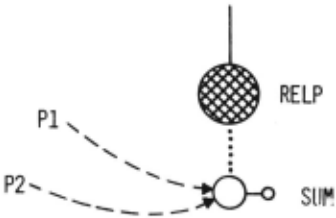
The structure created by applying picture functions, creating daemons, etc., is called the picture structure. Picture structures can be diagrammed as shown in Figures 1 and 2. The conven tions used are : picture modules are cross-hatched circles, outputs are small open circles, and daemons are larger open circles; modules are connected to the modules they own by solid lines and to the daemons they own by dotted lines;
outputs are connected to daemons which change their values by short solid lines; and dashed arrows lead from each output to all daemons which run when that output changes value.
Examples
Several examples of simple picture functions will now be presented.
The picture function RELP, which appears below, captures the notion of "relative position" in the following sense: it causes an output's value to be maintained as the sum of two other outputs' values.
(DEFPIC RELP (Pl P2 "OUT" SUM) (CONTIN (OUCH SUM (+ ,Pl ,P2)) ))
The picture structure created by applying RELP is shown in Figure 1.
---
FIGURE 1
The above DEFPIC "declares" RELP to be a picture function which takes two arguments: Pl and P2; these must be out puts, due to the way in which RELP uses them. Applying RELP creates a module whose local environment holds Pl, P2, and SUM; this is indicated by their presence in the argument list. The designator "OUT" indicates that at the time of RELP's application, SUM is to be initial ly bound to a newly created output with a value of NIL.
RELP's application of CONTIN creates a daemon which watches Pl and P2, running when either or both change value. When this daemon runs, it will apply OUCH (OUtput value CHange) to change the value of the SUM output to the sum of the val ues of the outputs assigned to Pl and P2. (Veetor arithmetic is assumed.) The commas (,)appearing in the CONTIN daemon are syntactic sugar for an application of the function OVAL, which, applied to an output, returns the value of that output. In addition to creating the daemon, CONTIN also runs the body of the daemon once before returning, thus initializing SUM.
The designator "OUT", in addition to indicating an initialization of SUM, also indicates that the value of SUM can be obtained from the created picture module after RELP has returned. This access of RELP's local environment is performed by the function OUT, abbreviated by a pre fixed exclamation point(!). Thus, for example,
(RELP DISPl !(RELP DISP2 PT))
creates a ".chain" of relative positions two elements long.
Now a picture function will be de fined which manages a hardware display file entry causing a visible line to be drawn. This picture function, defined below as LINE, takes two arguments, both of which are outputs containing posi tions, and draws a line connecting its arguments' values.
(DEFPIC LINE (Pl P2 "AUX" LINEID) (SFTQ LINEID (MAKE-ENTRY ,Pl ,P2)) (AS-NEEDED (CHANGE-ENTRY LINEID ,Pl ,P2) ) (ONC DELETE . (DESTROY-ENTRY LINEID))
The picture structure created by an ap plication of LINE is shown in Figure 2.
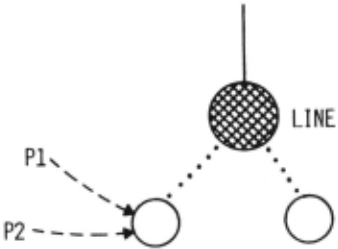
"AUX", in LINF.'s argument list, in dicates that LINEID is an AUXiliary iden tifier which is to be retained in the local environment for use by daemons. LINF.ID holds a display-file-entry identi fier returned by MAKF.-ENTRY, which creates the display file entry. The ap plication of AS-NEEDED creates a daemon like CONTIN but does not initially run that daemon. The created daemon watches Pl and P2 and will apply the function CHANGE-ENTRY to alter the display file entry whenever necessary. The applica tion of ONC (for ON Condition) creates a daemon which is run as part of the pro cess of deleting a LINE module; this dae mon applies the function DESTROY-ENTRY to deallocate the display file entry.
A relative line can now be defined as follows:
(DEFPIC RELINE (BASE DELTA) (LINE BASE !(RELP BASE DELTA))
RELINE creates no daemons; it effec tively delegates the authority to handle the creation of the relative line to the modules it created. Such delegation need not be total. As an example, consider the picture function WATCHP3 below:
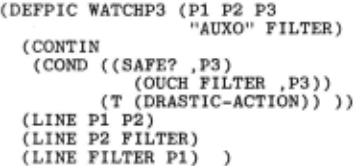
The "AUXO" argument list designator makes FILTER an AUXiliary identifier, like "AUX", but initializes FILTER to contain an output of value NIL.
WATCHP3 draws a triangle connecting its three argument outputs Pl, P2, and P3, provided that P3 has some range of "safe" values as checked by the predicate SAFE?. If P3's value is not "safe", the daemon performs some "drastic action''. It should be noted that the CONTIN daemon of WATCHP3 runs only when the value of P3 changes; changes to the values of Pl and P2 do not cause this daemon to run, but instead are responded to directly by dae mons in the LINE modules created by WATCHP3.
The previous examples illustrate no mechanism by which outputs can be passed back through multiple levels of picture function invocation. For example, the output created by RELP in RELINE -- the computed endpoint of the line -- may be of interest to RELINE's caller. This output passing is achieved via another argument list designator: "OUTU", for OUTput Uninitialized. "OUTU" operates like "OUT", in that the values of the identifier(s) it designates are retreiva ble by using the function OUT (!); but "OUTU" does not initialize its designated identifiers, instead allowing then to be assigned values by the picture function body . A RELINE passing its computed end point back using "OUTU" can be coded as follows:
(DEFPIC RELINEl (BASE DELTA "OUTU" EP) (SETQ EP !(RELP BASE DELTA)) (LINE BASE EP))
Thus the fragment creates a 2-element chain of relative lines in which the embedded RELP daemons are directly connected. This is shown in Figure 3, which shows the picture struc ture created by the above fragment.
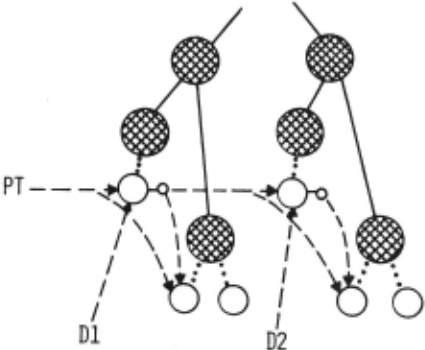
D2
FIGURE 3
~ Acyclic Daemon Scheduling ~
The DALI daemon scheduling rules define which daemons are to be run-anG the order in which they are to be run. Here we will deal only with scheduling rules for a special case: the situation when inter-daemon relationships are acyclic, i.e., no daemon can change an output value and in so doing cause itself to be run again at some future time. Unrestricted -- in particular, cyclic - relationships can be handled in DALI in a manner that leads to iteration, or "relaxation"; this more general situa tion ~s discussed in ~]. The acyclic rules described here form the basis of the treatment of the cyclic case, and occur in very many situations of inter est.
Some definitions are needed prior to the presentation of the acyclic daemon scheduling rules:
A daemon A is the father of a daemon B if and only if A specifies an output watched by B.
A daemon A is an ancestor of a daemon B if and only if there exists a sequence of daemons D(O), D(l), ... ,D(n) such that D(O)=A, D(n)=B, and for every i in the range O<i<n+l, D(i-1) is a son of D(i).
A picture is said to be acyclic if and only if it contains no daemon which is its own ancestor.
The acyclic daemon scheduling rules are :
Rule 1: (selection) A daemon will be run if and only if one or more of the outputs it watches is OUCHed; once run, it does not run again until such an OUCH occurs after its execution has terminated.
- Rule 2: (noninterruption) Once a daemon D begins execution, no daemon an cestrally related to D may run until D terminates of its own accord.
- Rule 3: (ancestors first) If daemons A and B are to be run, and A is a ancestor of B, then A is run be fore B.
- Rule 4: (closure) If two daemons are to be run and they are not related in ancestry, they may run in any order.
There is a simple method for imple menting the acyclic daemon scheduling rules on a sinKle-processor system. Each daemon is assigned an unchanging integer priority at its creation according to the following rules : (1) the priority of the application program, considered as the "root daemon" ancestral to all other dae mons, is 0; (2) the priority of a daemon is one greater than the largest of its fathers' priorities. Whenever an output is OUCHed, each daemon watching that out put is immediately placed on a global daemon queue in order of increasing dae mon priority. The running of daemons then consists of removing the daemon at the head of the queue from the queue and running it, repeating this until the queue is empty.
The scheduling rules above achieve two very important goals:
(1) Daemons can be considered as defining invariant relationships between their watched and specified outputs. This is critical to making DALI programs operate in a comprehensible manner. It means, for example, that wherever and whenever a RELP module is used, the SUM output can reliably be used in place of a computation of the sum of the module's inputs. This goal is primarily guaran teed by the ancestors first rule.
(2) Daemons operate in a stable en vironment. This is taken here to mean that the only data value changes which occur during that daemon's execution are performed by the daemon itself. This ensures that despite the fact that DALI is a multiple-environment, "multiple-process" system, each individu al daemon can be written as if it were running on the simplest possible single program counter machine lacking any form of multiple processing or interrupts. Races, hazards, and other synchronization worries are defined out of existence from the start.
The "stable environment" and "relationship" goals are as much a virtue as a necessity : a system like DALI, where use of hundreds of separate "processes" is implied, would literally be unusable if the "bugs" associated with coroutine or multiple-process systems could occur with their usual frequency . It should be noted that even given these goals, the ancestors first arid closure rules do provide for the possibility of true parallel operation of daemons in a multiple-processor environment.
Environment Structure
The structure of the environment in which a DALI daemon operates is composed of four parts: the primitive environment, the global environment, the ~ environment, and the temporary environment. These are considered to be arranged in a stack, as shown in Figure 4.
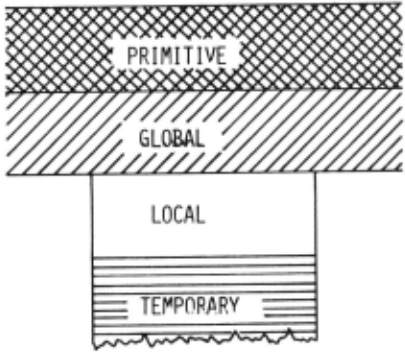
The primitive environment consists of those identifier-to-value mappings which are fixed for all time in the base language; it would typically include the identifier "+" . In interpreted LISP, this environment is null.
The global environment contains identifier-to-value mappings which are defined by the user, and are generally static for the duration of an execution of a program. The names of procedures generally lie here. In LISP, this envi ronment is unstructured; in a language with static block structure, such as AL GOL, the global environment would be structured in accordance with the static block structure.
A separate temporary environment is associated with each module, and retains its contents across daemon executions. The temporary environment contains purely temporary storage for use by daemons; it is empty when a daemon begins execution , and is emptied when the daemon finishes execution. Here we assume a stack-structured temporary environment; some modifi cation of this organization would be ne cessary if FORTRAN, which is not stack-structured, were the base language.
The total environment structure ex isting when no daemon is executing, il lustrated in Figure 5a (on a later page), is a broad but shallow tree with one tem porary environment for each existing mo dule. During any execution sequence that does not include picture function appli cation, the total environment appears as shown in Figure 5b : one temporary envir noment exists, that of the currently run ning daemon. When picture functions are being applied, several temporary envirno ments can exist simultaneously in a nest ed fashion as shown in Figure 5c. This occurs because each picture function body executes as if it were a daemon.
From the viewpoint of physical sto rage allocation, the situation with the DALI environment structure is simpler than the above discussion makes it ap pear. While the local environments must be allocated out of a heap, they are created and destroyed realtively seldom and do not vary in size during execution. On the other hand, the much more rapidly varying temporary environments can be allocated in a single stack, since the only occurrence of multiple temporary environments is nested.
The sharp distinction DALI makes between local and temporary environments thus makes the environmental aspects of the language -- allocation of storage space and identifier lookup -- quite ef ficient.
Current Implementation
Like any other programming language, DALI cannot be considered truly "tested" until a body of users have applied it to their problems. Unfortunately, no usable implementation of DALI exists at this writing. An experimental version of DALI has be~n programmed using the language MUDDLE L7] on a Digital Equipment Corpo ration PDP-10 in the Programming Technol ogy Group of M.I.T. Project MAC. This implementation was primarily intended to find out if the various pieces of DALI fit together in a reasonable manner, and to get an estimate of the size of the run-time system needed; the latter was gratifyingly small, amounting to approxi mately 6500 words of fairly "loose" PDP10 program. However, this implementation is an interpreter written in an inter preter, and compares favorably in speed only with continental drift. Recent at tempts at compiling the DALI interpreter have, however, produced sufficient gains in speed to justify the claims to effici ency made earlier in this paper.
Acknowledgements
The author would like to thank Pro fessor Michael Dertouzos of MIT for his aid in the course of the work reported here, especially in untangling into a presentable dissertation the snarl of ideas that were DALI. Professor J.C . R. Licklider of MIT provided the computer resources needed for the experimental implementation of DALI. The work of Christopher Reeve and other members of the MAC Programming Technology group on MUDDLE and its compiler made the DALI interpreter possible . The research re ported here was supported in part by Pro ject MAC, an M.I.T. research program sponsored by the Advanced Research Pro jects Agency of the Department of Defense under Office of Naval Research Contract N00014-A-0362-0006.
@inproceedings{ijcai1975p89,
  title     = {The Description And Control Of Changing Pictures..},
  author    = {Pfinter, G.},
  booktitle = {Proceedings of the Fourth International Joint Conference on
               Artificial Intelligence, {IJCAI-75}},
  publisher = {International Joint Conferences on Artificial Intelligence},
  editor    = {Patrick Winston and Carl Hewitt},
  pages     = {569--573},
  year      = {1975},
  note      = {A.I. Software},
  url       = {https://ijcai.org/proceedings/1975/89},
}
TY - CPAPER TI - The Description And Control Of Changing Pictures.. AU - Pfinter, G. T2 - Proceedings of the Fourth International Joint Conference on Artificial Intelligence, IJCAI-75 PB - International Joint Conferences on Artificial Intelligence PY - 1975 SP - 569 EP - 573 UR - https://ijcai.org/proceedings/1975/89 ER -Copied
Machine-readable versions of this paper, for tools and AI agents:





