
RITA - An Experimental Man-Computer System On A Natural Language Basis
Proceedings of the Fourth International Joint Conference on Artificial Intelligence. Natural Language Understanding. Pages 387-389.
© 1975 International Joint Conferences on Artificial Intelligence
Abstract
The report presents an experimental (Pictorial) Representation - Information!ext - juthor system intended-for work With teXts in natural language and simple geometrical compositions. The general principles of the system operation, ita architecture, and basic problems are discussed.
- H.A.Mem,qyK. OJIHT JIHHl'BHCTnecKol Teo- pHil MO.JleJlel TBIIS C~C'.JI-TEKCT, M. ,19?4.
- H.A.Me.o»qyK, A.C.Ha~. FHTA -sac- !!_~~B'l'BJl!»HSJI OBC'l'811B PHCYHOK-~PMA JlWI-TiKCT, ,llOKJIBll aa Yn CmmoSBYJ18 UO KB6epae'l'ue, T6.B.UoB, 19'74.
- A.C.HapBBUDB. Bsa.BMo.JtelcTue c •ua- BHMH CBC'l'eMaMI BB 8C'l'8CTB8BBOM SSKKe, C6op&HK •c•coreMBoe H Teopeoraqecaoe ~po rpBJDIIIpoBSue -74", HoBOcB6BpcK, !974.
- A.P.Yerahov. One View of lfan-llachine Interaction. Journal of the ACK, vol. 12, Io ) (July, 1965).
- X. TYyry. Pemeue sB,~tSq aa BAJJO.u- 'l'8Jl:&ma: IIO.Jle.ISX, iypBSJl Bli'IIBC.1DI'l'8.DtBOI IIBT811B'l'U.III B MBT8118'l'R8CKOI «-suB, j 3, !970.
References were extracted automatically from the PDF and may contain errors.
Full text extracted automatically from the PDF; figures, tables and equations may differ. The PDF is the version of record.
Introduction
Rl!I!A is an experiment~t.l sottwre Picture ... Text system intended tor opera tion within the bounds of a most simple "world" of graphic compositions construct ed from a small number of elementary geo metrical figures. The system is supposed
to be capable of&
- constructing a graphic composition ac· cording to a given textual description.
- composing a sufficiently adequate and natural description for any geometrical composition.
It was agreed that both graphic compo sition and textual descriptions should be, at the opening stage of the project reali zation, as simple as possible.
COMPOSITION: One, two, or three circl es located on a square screen. The propor tions ot the circles and their location on the screen, both absolute and relative to
each other, are arbitrar,r.
DESCRIP.HON: One Russian sentence of a maximal number of 45 words, containing no comparisons or metaphors. To make up tor the primitive geometrical "world", a reasonably large margin is suggested for
the syntactic structure of descriptions.
Principles of System Realization
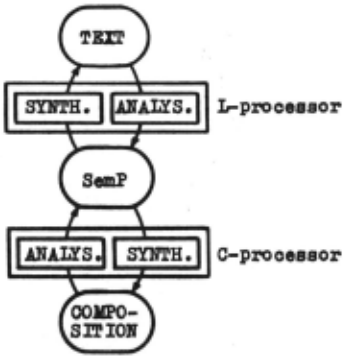
The system consists of two independ ently operating parts: 1) Language proces sor or L-processor and 2) Composition pro cessor or C-processor, both intended tor
analysis as well as synthesis.
The two parts are linked together through an intennediate level of the Seman tic Presentation of Information (SemP) ,
see Pig. 1.
Pigura 1
SemP, as a matter ot fact, is an in variant corresponding, on the one hand,to a sufficiently broad class of synonymous texts, and, on the other hand, to a cer tain number of compositions; for any of these, ever,y text of the class is an ac ceptable description. Apart from this , SemP is constructed as a fonnal object feasible for computer software representa tion. SemP acts as an intennediary language in Picture.,.semP~Text transtonnations. SemP, in the Rl!I!A system, is a directed graph, its vertices marked with symbols of elementary (that is! within the frames of the system in quest on) "senses", i.e. "predicates" and "objects" and arcs label led with symbols of relations between the predicates and their arguments (note that predicate arguments may be predicates or objects, whereas vertices marked with ob ject symbols are always te:nninal ones·).
The transtonnations corresponding to the phases of processor operation as indi cated by pointers in Pig. 1 are not unique in a general case (with the exception of
the Text~ SemP phase). It should be noted
· The system conception is based on a general ideology of linguistic Text~ Sense
models presented in [1].
that:
- the representation of different descriptions by one and the same SemP im plies that these descriptions correspond to one and t~~ same set of compositions;
- the representation ot a certain composition by more than one SemP does not imply that sets of compositions correspond ing to each of these SemP are the same , but, rather, that this composition belongs to the intersection of these sets;
- since the world we confine our selves to is extremely scanty end simple, sense units that need further semantic de composition in a more general context may be used as elementary ones.
Consider a very simple example Pig. 2). (see
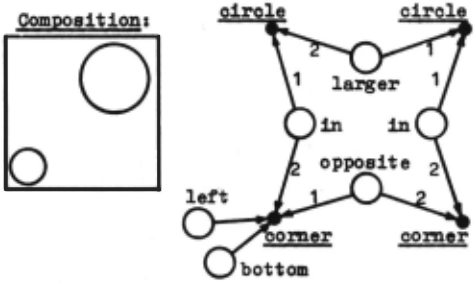
Figura 2
Text corresponding to SemP (I).
- A larger circle is located in the top right corner, and a smaller circle in the bottom left one.
- Of two circles on the screen,the smaller one is in the left corner on the bottom and the one that is large is in the opposite corner.
Terts corresponding to SemP (II) (Pig. 3).
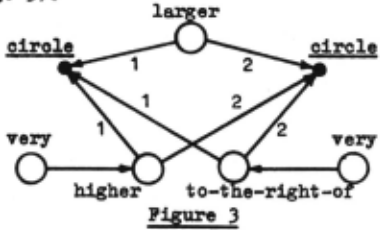
- There are two circles on the screen, the smaller one a deal lower that the larger one and on the left of the lat ter.
- Two circles are situated on the screen,one a lot higher than the other and to the right of ~t, that on top being big ger than the lower one.
System Architecture
A.. The L-processor includes 3 main blocks, ANALYSIS, SYNTHESIS and DICTIOlURY.
While in the analysis mode, the I. processor executes the standard routines 1 of natural text analysisa
- MOrphological analysis
- Surface syntactic analysis
- Deep syntactic analysis
- Transition to SemP.
At the opening stage of system reali zation it was agreed to avoid the morpho logical analysis and include all necessary toms of words in the DICTIONARY. Thus , the sequence of the analysis mode stages is as followsa
Every word ot the input sentence pro cessed by the DICT.IONARY is replaced by its entry tom plus certain number of grammar characteristics (i.e. the so-call ed deep morphological representation of the word, or the word's DJIR) · The out put at ring of the DJIR' a is an input for the ANALYSIS block. The aurtace analysis trans forms the string into a surface syntactic tree (SSS). At the deep analysis phase , the SSS is made into deep syntactic struc ture tree (DSS). At the last stage of ABA LYSIS!. the DSS tree is transtomed into a SeiiU".
The SYNTHESIS carries out the reverse function, i.e. transtoming the SemP into a sentence of the output description.
The SYJlTHESIS standard stages arec
- Transition from SemP to a deep syntactic structure (DSS)
- Transition from DSS to sss
- Transition from SSS to DJIR string
- MOrphological Synthesis.
DICTIONARYa A preliminary study of more thiii 1oo<Ietailed tertual descrip tions of arbitrary compositions from a chosen class has shown that a dictionary ot about 200 entries is sufficient tor the current stage of the system realiza tion.
Since the morphological level ia,tor the time being, excluded from the I.-pro cessor (see above), the dictionary m.r contain as many as 2000 entries including all paradigms ot words.
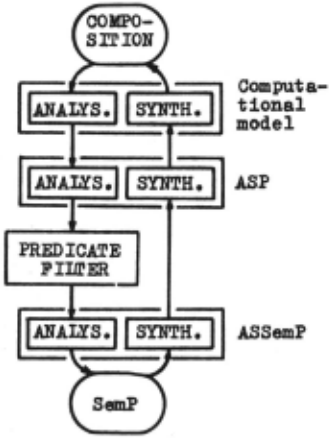
B. The a-processor consists of 4 main blocks (see Pig. 4):
- Computational MOdel of Composition 2. Analysis-Synthesis ot Predicates (ASP)
- Predicate Filter
- Analysis-Synthesis of SemP {A.SSemP)
Pigura 4
- The computational model [5] ot the composition uses a number of simple rela tions defined on the set of elementary nu merical characteristics of an image (e.g., the "distance between the 1st circle and the screen bottom edge", "radii ratio of the 2nd and 3rd circles" etc.) and state ments concerning geometrical properties of image elements (e.g. 11the second circle contacts the principal diagonal"r "the 1st and 2nd circles intersect", etc.J, the statements can be either "true" or "false".
Proceeding from given values of cer tain characteristics and statements, the model calculates values of other characte ristics and statements, connected with the given ones through a system of "com putable" relations. Por example, in the Picture..,. SemP transfo:nnation, the basie characteristics are the circle and its center coordinates.
- Analysis-Synthesis of Predicates sets a corresponding between values of statements and composition numerical cha racteristics and a certain set ot element ary predicates which are SemP elements.
- The predicate filter operates at the Picture..,. SemP transition stage only. Prom the predicate set obtained at the preTious stage the filter with the help of some heuristics selects a "representa tiTe" subject whose predicates have to be used as raw material in the SemP construc tion.
- ASSemPa in the analysis mode, comp lex predicates are constructed from the chosen ones. These complex predicates to gether with some of the elementary predi cates which have not been used before are made up into a SemP which must be "suffi ciently adequate" and "minimally redund ant". Ill the synthesis mode the input SemP is decomposed into predicates, complex
predicates are further decomposed into elementary ones. The set of elementary predicates obtained is passed to the in put of the synthesis module of the ASP block.
Discussion
The progress of large software sys tems requires a practical solution of the MAN-COMPUTER dialogue on a human laQgUage basis. Theoretical and experimental study of both linguistic and software components ot a natural language dialogue systems is one of the principal aims of the RIT.l pro ject. We also wish to confirm or correct our initial hypotheses as to what func tional blocks of the L-processor can be recommended as a standard "preprocessor" for a more or less broad class of comput er systems.
The preprocessor of any computer sys tem capable of "understanding" a natural language includes three main components: dictionary! grammar (syntax+ morphology), and semant cs are defined by the system· orientation grammar being the only sys- · tem-independent constituent of the prepro cessor.
We believe that the text processing from a sentence to the Deep Syntactic Structure (DSS) level may be introduced as a universal block of the preprocessor. This block also defines the fo~ts of the syntactic section of a dictionary entr,y, which can thus be made standard.
Besides the universal block the pre processor must contain an interface block of the DSS SemP transfo:nnation. The inter face realization is entirely dependent on the SemP representation methods which, 1n their turn, must tit into the user system. It is evident that, for the standard part of the preprocessor changeable interface blocks should be supplied, each of them oriented on some specific class of comput er systems (automatic management,retrieval systems, data banks, etc.).
The SemP language of intertace deter mines the other (semantic) part of a dic tionary entr,y. So, the computer system (or class of system) determines both the glossary of the preprocessor dictionary g.nd the structure of the semantic part of the entries.
The L-processor constructed within the framework of the RITA system will serve as an experimental test of the re ported ideology: first, a certain proto type of the universal part of the prepro cessor is made up to the standards attain able at this stage, second, the operation ot this universal part of the preproces sor the complex of the system as a whole.
As we wish to concentrate our main efforts on this problem the rest of the system is as much "lightened" as possible, its "world" being extremely limited, the SemP level simplified, a built-in learning mechanism renounced, etc.
However, the project purposes are not restricted by the problems directly as sociated with the L-processor. 1n the course of the C-processor elaboration a number of problems also arise that require special investigation.
To grant an example, consider the concept "the circle is in the (screen)cor ner". Moving from text to image, we shall necessarily have to pass over from a for mal expression of this concept on the SemP level to its interpretation in a moat simple but "real" world of compositions. What sort of interpretations do we mean? Let us correlate each with an interpreta tive function (!-function) the values of which vary from the "firm YES" to the "firm IO" depending on values of certain parameters. For instance, with the world maximally simplified (the effect of other composition elements neglected, the cor ner and screen sizes (fixed), the !-func tion in our case depends on the three pa rameters& the two coordinates of the circle center and its radius. To make the !-function useful, we have to develop techniques of their generation and com puter presentation. It offers no particu lar difficulties in the case of an !-func tion of a few variables; for functions of many variables, though, the problem is far from trivial. lt>at probably, the only possibility we have is to try to find ap proximation methods :for !-:functions, i.e. ultimately, to replace a complex concept with a super-position of simpler ones. The efforts to elaborate a sufficiently adequate procedure of such replacement can go in a few different directions:
- "Explanatory dictionary": a rest ricted base set of "elementary" concepts is selected. Por each non-elementary con cepts and therefore is in itself an expla nation (or "definition") of a non-element ary concept through elementary ones. The evident advantages of the approach are
- that (i) the !-functions are forced into a "lower level" where they can be handl ed without particular difficulties and that
- (ii) it enables deep synonymous para phrasing on SemP level.
The disadvantage of the approach is that we do not dispose of an objective ~rocedure of building-up "explanations" (although we can imagine an objective pro cedure of their verification). The draw back is the more troublesome as there are positively no proofs that the explanation technique is powerful! (or, rather, natu ral) enough to provide a "close" approxi mation tor complex !-functions of many variables.
- Analytical approximation& the re-
construction, with analytic methods, of a complex !-function from partial data,e.g. individual cross-sections projections, etc. We can also mention !he approximation ot !-functions of many variables with me thods close to those of pattern recogni tion (when the situation is described as a set of values of simple concepts).
- Research in techniques of a "natu ral" formation of complex concepts from simple ones, close to that in psychic and psychobiological mechanisms.
A combined strategy m~ prove to be the most efficient one: an explanatory dictionary up to a definite level, then methods of handling !-functions directly· The search for such a strategy and speci fic methods of its realization is also one of the main problems of the Rl!U. pro ject.
@inproceedings{ijcai1975p61,
  title     = {RITA - An Experimental Man-Computer System On A Natural Language Basis},
  author    = {Ershov, A. and Nariniany, A. and Mel'chuk, I.},
  booktitle = {Proceedings of the Fourth International Joint Conference on
               Artificial Intelligence, {IJCAI-75}},
  publisher = {International Joint Conferences on Artificial Intelligence},
  editor    = {Patrick Winston and Carl Hewitt},
  pages     = {387--389},
  year      = {1975},
  note      = {Natural Language Understanding},
  url       = {https://ijcai.org/proceedings/1975/61},
}
TY - CPAPER TI - RITA - An Experimental Man-Computer System On A Natural Language Basis AU - Ershov, A. AU - Nariniany, A. AU - Mel'chuk, I. T2 - Proceedings of the Fourth International Joint Conference on Artificial Intelligence, IJCAI-75 PB - International Joint Conferences on Artificial Intelligence PY - 1975 SP - 387 EP - 389 UR - https://ijcai.org/proceedings/1975/61 ER -Copied
Machine-readable versions of this paper, for tools and AI agents:





