
Automatic Program Synthesis from Example Problems
Proceedings of the Fourth International Joint Conference on Artificial Intelligence. Learning Debugging And Automatic Programming. Pages 268-272.
© 1975 International Joint Conferences on Artificial Intelligence
Abstract
Desired algorithms to be synthesized are described implicitly by example problems that the algorithms should solve. The example problems are first solved by the probl~olver LAWALY. The obtained solution represents a trace of the desired algorithm. From the trace, the algorithm is synthesized by the synthesizer SYN. SYN writes recursive programs with repeat statements, and generates its own subroutines. Examples of functions synthesized include repetitive robot tasks and tree traversal algorithms.
- Kowalski, R., "Predicate Logic as Programming Language," Proc. IFIP Congress 74, Stockholm, 569-574.
- Sikl~ssy, L., "The Synthesis of Programs from their Properties, and the Insane Heuristic," Proc. Third Texas Conference on Computing Sys- tems, Austin, Texas, 1974.
- Boyer, R. s., and Moore, J. S., "Proving Theo- rems about LISP Programs," Third International Joint Conference on Artificial Intelligence, Palo Alto, California, 1973, 486-493.
- Waldinger, R. J., and Lee, R. C. T., "PROW: 5.
- A Step Toward Automatic Program Writing," International Joint Conference on Artificial Intelligence, Washington, D.C., 1969, 241-252.
- Manna, Z., and Waldinger, R. J., "Toward Auto- matic Program Synthesis," Comm. A. C. M., 14, 3, 1971, 151-164.
- Lee, R. C. T., Chang, C. L., and Waldinger, R. J., "An Improved Program-Synthesizing Algor- ithm and its Correctness," Comm. A. C. M., 7. 8. 9. 10. 11. 12. 13 . 14. 11• 4, 1974, 211-217.
- Buchanan, J. R. and Luckham, D. C., On Automa- ting the Construction of Programs, Technical Report STAN-CS-74-433 Computer Science Depart- ment, Stanford University, 1974.
- Biermann, A. w., "On the Inference of Turing Machines from Sample Computations," Artificial Intelligence, _ l, 1972, 181-198.
- Biermann, A. W., Baum, R., Krishnaswamy, R., and Petry, F. E., Automatic Program Synthesis Reports, Technical Report OSU-CISRC-TR-73-6, Computer and Information Sciences Research Center, Ohio State University, October, 1973.
- Sikl~ssy, L. and Dreussi, J., "An Efficient Robot Planner which Generates its own Proced- ures," Third International Joint Conference on Artificial Intelligence, Palo Alto, California, 1973, 423-430. IJCAI
- Sikl&ssy L. and Roach J., "Collaborative Prob- lem-Solving between Optimistic and Pessimistic Problem-Solvers," Proc. IFIP Congress 74, Stockholm, 1974, 814-817.
- I .
- Siklossy, L., "Procedural Learning in Worlds of Robot•s," Proc. NATO Advanced Study Insti- tute on Computer Oriented Learning Processes, Bonas, France, 1974, 423-436.
- Sikl~ssy, L. and Roach, J., "Model Verifica- tion and Improvement using DISPROVER," Artifi- cial Intelligence, ~ 1975.
- Green, C. C., et al., Progress Report on Pro- gram-Understanding Systems, Technical Report AIM-240, Computer Science, Stanford University, 1974.
References were extracted automatically from the PDF and may contain errors.
Full text extracted automatically from the PDF; figures, tables and equations may differ. The PDF is the version of record.
1. Introduction
A program synthesizer transforms the implicit or explicit description of an algorithm into execut able code. Although a compiler for a high level language might be considered a synthesizer, since it transforms an algorithm written in the language into executable machine code, generally discuss ions of program synthesizers are restricted to those systems which transform into code descrip tions which are "far" from being executable. The concept of "far" is relative to a state of know ledge. For example, some synthesizers accept de scriptions of algorithms in the predicate calculus. On the other hand, Kowalski (1) has argued in favor of a predicate calculus programming language. When a compiler for such a programming language is available, we can expect that some synthesizers will lose their "raison d'~tre".
Approaches to program synthesis can be disting uished according to the descriptions of the al gorithm to be synthesized. Properties of the al gorithm can be given to the synthesizer, expressed in a programming language (2) or a logical cal culus (4-7). A theorem-prover is used to extract the synthesized program. This approach suffers from difficulties in obtaining axiomatizations, and from the lack of power of present theorem provers.
Another approach (8,9) starts from the traces that the algorithm would have produced-if it existed on some particular test cases. The traces are generalized to the synthesized program. In this way, a variety of looping programs have been ob tained. This approach suffers from the tedium ex perienced by human beings in producing traces, and from the errors that all too often manage to creep into the traces. The above approaches are de scribed more fully in section 2.
We present here a novel approach to synthesis. The progro.tm to lw t:ynthcflized is descr !bed impli citly by sample problems that are assumed to be typical of the class of problems that the program should solve. The sample problems are first solved by the problem-solver LAWALY (10-12). The obtained solutions are traces which are &eneral ized to the synthesized pro,rams. Other efforts to synthesize programs given input-output pairs, Our synthesizer SYN has generated recursive pro grams with repeat statements. SYN writes its own subroutines. The synthesis process is totally automatic once sample problems, and the elementary operations necessary to solve the problems, have been given.
SYN is a running system programmed in LISP. The behavior of SYN is exemplified by several sample problems.
2. Approaches to Program Synthesis
2.1 Properties of Programs.
In many approaches to program synthesis, the syn thesizer is given a description of properties of the desired program in some language, for example logical calculi or a programming language.
2.1.1 Properties in a Programming Language.
Sikl~ssy (2) has described a synthesizer which accepts properties of algorithms expressed in LISP. Examples of such properties are: (EQUAL (TIMES A (PLUS B C)) (PLUS (TIMES A B) (TIMES A C))) and (EQUAL (APPEND A (APPEND B C)) (APPEND (APPEND A B) C)). The synthesizer uses a property prover similar to that of Boyer and Moore (3).
2.1.2 Properties in Logical Calculi.
Several synthesizers accept descriptions of prop erties of algorithms in the predicate calculus (Waldinger, Lee and Hanna, 4,5,6). A theorem prov er is used to synthesize the algorithm. Other log ical calculi have been used, for example by Luckham and Buchanan (7) in a synthesizer that permits man
machine interaction.
2.2 Traces of the Algorithm
The approaches described in section 2.1 suffer from several drawbacks: a) It is often difficult, if not downright painful at times, to give adequate axiomatizations of algorithms and their associated data structures. b) Among the major difficulties encountered in the approaches via logical calculi (section 2.1.2) is the requirement that the axio matization be complete. If some property of the algorithm or data structure is not included, the theorem-prover used by the synthesizer cannot com plete a proof, and no algorithm is synthesized. This difficulty does not exist in the approach via prograrnmint language description (sect i.on 2. 1 .1), since the synthesi~er can produce partial syntheses which immediately result in demands for additional properties. c) Presently available theorem-provers in particular for logical calculi, appear too weak to synthesize difficult pro&rams. Until the the orem-provers become more powerful, the logical calculi approach has been called "not pragmatic"
Human beings often understand a given program by executing (or simulating the executing of) the al gorithm on some test cases, i.e. by considering 'traces of the algorithm. Similarly, human beings often prefer to have a desired algorithm (to be programmed) explained to them by a description of the behavior of the algorithm on some particular sample problem, i.e., in terms of traces. Bier mann (8,9) has described a synthesizer which ac cepts the traces of an algorithm to be synthesized. The traces are assumed to be equal to the traces that the desired algorithm (if it existed) would have produced on the same test cases. The syn thesizer generalizes the traces to a program which does produce the correct traces on the sample test cases. The programs synthesized include loops, and subroutines if these were specified in the traces.
2.3 Example Problems
Biermann (personal communication) has reported that inputting the traces by hand was not only te dious, but could not always be done without the inclusion of errors in the traces. We have there fore been led to automate the production of traces, both to avoid errors and to eliminate a tedious task.
In our synthesizer, SYN, the inputs are specific, sample problems belonging to the class of problems which the algorithm to be synthesized should solve. The human being is saved the tedium of producing traces. In addition, the description of the de sired algorithm is not given under any form. The user of the synthesizer has the same relationship with the synthesizer as he has with a systems pro grammer: he only describes problems to be solved. It is the synthesizer's task, as it is the system programmer's,to develop an algorithm that solves the sample problems, and in addition a reasonable class of more general problems that include the sample problems.
The problems input to SYN are solved by the prob lem~olver LAWALY (10-12) .which produces a solution which is interpreted as the trace of the desired algorithm. The trace is then generalized to an algorithm. The synthesizer proper, also called SYN, which produces programs from the traces, bears almost no resemblance to Biermann's synthe sizer. While Biermann produced looping programs, SYN writes recursive programs with repeat state ments in a language similar to LISP. SYN also generates its own subroutines.
Since the problem solver LAWALY has been described elsewhere in the literature, we shall concentrate on the synthesizer proper. Since, as we have argued, programs are best understood by describing their trace on a sample problem, we shall exhibit the behavior of SYN on a simple sample problem.
3. SYN on a Simple Sample
We consider a simple problem, illustrated in Fig ure 1. A robot is on ground X. She holds a flag FLAG. She can climb from X on boxes A, B, and C, one after the other. On the top box C she can plant the flag. We want the robot to plant the flag and return to the ground X.
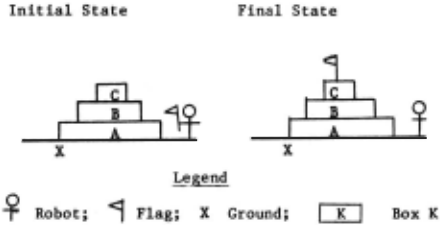
As in (10-13), the world is described by a set of true facts, and the capabilities of the robot are given by elementary operators. The format of each operator is: (operator-name (list of arguments) (set of preconditions of the operator) (delete set of the operator) (add set of the operator) For an operator to be applicable to the world OW, the preconditions of the operator must be satis fied in OW. As the result of the application of the operator, the world changes into a new world NW given by:
NW :· ( (OW- delete-set)+ add-set), where- and + are set difference and union, respectively.
(climb (boxl box2) ((on box2 boxl) (onrbt boxl)) -preconditions ((onrbt boxl)) -delete set onrbt · on robot ((onrbt box2)) -add set (unclimb (box2 boxl) ((onrbt box2)) ((on ho::c2 bo;;l) (onrtr. b.1x~)) ((onrbt boxl)) (plantflag (flag box) ((top box) (holding flag) (onrbt box)) ((holding flag)) ((planted flag box)) )Figure 2 lists the operators relevant to the exam ple task. In a more complex world, a more careful axiomatization could be necessary (13). Figure 3 shows the sequence of operators which constitutes the solution trace found by LAWALY to the problem. Each step of the solution is indexed by (Ei) for subsequent reference.
| Operator | Reference |
|---|---|
| (climb X A) | (El) |
| (climb A B) | (E2) |
| (climb B C) | (E3) |
| (plantflag FLAG C) | (E4) |
| (unclimb C B) | (ES) |
| (unclimb B A) | (E6) |
| (unclimb A X) | (E7) |
Figure 3. Trace of solution to Simple Sample Problem.
3.1 ODBOL
The synthesized programs are written in ODBOL (no acronym), which has the flavor of LISP. The syn tax of ODBOL is given in Figure 4. We intend to extend ODBOL as the power of SYN increases.
<fundefn> ::· (<identifier>(LAMBDA<idnlist><body>» <idnlist> ::· (<identifier>*) *denotes theKleene star. <body> ::· (COND<block>*) <block> ··· (<ifpart><opart>) <opart> ::· BEGIN <op>* END! BEGIN <op>* REPEAT END <ifpart> ::· (TRUE) I (IF <precondition>*)! (EXISTS <idnlist><precondition>*) <op> ::· <robot operator>l<function call>Figure 4. Syntax of ODBOL.
The semantics of ODBOL are as follows:
- When a function F is called, the formal parame ters of F are bound to the actual parameters of the call.
- Having bound the parameters, each <block> in the <body> is scanned from left to right until an <if part> is found to be true. The corresponding <o part> is then executed. (If no <ifpart> is true and the <body> is exhausted, then an error has occurred.)
- The <op>s within the block are executed from left to right, as in the PROG feature in LISP. If the <op> is a function call, the indicated func tion is executed with the indicated arguments. Otherwise the <op> is executed and control passes to the next <op>. An END is treated as a RETURN statement in a LISP PROG. A REPEAT statement is equivalent to a transfer to the top of the <block~ unless the block condition is now false, in which case control is passed to the next statement (al ways an END according to the syntax.)
- In the case of EXISTS, the identifiers in the <idnlist> are bound before entering the block, and these bindings hold throughout the rest of the block. If more than one possible binding is found for an identifier, then one of the bindings is chosen arbitrarily. (REPEAT statements or recur sion will make the system consider several of the possible bindings.)
3.2 Arguments of the Function.
The function to be synthesized must be given a l~t of arguments. To select the arguments, we consid er the preconditions of the first operator in the trace. The preconditions are ranked according to a hierarchy (see 10). The lowest ranked precondi tion, corresponding to the most restrictive pre condition, is selected. Its arguments become the arguments of the function .
In our example, among the preconditions of the op erator (climb X A), the most restrictive one is (onrbt X), hence X is selected as the argument of the function (call it FF) to be built.
If the first operator is to some extent incidental to the solution, this approach would appear unsat isfactory. However, as is shown in section 4.2, SYN will then generate a first function which ac complishes the incidental work, and calls another function which performs the significant tasks.
3.3 Building the Function.
We shall show how the function FF is built. The total function FF is
ODBOL Code Line Reference
(FF (LAMBDA (X) (COND
(Ll)
| ((EXISTS (A) (on A X)) BEGIN (climb X A) (FF A) (unclimb A END) ((EXISTS (FLAG) (top X) (holding FLAG)) BEGIN (plantflag FLAG X) · END) )) ) | (L2) (L3) (L6) (L7) (L4) |
The line references correspond to the order in which the lines of code are generated.
So far, we have line Ll only. The <ifpart> of the <block> comes from the preconditions for (climb X A), namely (on A X) and (onrbt X). The latter provided us with the variable X. (on A X) involv~ a new object, A, so an EXISTS construct· is intro duced. We obtain line L2. Having used El, we consider E2. Since the operators in E2 and El are the same, recursion is attempted, yielding line L3. The recursion is on A, since A occupies the same position in E2 as X did in El.
The new program is executed to verify that it con forms with the trace. In fact, not only El and E2 agree with the program, but E3 as well, As we try to execute (FF C), the condition (EXISTS (al pha) (on alpha C)) is not satisfied in the world, hence the test fails, and we need to write new code. From the preconditions of plantflag in E4, we generate a second test in the CONDitional, line L4. Notice how the constant FLAG becomes a vari able. Previously, the ground X also became a var iable.
We next consider ES: (unclimb C B). The constan~ C and B in ES are the same ones that were current in the call (FF B). (As the partial programs are executed, all contexts are saved for subsequent examination, if necessary.) Hence, it appears that a change of recursive level has taken place, since B is unknown in the call (FF C). Hence, we terminate the plantflag part of the program by adding END, line LS -which forces a return to the previous recursive level- and by inserting an un climb, line L6.
Looking at E6: (unclimb B A), we notice that the recursive context is changed again. Hence, an END is inserted after the unclimb, line L7. As before, new code must be checked against the trace. In fact, even E7 is generated, hence the synthe sized program is found completely satisfactory.
3.4 Comparison with Human Programs.
The authors have asked several friends and collea gues to describe a generalization to the simple sample problem of Figure 2. Invariably, the so lution was of the form:
-make a loop as the robot climbs to the top; -plant the flag;
- -make a loop as the robot unclimbs down to the ground.
It is remarkable that the program synthesized by SYN is in fact "better" than the version proposed by all humans (including ourselves!) as the most "natural" solution. The solution FF can be des cribed as follows: a series of recursive calls leads the robot up to the top; she then plants the flag. Then, as the recursive calls are undone, the robot climbs down. So, in particular, the operators (climb X A) and (unclimb A X) are paired in the same function call, and their complementary relationship is made transparent. By contrast, the "climb" and "unclimb" operators are separated in the two distinct, separate loops in the human program.
The above example does not illustrate all the cap abilities of SYN. Some modifications of the simp~ sample problem will give a more complete picture of SYN.
3.5 REPEAT statements.
If the robot holds several FLAGS, and plants all of them on the top box, the second block of FF would be synthesized as:
((EXISTS (FLAG) (top X) (holding FLAG)) BEGIN (plantflag FLAG X) REPEAT END )
Recursion could also have been used, but it would define (FF X) in terms of (FF X), the infinite re cursion being avoided because of side effects. Hence, a REPEAT statement appears "cleaner" and easier to implement. Some synthesized programs contain several embedded REPEAT statements, see section 4.4.
3.6 Placement of <block>s within a <body>.
Let us assume that the robot can plant a FLAG while standing on the box just below the top box, with the help of the operator plantflag2. The trace would be:
| (climb X A ) | (El) |
| (climb A B) | (E2) |
| (plantflag2 FLAG C B) | (E3) |
| (unclimb B A) | (E4) |
| (unclimb A X) | (E5) |
Hence the robot climbs only to B, then plantflag2~ (sic!). Synthesizing the procedure, we would gen erate lines Ll, L2 and L3 of code. When X is bound to B, FF would make the robot climb on C, which is not in the trace. Hence, an <ifpart> is inserted to prevent the execution of (FF C). The partial definition of FF3 now becomes: (FF3 (LAMBDA (X) (COND . (Ll)
((EXISTS (FLAG C)(on C X){top C)(holding FLAG))
BEGIN (plantflag2 FLAG C X),,,) (L4') followed by L2 and L3. Of course, SYN must verify that this new insertion does not change the agree ment of the program with the earlier parts of the trace.
3.7 Writing new functions.
ODBOL does not allow the binding of variables past the <ifpart> of a <block> · If we want to test whe ther there is a nice cube on A (which should be picked up if it is already melting) before calling FF again, we must have access to a variable that can be bound to nice cubes. SYN would call a new function GG with a definition similar to: (GG (LAMBDA (A) (COND
((EXISTS (NICECUBE)(melting NICECUBE A)'
BEGIN {pickup NICECUBE A) ··· Hence, we can see that SYN fights the increased complexity due to additional bindings within a <block> by creating new functions that absorb the bindings. The creation of new functions is also helpful when the original choice of function parameters is inappropriate (see sections 3.2 and 4.2).
4. Some Additional Synthesized Programs
In this section we describe some additional prob lems that were given to SYN, and the resulting synthesized programs in ODBOL. Each problem was synthesized independently and the actual computer outputs are given.
4.1 Returning to the First Step.
We modify the final state of the first example problem by letting the robot finish on step A in stead of the ground X. The synthesized programis: (FOOOOl (LAMBDA (X) (COND
where F00002 is identical to FF except for vari able names. In the solution FOOOOl, a step is climbed and an auxiliary function is created, es sentially identical to FF, which does the sym metric climbing and unclimbing, and plants the flag. The symmetry of much of the solution is apparent.
4.2 Picking up a backpack before planting the ~
Before accomplishing the same task as in Figure 1, we require that a backpack be picked up as a first step. Hence this first step is irrelevant to the main problem to be solved. The synthesized pro gram is F00006:
(F00006 (LAMBDA (BACKPACK X)
(COND
((TRUE) BEGIN
(PICKUP BACKPACK)
(F00007 X)
END )
)) )
Where F00007 is identical to FF. F00006 picks up the backpack (now a variable) and calls an auxi liary function F00007, essentially identical to FF, which does all the work.
This problem shows that SYN was not misled by in cidental early actions in the trace.
4.3 Binary Tree Traversals.
Tree traversal algorithms are popular recursive algorithms. We start with a tree, and describe the order in which the nodes should be traversed. We shall describe results for postorder (inorder) and preorder traversals. The tree is shown in Figure 5.
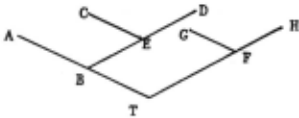
Figure 5. A Sample Tree
4.3.1 Postorder Traversal.
The input problem indicates that the branches should be MARKed in the order: A B C EDT G F H. LAWALY uses operators CLIHBLeft, CLIHBRight, and
MARK to indicate wt>.en thf branch is actually visi ted. Predicates LBR and RBR test for Left and Right BRanches. The solution is FOOOOl and the output is: (FOOOOl (LAMBDA (T) (COND ((EXISTS (B) (LBR B T)) BEGIN ((TRUE) BEGIN (HARK T) END (F00002 (LAMBDA (B) (COND ((EXISTS (E) (RBR E B)) BEGIN (CLIHBL T B) (FOOOOl B) (UNCLIHB B T) (MARK T) (F00002 T) END ) )) ) (CLIHBR B E) (FOOOOl E) (UNCLIHB E B)END))))4.3.2 Preorder Traversal.
The branches are traversed in the order: T B A E C D F G H. The same operators as before are used by LAWALY to generate the trace of the solution on the sample tree. The synthesized solution by SYN is FOOOOl and the output is: (F00002 (LAMBDA (T) (COND
((EXISTS (B) (LBR B T)) BEGIN (CLIHBL T B) (FOOOOl B) (UNCLIHB B T) (F00003 T) END ((TRUE) BEGIN END ) ))) (F00003 (LAMBDA (B) (COND ((EXISTS (E) (RBR E B)) BEGIN (CLIHBR B E) (FOOOOl E) (UNCLIMB E B) END ) ))) (FOOOOl (LAMBDA (T) (COND ((TRUE) BEGIN (tfARK T) (F00002 T) END ) )))F00002 and F00003 initiate traversal towards the left and right, respectively, and FOOOOl does the marking.
4.4 Embedded REPEAT Statements.
With a house as in Figure 6, the robot is asked to move boxes X, Y,Z and W into the HALL. She picks up one by one all the boxes in one room, moves them into the HALL and puts them down one by one, then repeats the same operations for all the rooms.
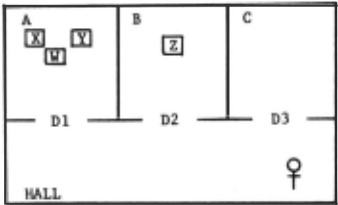
The synthesized program is FOOOOl: (FOOOOl (LAMBDA (HALL) (COND ((EXISTS (A Dl) (CONNECT HALL A Dl)(UNVISITED A)) (F00002 (LAMBDA (A) (COND BEGIN (ENTER A Dl HALL) (F00002 A) (EXIT A Dl HALL) (F00003 HALL) REPEAT END) ))) ((EXISTS (X) (INROOH X A)) BEGIN (GONEXT X A) (PICKUP X) REPEAT END) ((TRUE) BEGIN END) ))) (F00003 (LAMBDA (HALL) (COND ((EXISTS (X) (HOLDING X)) BEGilf(PUTOOWN X HALL) REPEAT .END) ((TRUE) BEGIN END) ))) F00002 does the picking up, F00003 the puttingdown. Dl, D2 and D3 are doors.
5. Conclusions
In our approach to program synthesis, a program is described implicitly by typical problems that it should solve. This description is sometimes very natural and compact, as in the case of tree traver sals, for example. We have described only a few programs among the many that SYN synthesized. The principal difficulties of the approach are tied with axiomatizations and the problem-solver, syn theses from several problems, and the question of the correctness of the resultant programs.
In all our examples, the trace was obtained by our problem-solver LAWALY. If we insist that LAWALY (and not a human) generate the trace, we can syn thesize only those programs which solve problems in a class typified by some problems that LAWALY can solve. Of course, we could always bypass LAWALY and give the trace of a solution by hand. Moreover, the trace should include the relevant operators and predicates. For example, the traces of the tree traversal algorithms must include the notions of left and right branches, and directions for climbing. The importance of a good axiomatiza tion must once again be emphasized (13) .
Until now, our syntheses all proceeded from a sim ple trace. Some programs might be so complex that no single problem would exemplify fully the class of problems to be solved. We are attempting to extend SYN to such cases.
Once the program has been synthesized, we know that it is a generalization of the trace input to SYN, but do not know whether it is "correct". To decide whether the program is correct, we must give addi tional properties of the program, besides typical problems that it should solve. The language ODBOL has a structure which would make proofs of correct ness of ODBOL programs fairly easy.
We do not think that any single approach to program synthesis is fully satisfactory. As we mentioned, the problem-solver may be too weak to solve some problems, and it might be necessary to input traces by hand. Sometimes, some aspects of the program to be synthesized are best described as properties of the program, given either in a programming lang uase or a logical calculus. Finally, the various approaches to program synthesis and correctness should be embedded in a man-machine environment be fore significant advances in the automatic produc tion of complex, quality software can be achieved.
6. References
- Kowalski, R., "Predicate Logic as Programming Language," Proc. IFIP Congress 74, Stockholm, 569-574.
- Sikl~ssy, L., "The Synthesis of Programs from their Properties, and the Insane Heuristic," Proc. Third Texas Conference on Computing Sys tems, Austin, Texas, 1974.
- Boyer, R. s., and Moore, J. S., "Proving Theo rems about LISP Programs," Third International Joint Conference on Artificial Intelligence, Palo Alto, California, 1973, 486-493.
- Waldinger, R. J., and Lee, R. C. T., "PROW: A Step Toward Automatic Program Writing," International Joint Conference on Artificial Intelligence, Washington, D.C., 1969, 241-252.
- Manna, Z., and Waldinger, R. J., "Toward Auto matic Program Synthesis," Comm. A. C. M., 14, 3, 1971, 151-164.
- Lee, R. C. T., Chang, C. L., and Waldinger, R. J., "An Improved Program-Synthesizing Algor ithm and its Correctness," Comm. A. C. M., 11· 4, 1974, 211-217.
- Buchanan, J. R. and Luckham, D. C., On Automa ting the Construction of Programs, Technical Report STAN-CS-74-433 Computer Science Depart ment, Stanford University, 1974.
- Biermann, A. w., "On the Inference of Turing Machines from Sample Computations," Artificial Intelligence, _l, 1972, 181-198.
- Biermann, A. W., Baum, R., Krishnaswamy, R., and Petry, F. E., Automatic Program Synthesis Reports, Technical Report OSU-CISRC-TR-73-6, Computer and Information Sciences Research Center, Ohio State University, October, 1973.
- Sikl~ssy, L. and Dreussi, J., "An Efficient Robot Planner which Generates its own Proced ures," Third International Joint Conference on Artificial Intelligence, Palo Alto, California, 1973, 423-430.
- Sikl&ssy L. and Roach J., "Collaborative Prob lem-Solving between Optimistic and Pessimistic Problem-Solvers," Proc. IFIP Congress 74, Stockholm, 1974, 814-817.
- I . Siklossy, L., "Procedural Learning in Worlds of Robot·s," Proc. NATO Advanced Study Insti tute on Computer Oriented Learning Processes, Bonas, France, 1974, 423-436.
- 13 . Sikl~ssy, L. and Roach, J., "Model Verifica tion and Improvement using DISPROVER," Artifi cial Intelligence, ~ 1975.
- Green, C. C., et al., Progress Report on Pro gram-Understanding Systems, Technical Report AIM-240, Computer Science, Stanford University, 1974.
- Project MAC Progress Report X, Massachusetts Institute of Technology, Cambridge, 1973, 151-156.
@inproceedings{ijcai1975p41,
  title     = {Automatic Program Synthesis from Example Problems},
  author    = {Siklóssy, Laurent and Sykas, D. A.},
  booktitle = {Proceedings of the Fourth International Joint Conference on
               Artificial Intelligence, {IJCAI-75}},
  publisher = {International Joint Conferences on Artificial Intelligence},
  editor    = {Patrick Winston and Carl Hewitt},
  pages     = {268--272},
  year      = {1975},
  note      = {Learning Debugging And Automatic Programming},
  url       = {https://ijcai.org/proceedings/1975/41},
}
TY - CPAPER TI - Automatic Program Synthesis from Example Problems AU - Siklóssy, Laurent AU - Sykas, D. A. T2 - Proceedings of the Fourth International Joint Conference on Artificial Intelligence, IJCAI-75 PB - International Joint Conferences on Artificial Intelligence PY - 1975 SP - 268 EP - 272 UR - https://ijcai.org/proceedings/1975/41 ER -Copied
Machine-readable versions of this paper, for tools and AI agents:





