
The Representation of Concepts in OWL
Proceedings of the Fourth International Joint Conference on Artificial Intelligence. Representation Of Problems and Knowledge. Pages 107-113.
© 1975 International Joint Conferences on Artificial Intelligence
Abstract
This paper discusses the theoretical basis of the for.allsa used as a foundation for OWL, a systea for representing and processing conceptual knowledge. This foraallsa atteapts to capture the expressive power of natural language by adopting the underlying representational conventions and "conceptual aodels" of English. The foraallsa is built around specialization, which ls perceived to be the key organizing principle of English at a deep conceptual level. The use of specialization in coabinatlon with another low-level structural device, reference, leads to a staple but powerful structure, the concept, which \s ideal both for the representation of a broad spectrua of conceptual knowledge and for coaputatlon on existing .achines equipped with large, high-speed, randoa-access aeaories.
- Blooafleld, L., Lugutge, Holt, Rinehart and Winston, New York, 1933, pp. 207-246.
- Fahhan, S., "Thesis Progress Report: A Systn for Representing and Using Real-World Knowledge", Meao No. 331, Artificial Intelligence Laboratory, M. I.T., C&abrldge, Mass., ~975.
- Hawkinson, L., "The OWL Forul1 sa for Conceptual Knowledge", Technical Meaorandua, Project MAC, M. I. T., Cnbrldge, Mass., 1975.
- Jesperson, 0., Aulrttc Sr•tu, Hoi t, Rinehart and Winston, New York, 1969, p. 124.
- Martin, W.A., "Conceptual Graaur", Autoaatlc Prograaaing Group Internal Meao 20, Project MAC, M. I.T., Caabridge, Mass. (subaltted to the fall 1975 aeeting of the Association for Coaputational Linguistics). 114
- Minsky, M., "A Framework for Representing Knowledge", Meao No. 306, Artificial Intelligence Laboratory, M. I.T., Caabridge, Mass., 1974.
- Moore, J. and Newell, A., "How can Merlin Understand?", In Gregg, L. (ed.); Kru•ledge and Cognttio•, Laurence Erlbaua Associates, Poto•ac, Md., 1973.
- Quill ian, R., "Seuntic Meaory", in Minsky, M. (ed.), Semtftttc lnfon.atto• Proce&&tftg, M. I.T. Press, Caabridge, Mass., 1968.
- Raphael, 8., "SIR: Seuntic lnforaation Retrieval", in Minsky, M. (ed. ), Sen•Uc lrtfonrratto• Proce&&hg, M. I. T. Press, • Ca•bridge, Mass., 1968.
- Schank, R., "Identification of Conceptualizations Underlying Natural Language", in Schank, R. and Colby, K. (eds.), COMputer Model& of r~oug~t lftd Llftf•lfl, W. H. Freeaan, San Francisco, 1973.
- Winograd, T., "Fraae Representations and the Declarative/Procedural Controversy", In Bobrow, D. and Collins, A. (eds. ), Repre&e•tation aftd U~der&ttftdt••• Acadeaic Press, New York, 1975.
References were extracted automatically from the PDF and may contain errors.
Full text extracted automatically from the PDF; figures, tables and equations may differ. The PDF is the version of record.
Introduction
OWL is a systea for representing and processing conceptual knowledge, intended for applications requiring interaction with hu.ans in natural language, at a huaan-like level of competence. Development of OWL has been proceeding for the past two years within the Automatic Programming Group of Project MAC under the direction of Williaa A. Martin. It ls his successor to an earlier systea called MAPL.
This paper discusses the theoretical basis of the OWL formalism for conceptual knowledge, which serves as a foundation for the OWL systea. The purpose of this foraalisa ls to allow conceptual (1. e. , non-imagistic) knowledge to be expressed in teras of concepts and connections between concepts; in this respect, 1t does not differ fro· such existing formallsas as Quillian's seaantic memory or Schank's Conceptual Dependency networks. It is quite different, however, in respect to details of structure, notation, and coaputer llpleaentatlon. ."mong the advantages we expect to obtain froa the OWL foraallsa are:
- despite its siapllclty and unlforalty, we expect it to be suitable for representing a broad spectrua of conceptual knowledge at all levels of abstraction and detail, ln a "natural" way;
- <2> lt provides an organizational fraaework that should allow processing tasks required for comprehension of natural language to be carried out effectively and efficiently on a serial computer;
- 1 ts organizational fraaework 1s such that its performance should not deteriorate significantly as the size of its knowledge base and the scope of its appllcabiiity increase, given an adequate amount of high-speed, randoa-access aeaory;
THE REPRESENTATION OF CONCEPTS IN OWL
Lowell Hawkinson
Pro~ect MAC Massachusetts Institute of Technoloay Caabrldge, Massachusetts
- the notation for lt will be easy for English speakers to learn and use; and
- its structures and notation are especially effective for dealing with very large knowledge bases.
There are several distinct aspects of the OWL formalisa which we aight exaalne. This paper focuses prlaarlly on the structural aspect, but also looks briefly at the notational, English, and operational (1. e. lapleaentatlon) aspects. For further description of the foraallsa, see Martin and Hawkinson.
To have any reasonable chance of realizing our goals for OWL ln the near future, we have felt lt wise to structure knowledge ln OWL ln accordance with the principles of organization of the huaan cognitive systea, insofar as we understand thea, even though the continual advance of our understanding aandates continual evolution of the OWL foraallsa. Since auch of the slgnlflcant evidence we have of this organization derives fro· our understanding of the structure of natural language, we have tried to use those linguistic insights to develop a formalisa that would capture the expressive power of natural language without sacrlflclng computational efficiency. We felt we could succeed ln this only by adhering as closely as possible to the representational conventions and conceptual aodels of one particular natural language, English, even for the representation of "deep-level" structures, i.e., structures at the level of Schank's Conceptual Dependency networks or Minsky's fraaes. An obvious advantage of a foraalisa based on the structure of English is that translation back and forth between lt and English alght be done with relative ease; this ls important not only for the OWL system as ultimately developed, but for the development process itself.
We do not yet know enough about the structure of English to have a definitive blueprint for our OWL foraallsm. We have had, ln fact, to decide among competing alternative solutions to a host of representational probleas by applying principles of econoaical system design -- being careful, however, not to coapromlse our primary guideline of choosing representations that are readily aappable into English and vice versa. The structural organization we have arrived at as a result of our design efforts seems so staple and natural, and the evidence for its pervasive use throughout natural language seems so lntultlvely convincing, that we feel lt must hold profound implications for psychological aodels of human cogni tlon. For example, 1t aight be used as the basts for a strongly predictive model of word phrase association.
Though the OWL formalisa has been implemented ln LISP, OWL does not ln fact adopt or build upon LISP's model of how data should be structured, na11ely, in terms of tree-like list structures and property lists of atomic symbols. Rather, the OWL formalism provides an alternative scheme for the low-level ("sub-frame"> structuring of knowledge (hence data) that is, I believe, as fundaaental in character as that provided by LISP. This foraallsm aight prove a suitable foundation not only for the OWL system, but also for other high level systeas ll~e Moore and Newell's Merlin or any of the recently proposed "fraae" systeas.
The Theoretical Basis for the OWL Foraalisa
In developing the OWL foraallsa for conceptual knowledge, the first big issue that confronted us was how to classify and "index" the enoraous nuaber of concepts OWL would need for human-like coapetence in natural language. We started with three fundamental principles:
- that essentially all conceptual knowledge should be represented in teras of a unifora, siaple "building block", which we call a concept;
- <2> that the set of all concepts should be arranged into a single conceptual taxonoay (concept tree) in such a way that individual concepts would "inherit" fro· superior concepts ·ost of their properties, especially "·eta properties" that indicate what to do with concepts 111 various interpretive contexts;
- that the vast bulk of the conceptual taxonomy should be deterained "derivatively", so that a few tens of thousands of individual classification decisions aight suffice to deteralne a conceptual taxonoay containing allllons of concepts.
Alaost a corollary of the second principle is that the concept tree should have a low, relatively unifora "fan-out" <where alaost all concepts have fewe~ than, say, ten iaaediate subconcepts), since it is unreasonable to expect a concept to inherit aost of 1 ts properties froa concepts slgnlflcant.ly aore general than it. A low, relatively unifora fan-out also offers laportant structural and co·putational advantages.
We adopted these fundaaental principles primarily because we judged that a foraallsa based upon thea would simplify the ttsk of building a large OWL knowledge base just enough to aake that task feasible. However, we would not be surprised to find that th~se principles were also fundamental to the organization of huaan conceptual aeaory, which, after all, aust acquire and aalntaln an even larger knowledge base.
Underlying the OWL foraallsa for conceptual knowledge, and hence the structure of a concept, are two basic structural devices: specialization and reference. Properly utilized, these devices peralt the formalism to satisfy our three fundaaental principles, and they also give it great expressive power and characteristics that aake it efficient to work with. (To elialnate a possible source of confusion, note that when we speak of the structure of a concept, we understand it to be located at soae one fixed place within a particular copy of a particular knowledae base, though it may be referred to in any nuaber of places.)
Specialization
Specialization is a means for identifying a concept unlquel y by a pal r of entities: the concept · s genus, a super lor concept l.n the concept tree, and its specializer, most often also a concept.* Every concept in OWL aust, in fact, be identified by specialization, and thus a concept is often itself referred to as a specialization (of its genus). The significance, if any, of a concept's speclalizer cannot be deterained according to a few simple, set rules; indeed, it aay be arbitrary, though it typically depends on some generalization of the concept at or near the level of the genus.
The fact that every concept aust have exactly one genus does not aean that a concept cannot be "a kind of" more than one thing. Actually, as we shall later see, a concept can have any nuaber of distinct characterizations. This aeans that a genus could be viewed as siaply a characterization singled out to provide identification for and primary classification of a concept. The choice of a genus is nevertheless very iaportant, since in practice, most low-level interpretive decisions as to what to do with a given concept aust, for reasons of serial proce.sslng efficiency, depend on its genus alone. Fortunately, as we will demonstrate below for English, a natural language expresses many concepts in terms of an appropriate genus and speciallzer, and aost of the rest can be determined through the use of staple, productive, language-speCific rules. Only a relatively sull number of hard choices reaain for the conceptual taxonoaist, but it is iaportant that be make thea wisely (though on philosophical grounds, it seeas unlikely that there is one true conceptual taxonomy),
Specialization is directly evident in natural language; in fact, I believe it to be the aost laportant technique of signification (concept identification> within natural language . . Let us look at some English phrases that identify concepts by aeans of specialization. In our examples below, we will underscore the part of each phrase that identifies the genus. The rest of each phrase, alnus staple connectives like "of", "as", "than", and soaetiaes "to", "for", and "in", identifies the speclallzer (only because we have deliberately excluded extraneous aodlflers, such as leading articles, that apply to the phrase as a whole). Of course, a genus or a speciallzer can itself be a specialization.
h!!. the ball, hittina the ball
~ a book, ~ a job, ~ to go, ~ lost, ~ wet, ~ up
look up the name, put off ay decision
*It bas been observed that the tera speclalizer can be aisunderstood by persons who are just becoming familiar with OWL terminology. It should be understood to mean "that component of a concept which makes it special" or "that coaponent of a concept which aakes it a particular specialization of the genus", 1ot as "that which produces the specializations of a concept".
&Q by bus, want hia to know
flower garden, garden flower (Jespersen)
co·puter sales, August sales, sales increase
sales of computers, sales for August, --increa!'e in sales, sales in dollars, lli ir.size
glass of ailk, £!rr of beans, !!! of us
robins' nests, John's father, John's being late
left hand, capital letter, passenger tl re
black tie (but not blue tie)
Fri!!!r, sell~ want!!!&.. wanted
sky blue, dead wrong, easy to read
~ for a cat, ~ than an elephant, less than 3
in the house, in June in trouble, -- 1rr toto, in stock~in good faith
in back of the bus, !rr the back of the bus
~ of the block, let the block go
Let us now generalize froa soae of these sa·ple phrases in terms of parts of speech, ignoring for now the possibility of exceptional cases.
verb direct object
verb infinitive, verb adjective, -- verb partlcle<iireposi tlon)
verb secondary clause
noun nominal, nominal "of" noainal, gen 1 t 1 ve nomi.nal
adjective infinitive, noun adjective
"as" adjective "as" nominal
preposition nominal, stea suffix
What criteria have we used here to recognize an English phrase as a specialization? First, the phrase must be meaningful as a concept, the test for which is that the phrase as a whole aust denote something that could be further described. Secondly, the phrase must have a sub-phrase which one can say the whole phrase is "a kind of", though perhaps only in some very abstract sense (e. g., "in trouble" is a kind of "in" only in so·e abstract sense of the word "in">; the aaxlmal such sub-phrase <e. g., "on top" rather than "on" in the phrase "on top of the table") identifies the genus of the phrase. Thirdly, the phrase must contain another sub-phrase which, when properly interpreted in context, combines with the genus to identify, independent of the context, the concept
represented by the phrase as a whole; this other sub-phrase, if it exists, is the speciallzer. A couple of exaaples should help to clarify this last crl terion. The phrase "the red book", though it satisfies the first two criteria, does not satisfy the third, since neither "the" nor "red" nor "the red" combines with genus "book" to unambiguously identify, independent of context, the book being referred to. The phrase "·Y father" on the other hand, would be a specialization since it has a genus, identified by "father", and a speclallzer, the referent of "·Y" (presumably determinable from context), which together identify the concept (though not necessarily tt& referent) uniquely without need of context. A useful diagnostic for English phrases that are specializations is that, in most cases, both the genus and specializer will carry stress, with the stress on the specializer at lea&t as strong as that on the genus (when no word in the phrase is being stressed for the sake of e·phasis).
In actuality, a large proportion of English grammatical constructions may be treated as particular forms of specialization, that is, different syntactic patterns that all do basically the same thing, namely, identify a concept by specifying its genus and specla.llzer. Analyzing English constructions as specializations, where possible, often obviates their analysis in teras of traditional grammatical categories, such as parts o( speech. Where it is possible to analyze an English phrase as a specialization that "aatches" a "sufficiently specific" concept in the knowledge base, there is no real need to also
match it to some ·ore abstract graaaar rule.
Indeed, if we view the genus, specializer, and syntactic properties of each generic concept in an OWL knowledge base as a grammar rule, we can envision a conceptual grammar which, for a large knowledge base, could easily include hundreds of thousands of such rules. In a conceptual graaur, idioms would be rules, not exceptions to rules. A conceptual grammar acknowledges and emphasizes the essentially idiomatic character, at every level, of natural language as used, whereas traditional grammars have tended aore to eaphasize the essential regularities that can be abstracted froa instances of its use. From our point of view, in fact, the principal goal of a traditional grammarian is to approximate a large conceptual grammar by a grammar of relatively few rules expressed in some particular formalisa, a task of immense difficulty. Tradl tional grammars, even if they could be realized, would not be as satisfactory for OWL as a more straightforward conceptual grammar. Because most of what is needed for a conceptual grammar is already required to be in the knowledge base for purposes of conceptual aodeling, it would alaost certainly be less work to create a conceptual grammar for a large knowledge base than to program the aapping between OWL conceptual structures and structures produced by a parser for some traditional graaaar.
Thus far, we have analysed as particular forms of specialization only those English words and phrases wherein both genus and specializer are manifest. However, for the sake of uniformity, we would like to treat monomorphemlc words as specializations and also aany specific phrases and constructions that fall to express either the genus or the speclalizer or both. Thus, we
typically treat the concept corresponding to a aonoaorpheaic wo:·d as soae appropriate genus specialized by the written syabol for that word, e.g., the concept spider as the concept insect specialized by "spider." Non-word aorpheaes, such as "-ing", are treated siailarly. We call such concepts syabol aeanings. (Concepts specialized by concepts, on the other hand, are said to be classified; in this case, the specializer aay be referred to as a classifier.) An idioaatic concept like "hot dog" is dealt with in a way that is soaewhat analogous to the treataent of syabol aeanings; in particular, "hot dog" is treated as the concept sandwich specialized by the concept consisting of concept dog specialized by concept hot. <Note that there is another aeaning of "hot dog· that would require the concept skier in place of the concept sandwich.) Mor~ generally, we have observed a diachronic tendency for concepts to becoae identified in English by their specializers, e.g. "capital letter" by "capital" and "New York City" by "New York", where both foras are in coaaon use, and "general officer" by "general", where the first fora (the one revealing the genus) is now archaic. As Martin points out, this tendency to identify a concept by its specializer is just a special case of the widespread, aore general phenoaenon in English of a concept being identified (naaed) by soae other, usually "closely related" concept.
We could continue to exhibit here successively more elaborate foras of specialization, but that would take us beyond the scope of this paper and into Martin's paper, which presents a far more comprehensive theory of English. As it is, our treataent abov.e of "spider" and "hot dog" cannot be argued here to be anything more than conventional; a deeper justification could not possibly be given without that more comprehensive theory.
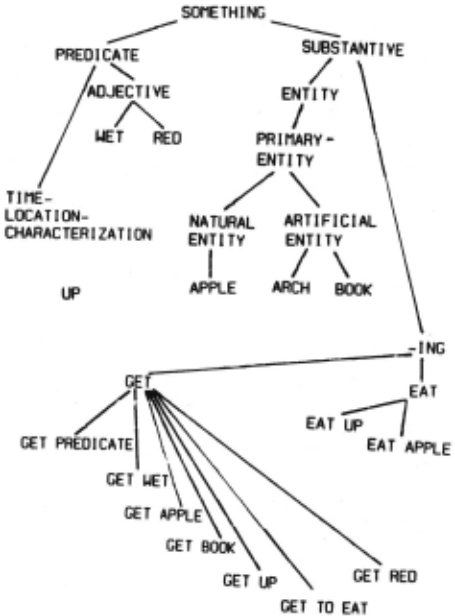
We have defined and discussed specialization as a means for ideRtifging concepts, but specialization may be equally viewed as a aeans for cla&&t!ving concepts. Bot~ the genus and specializer of a concept contribute to that concept's classification. The contribution of the genus is readily apparent -- the gross structure of the concept tree can, in fact, be defined as the set of all mappings fro· concepts to their genuses (or, alternatively, fro· concepts to their specializations). This gross structure is then further refined by aaking use of the specializers, a process known as derivative subclassification. The rule for derivative subclassification of concepts by their specializers aay be stated, soaewhat imprecisely, as follows: subclassify the specializations of a concept as their specializers are classified.
An illustration will serve to clarify the meaning of derivative subclassification. Figure 1 shows the gross structure of a tiny concept tree (or a tiny extract froa a large concept tree - the analysis applies in both cases). Figure 2 shows that same structure refined by derivative subclassification, i.e., the fine structure of the tree. Notice that new generic concepts have been introduced into the tree such that, for every pair of classified specializations that share a coaaon genus, say 11 specialized by & 1 and &2, there will exist a corresponding specialization of 1 by the aost specific comaon superior of s1 and &2, except when that superior is the suaaua aenus "something". Thus, for instance, concepts "get adjective" and "get substantive" are introduced, but "get entity" and "get natural-entity" are left out (although one or both could later be introduced either directly or in consequence of other newly formed specializations of "get").
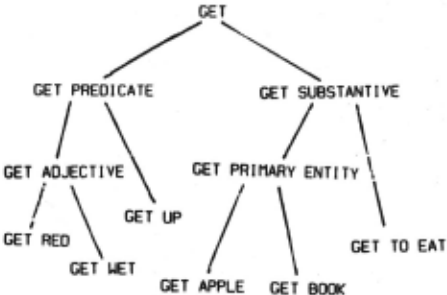
To facilitate further discussion of the fine structure of a derivatively subclassified concept tree, we need to define a few additional teras. To begin with, we will define the tera generalizer to be the laaedlate superior of a concept ln a derivatively subclassified concept tree. Thus, the generalizer of "get book" in the concept tree of Figure 2 would be "get primary-entity". Note that, unlike the genus, the generalizer of a concept aay change as new concepts are introduced into the concept tree. The generalization path of a concept is the sequence of concepts encountered in moving from it to the summua genus by successively taking the generalizer at each step. Again with reference to Figure 2, the generalization path of "get wet" would consist of "get adjective", "get predicate", "get", "-ing", "substantive", and finally "something". The generalization path of a concept is the priaary path along which properties are inherited; we would therefore expect "get wet", for instance, to inherit certain of the properties of "get adjective", "get predicate", etc. (Soae properties are not inherited by inferior concepts because they are contradicted at lower levels or because they are specifically known not to apply beyond a certain depth). We will use the tera conceptual model to refer to a concept and all its subconcepts. Thus, in the concept tree of Figure 2, there is a conceptual aodel for "get", which consists of "get" and the subtree beneath it, together with whatever aight be attached thereto. Finally, generic subconcepts in a conceptual aodel are said to be ~ of the concept at the top of the model. Hence, "get adjective" and "get substance" could be described as senses of "get".
What is the significance of using a derivatively subclassified concept tree? First of all, if we were to have a conceptual taxonoay with tens of aillions of concepts (which we would surely need to approach a huaan level of competence in natural language), we aight expect derivative subclassification to account for at least 99' of the classt"ficatlon decisions required to build that taxonoay. Secondly, if, when building our taxono·y, we contrive to put a liait (say ten) on the nuaber of .Sfllbol .euillf specializations a concept aay have, then that saae liait can be shown to hold for the nuaber of iamediate cla.s.stfted specializations any concept could possibly have. Thus, we can easily arrange to get a concept tree whose fan-out at any given node is strictly liaited. Thirdly, if we put into our concept tree a representative sample of the specializations of a particular concept (as they occur in ordinary use of the lsnguage), derivative subclassification will provide us with a useful and intuitively reasonable set of senses of that concept to attar.h inheritable properties to. Thus, if our sample of the specializations of "have" includes, say, "have a tail", "have four legs", and "have a top", where "tail", "legs", and "top", are already classified as "parts", then derivative subclassification will give us the sense "have as part", which, as the head of an important ~onceptual submodel of "have", will carry many inheritable properties. (The question of how we might automaticallg derive properties for "have as part" from its inferior concepts is interesting, but beyond the scope of this paper.) Note that just because a concept like "have a tail" is a subconcept of "have as part", there is no need to explicitly spell out "have as part" when expressing "have a tail" In a foraal notation, any more than there is a need to do so when expressing it in English. In fact, we might go so far as to say that a rule of derivative subclassification is necessary in a very large, finely subdivided taxonomy to allow economical identification (naaing) of concepts within it. Finally and in sua, derivative subclassification furnishes the aeans for satisfying the three fundamental principles proposed near the beginning of this paper.
Reference
Reference, the second of the two basic structural devices of OWL, is the aeans by which one concept or symbol aay refer to another. By the tera reference, we are trying to suggest the general function of a connection that is syabolic (non-physical), unidirectional, precisely definable, and differentiated only as to function (not, say, by a label on the connection); these important properties of reference are not conveyed well by such teras as "pointer", "association", or "associative link". The most important computational property of references is that the references under a concept or sy·bol (to other concepts or syabols) may be accessed trivially fro· it. In fact, a concept aay be thouaht of as being coaposed entirely of references, arranaed 1n an orderly way. (A syabol has a spelling in addition to references).
We distinguish three categories of reference: the generalizer and specializer of a concept, indexing, and description. Except for generalizer and speclalizer references, which are recognized by where they appear in a concept's structure, the category of a reference may be deterained solely by inspection of the referent (the concept referred to). Of course, in an actual computer iaplementation, we might use a aore elaborate structure for a concept than is strictly necessary, so that we can categorize a reference or retrieve all references of a particular category aore rapidly than by inspection of the referent. It is well to be awure, thouah, that such elaborations of structure are not theoretically activated or required.
Indexing in OWL is a category of reference used to connect (1) any concept to its iaaediate specializations, (2) any concept to all concepts specialized by it, or (3) any sy·bol to its syabol meanings. Thus, with indexing, it is easy (computationally) to go from the syabol "spider" to the concept spider, and from there to specializations like red spider and black widow spider, and also to concepts classified (specialized) by spider, such as spider web, spider monkey, and spidery. An Index reference can be recognized as such by the fact that the concept or symbol it ls under will appear as either the generalizer or the specializer of the referent. Thus, a reference to spider web under spider would be identified as an Index reference by the fact that spider ls the specializer of spider web. Note that Index references under a concept c are sometimes called "back pointers"
because they "point back at" concepts whose generalizer or specializer "points at" c.
There is one unresolved proble· with index references of type (2) above. Whereas index references of types (1) and (3) are li·ited in number by derivative subclassification and by the low level of ·orpheaic a·blguity in English, respectively, tl'!ere will exist in the knowledge base ·any concepts having hundreds of index references of type (2), e.g., the concept house. This goes against a principle we would like to be able to adhere to, namely, that the nu·ber of references under any one concept should never significantly exceed,. say, twenty. The likely solution to this proble· is a second for· of derivative subclassification to subclassify all the concepts specialized by a given concept. However, we have ,,,, t yet adopted such a solution, in part because it turns out to be unsatisfactory to use the obvious counterpart of the rule for derivative subclassification of the concept tree.
Description Is a broad category of reference that, by definition, includes every reference not used for indexing or for the generalizer or specializer of a concept. The ter· description is nonetheless quite appropriate, since individual descriptive r~ferences (or descriptors) can al·ost always be said to describe the concept they're under (the subject of the description). We will distinguish here, on functional grounds, two principal types of descriptive reference, na·ely characterizations and aodifiers, each with nu·erous subtypes. But we wi 11 side-step, for now, the difficult proble· of providing effective criteria (tests) for such distinctions, relying instead on illustrative exa·ples and on the noraal English meanings of the ter·s we have chosen for the types and subtypes.
A characterization is an alternative, partial description of a concept (the subject of the characterization). For exuple., a particular dog aight be characterized as follows: a nuisance (abstract characterization), Mary's pet and Fido's father <relational characterizations), a good swiaaer (skill characterization), a chaser of cars (habitual role), and the dog who ran across our yard yesterday (event participant).
Relational characterizations deserve special note. In OWL, a relationship 1 It b Is represented by a two-way characterization: 1 as a value characterization under R specialized by~nd It specialized by bas a relational characterization under 1. Thus, for Instance, "Ellen is the .other of Sa·" would be represented by the value characterization "Ellen" under "Sa·'s aother" in conjunction with the relational characterization "Saa's ·other" under "Ellen". Seaantic case relationships such as "New York was the location of the de·onstratlon" and arlth·etic relationships such as "5 is greater than 3" would be handled in an analogous way. This co·poslte technique for representing relationships, which has been borrowed directly fro· English, offers at least two iaportant advantages over the traditional logical for·ulation widely used as the basic connec t1 ve link in se·antic networks. First, specialization of the relation by one of its arguaents produces a conceptual ·odel for the relation; such a conceptual ·odel serves as an effective fra·ework for organizing knowledge of specialized uses of the relation. For exa·ple, the conceptual model of "father" aight be expected to include the senses "father of a person", "father of a country", "father of a science", and "father of a bride", each appropriately described. Second, whenever there are relationships that are Identical except for their value argu·ents, the set of distinct value arguments will be automatically grouped as value characterizations under the shared relational characterization. Thus, if Mary has both a dog and a cat, they would both appear as value characterizations under "Mary's pets". We ·lght also point out here that OWL does not represent reversible relationships canonically, e. g., "the elephant is bigger than the ·ouse" would be represented differently fro· "the mouse is s·aller than the elephant"; huaans also see· not to canonicalize such relationships.
A ·odifier is any descriptor not dee·ed to be a characterization of its subject. Typical ·odifiers are: "black" (property), "actual" (feature), "the" (deteniner), "all" (quantifier>, and "In the box" (location). Note that so·etiaes the dividing line between ·odifier subtypes is not sharp (e.g., between properties and features).
A descriptor that is often applied to a particular concept tends to beco·e a speciallzer of that concept. For exa·ple, "fat ·an" is specialized by a ·odlfler ("fat") and "father figure" by a characterization <"father"). A concept specialized by a descriptor Is usually aore specialized in aeaning than if that descriptor was acting oftlU as a descriptor; thus, not every black bird Is a blackbird, nor is every round house a roundhouse.
An l·portant transfor·ation in OWL, again a reflection of a siailar transforaaton in English, Is the conceptualization of a description to produce a predication. (We use the ter· predication here in the classical sense of a predicate applied to, 1. e., specialized by, so·e subject). A description (descriptor under so·e subject) is transfor·ed Into a predication as follows: first, the predicate is foned as a specialization of "being" (the copula) by the descriptor; then, that predicate Is specialized by the descriptor's subject to give the predication. The reason for conceptualizing <·aklng a concept out of) a description Is so that the description can Itself be described, specialized, or otherwise used as a concept. In linguistic ter·inology, both the process of conceptualization and the resulting predication would be referred to as nominalization. An exa·ple of a predication in English Is the phrase "John's being happy", which we have already used above as an exa·ple of specialization.
The Structure of the Knowledge Base
All knowledge in an OWL-based syste· Is held In a single, large, unified knowledge base of concepts and symbols, except for a rather saall though important amount embedded in LISP and ·achlne language programs and their associated data structures. This knowledge base is not structurally partitioned by subject ·atter, by peraanence <long-tera vs. "inter·edlate-ter·">, by type of concept (se·antlc vs. episodic, Individual vs. generic), or by level of abstraction <surface language vs. prl·ltive action, for exa·ple), although obviously such distinctions ·ust often be inferrable by inspection of individual concepts. There is even no separate lexicon -- knowledge about English words and grammar is distributed throughout the knowledge base and is essential to its organization.
All of the following terms are virtual synonyms of knowledge base: world model, semantic network, Knowledge Net (a Merlin term>, conceptual data base, conceptual memory, conceptual grammar, conceptual taxonomy, and concept tree. The ter·s conceptual taxonomy and concept tree do not encompass symbols, but then symbols play only a minor role in the knowledge baje. Sy·bols correspond to English words and morphemes and contribute no more to the knowledge base than do the spellings of words to the content of a book. Essentially the entire body of knowledge is represented in terms of concepts.
When OWL structures are modeled in terms of LISP data structures, a concept is typically represented by a list of its constituent refetences, where the first two list elements are the generalizer and specializer, respectively. A symbol is represented by the ato·ic sy·bol whose "pname" shares its spelling, and the references under the symbol appear on a list carried as the value of a property of the atomic symbol.
Relation to Other Work
Various uses of specialization, especially for compounds, have long been recognized by grammarians. Bloomfield, for example, discusses how the meanings of various kinds of compounds depend on the meanings of their constituent parts, thereby illustrating many of the properties of specialization. (He also compares his classes of compounds to similar classes used by Sanskrit scholars over two thousand years ago). Jespersen saw the "specializing power" of a modifying phrase (one of the lower "rank"), noting that "the object serves to make the meaning of a verb more special". However, no one appears to have understood the universality of specialization as a means for identifying and classifying concepts expressible in natural language, even though binomial systems of nom.enclature have been used to identify and classify biological species ever since Linnaeus introduced the first such system in 1753.
Conceptual taxonomies ("hierarchies of knowledge") are of classical origin. Raphael was perhaps the first person to consider using a conceptual ta~onomy as part of a computer syste· interacting with a user in English. He rejected it, however, on pragmatic grounds, citing the complexity of the required structure and the difficulty of producing a "useful" taxonomy. During ·that same period, Quillian made a serious attempt to design a model suitable for a large semantic memory, but his organizing principles were too weak and his structure was connected in too ad hoc a fashion to be effective In dealing with knowledge on a large scale. There has only recently been a revival of interest in using large conceptual hierarchies, triggered primarily by disenchantment with the poor efficiency and non intuitive functioning of systems using logic-based rules of i.nference. <Inheritance of properties, which is primarily what hierarchies are good for, is probably the simplest and most "natural" rule of inference). However, the hierarchical structures proposed by Moore and Newell, Winograd, and Fahlman permit concepts to belong to any number of classes, none of which is particularly favored, whereas in OWL each concept is considered to belong to only one class <Its genus), though it may have any number of characterizations <each itself a distinct concept). The OWL use of hierarchy is superior if a genus can be readily chosen for each concept and If inheritance of properties along the generalization path of a concept is often sufficient for ·aking low-level decision as to what to do with that concept.
To the best of my knowledge, the closest relative of the OWL formalism for conceptual knowledge is found in the Merlin system of Moore and Newell. As a prelude to making comparisons between these two formalisms, let us tabulate corresponding tens:
Merlin
knowledge base conceptual taxonomy concept genus description characterization Knowledge Net hierarchy of knowledge p-structure scheu component alternate view
Note first that in Merlin there is no equivalent of specialization as an essent:al aspect of every concept in the knowledge base. Thus Merlin has no universal means of concept identification (aside from full specification of the sche·a and all components) and no fine structuring of the concept tree through derivative subclassification. <Actually, genus-specializer identification of concepts can be found among samples of Merlin p structures, e.g., [EYES BLUE) and [TASK LOGIC), although other p-structures of a similar form, e. g., [AUTHOR NEWELL-S IMON-SHAWJ and ( + 3), do not follow the same (genus specializer) paradigm, at least according to OWL's English-based criteria for what constitutes a specialization). Second, each alternate view of a p-structure can adequately represent it as a principal view, whereas a characterization of an OWL concept is an entirely separate concept that need be only a partial description and which could be the characterization of any number of other concepts. Mapping among alternative characterizations is not a fundamental operation in OWL as it is in Merlin. Thirdly, OWL represents essentially all knowledge as concepts in a single, unified knowledge base, whereas Merlin uses a separate formalism for expressing procedures (actions), which are, however, attached to and considered part of the Knowledge Net. Neither OWL nor Merlin makes a basic structural distinction between individuals and generics.
Acknowledgeaents
I would like to thank ay colleagues Gretchen Brown, Suzanne Hawkinson, Williaa Long, and Alex Sunguroff for their valuable suggestions and criticisa, and especially Willlaa A. Martin, whose work In the area of natural language originally led to and then later extended the theory reported herein.
This work has been supported In part by the Defense Advanced Research Projects Agency work order 2095, under Navy Contract IN0014-75-C-0661.
@inproceedings{ijcai1975p17,
  title     = {The Representation of Concepts in OWL},
  author    = {Hawkinson, L.},
  booktitle = {Proceedings of the Fourth International Joint Conference on
               Artificial Intelligence, {IJCAI-75}},
  publisher = {International Joint Conferences on Artificial Intelligence},
  editor    = {Patrick Winston and Carl Hewitt},
  pages     = {107--113},
  year      = {1975},
  note      = {Representation Of Problems and Knowledge},
  url       = {https://ijcai.org/proceedings/1975/17},
}
TY - CPAPER TI - The Representation of Concepts in OWL AU - Hawkinson, L. T2 - Proceedings of the Fourth International Joint Conference on Artificial Intelligence, IJCAI-75 PB - International Joint Conferences on Artificial Intelligence PY - 1975 SP - 107 EP - 113 UR - https://ijcai.org/proceedings/1975/17 ER -Copied
Machine-readable versions of this paper, for tools and AI agents:





