
Toward a State Based Conceptual Representation
Proceedings of the Fourth International Joint Conference on Artificial Intelligence. Representation Of Problems and Knowledge. Pages 83-89.
© 1975 International Joint Conferences on Artificial Intelligence
Abstract
This paper discussas rapresenta t ions of seeantic inforeation d~rivP.d froe these of Scllank (1972, 1973), Wilks (197Ja, 197Jb, 1973c), and Schank et al. (1973). A critic•l r.?viev of th"ir relAtEd arproachdS is given that ShOVS representational in4dequacies for language coepreh~nsion in their theories. ~ore gen~rally, various probl~•s in representing knovledg~ arinvestigated and edthods suqgest~d for handling so•of thee. Thes& probl~•s concern the r ~ presentation of states, ~•ents, ~ctions, and cas~s, as v~ll as the handling of logical and natural language quantifiers, adve=bials, fuzzin ~ ss, and the eeanings of coeflex concepts.
- Bartsch, B., and 'ennesann, T. (1972). ~!llS1£ ~!,YS1Y~Li• Athenaua Verlag, Frankfurt, Geraany.
- Evans, c. (1967). "States, Activitie•, anJ Perforaances•, Australasian Journal of Philosophy, 45, FP 293-308.
- Fodor, J. (1972). "Troubles About Acticns•, in ~!UJil.i,!; §..
- !J.!.1.11.ULJ.!.!l.!l!!~.!l:t• D. Davidscn and c. Haraan (ads), D. Reidel Publishing Coapany, Boston, ftassachusetts
- Katz, J. and Fodor, J. (19611). "The Structur~ of Seaantic Theory•, in lh2-~liY£1Y~21-J.!t9Y!g!, J. Fodor and J. Katz (eds), Prentice-Hall, Englewood Cliffs, New Jerser.
- Lakoff, c. (1972). "Linguistics and llatural Loqic•, in §U!.O!i,!; §_.2!_l!ll.!!ill.J~~. D. Davidson and c. Haraan (eds), D. Peidel Publishinq Coapany, Bostcn, ftassachusetts ftcCarthy, J. and Hayes, P. (1969). •soae Philosophical Proble•s fro• th~ Standfoint of Artificial Intelliqence", in ~achinLll!..t!:Jl!.li.!lll£.
- • B. fteltzcr and D. ftichie (eds), American Els c; vi"r Publishinq Co•Fany, New York, New York.
- ftinsky, n. (19711). "A frao~work for Representinq Knovled9e", Artificial Intelliq~nce Ke•o ~o. l06, A. I. Laboratory, "IT, Cambridge, ftassachusPtts.
- ftontaque, R. (1970). ••ne Proper Tr£atm~nt of Quantification in Ordinary !nlli&h", Departm~nt uf Philosophy, Univ~rsity of California, Los Anqul•n, Cali torn h.
- llontaque, R. pg72). "Praqe.ttics and Intensional Loqic", in ~~!!nli~~-21-M~1~!1-~A9~~~.
- D. Davidson and G, Uar•an (ed~), o. R~id~l rublishing Coapany, Bostcn, ~arsachu sP tts Ouin~, v., (1'l60) • .!!21:Ull!L~!.• lilT Prt>ss, Ca•bridqe, ~~~~sachusetts.
- Rosser, J,, and '!'urquett .. , A. (1952) • .I!.U!.I.:..!.ll.!!f~ 12~1£~, Aest~rda•, North Helland.
- Schank, R, (1~72). "Concd~tu.tl D~pendency: A Theory of N.ltural Lanquaqe Understanding•, Cognithe Psychology, v 3, fP 552-631,
- Schank, R. (1973). "Identiticaticn of Conceptualiz.lticns Underlying Natural Lan~uag~". in ~.!£ll.ll!_.!!~~.l.L9.L1.!J.IU!!lh.!..J..!!.LU.Il.!l.l'i!~, R.
References were extracted automatically from the PDF and may contain errors.
Full text extracted automatically from the PDF; figures, tables and equations may differ. The PDF is the version of record.
TOIIARD l STATE DASED CONCEPl'UAL RF.PRESt:NTATlOM
Nick CP.rconq and Len Schubert
Departe~nt of Coeputing Science University of Alberta !deonton, Alb~rta, Canada
This paper discussas rapresenta t ions of seeantic inforeation d~rivP.d froe these of Scllank (1972, 1973), Wilks (197Ja, 197Jb, 1973c), and Schank et al. (1973). A critic·l r.?viev of th"ir relAtEd arproachdS is given that ShOVS representational in4dequacies for language coepreh~nsion in their theories. ~ore gen~rally, various probl~·s in representing knovledg~ ar~ investigated and edthods suqgest~d for handling so·~ of thee. Thes& probl~·s concern the r ~presentation of states, ~·ents, ~ctions, and cas~s, as v~ll as the handling of logical and natural language quantifiers, adve=bials, fuzzin~ ss, and the eeanings of coeflex concepts.
I. UTRODUCTION
The Rii·a fa~ appeal of eany natural languag~ understanding ~ystees dieinishes und ~ r close &crutiny. ~nis is due in part to a lack of d~tailed consideration of eany classas of problees ir.herant in languag~ understanding. Oftent i~es an existing theory cannot b~ augaented to account for a nev class of problees. 7hus the original theory eust be restructured or replaced.
To facilitate the fornlation of a general theory of natural languaga und c rs ~ anding, a representational scbeaa is =eyuired that bas sufficient erp=essive pov~r to r~pres~nt th~ ae3ning content of orc!ir.ary languag-.. :'his "ntails eakinq eractly those predic~ions and infarences fro· th ~ representation of an uttarance that can b~ aadP froa the ori<Jinal utt.?rance. The following is a deYeloF·~nt of so·~ ideas concerninq th~ representation cf indiYidual itees of "factual knovledg~" in a coaputer, vhere this knowledge is thought of as being conveyed to the ccaputer in natural language.
Th9 next section enumerates vhat ve bElieve to be t h'! advanta<,~es of tvo relat"d approaches to th t> problea of r'>presenting natural ldnquaqe in t~rms of aeaning structures. These approach~s are thos~ of Schank (1972, 1973), Wilks (1973a, 1973b, 1973c), and Schank et al. (1973). We believ~ thEir vo~k ereeplifi ~s the correct approach to th~ ftobl~· of repreEenting the conceptual content of natural language utterances.
Subsequent sections outline several difficulties vith Schank's and Wilks' theoLi~s. These difficulti~s ccncern th~ representation of states, e·ents, actioon , and cases, as vell as th ~ handling of lngical and natural languag~ quantifiqrs, ad·erbials, rE'f<'rt>ntial opac i ty, fuzzingss, and tbe aeanings of coepler conc·pts,
II, TWO RELATED APPROACHES
The conceptual d~pendency approach of Schank and the preference s~ aantics app~oach of Wilks h~vt> the fclloving d~sirable features regarding knovl~ dqe representation. These f~atures have not all been articulatqd by eithP.r Schank or Wilks and they vould perhaps dispute this characterization of th~ir respective approaches.
(i) .!AUU~.ti!!L~.iU.tlr~ru!
the ~eanifi~ s~ruc~u;es ~or~cspor.dir.~ to natural lanqua<,~~ utt e r~nccs are for~8 d accordin~ to £i·pl~ structur4l rula5. Poverful h~uristic criteria, based on the central role oi ·erbs and on preferred seeantic cat~qories for the subjects and objects of verbs, guid e E'ach c~oic· in the cr~~tion of ·~aninq 3 ttuctur~s. Interpretation of utterancas thwn takrs on a "slct and fill q r" Chdrac':~r, L·utht ~ r than requiring erte nsiv~ trial and error ~ ~arch.
Section 2: Representation of Problems and Knowledge
(iil ~~·~§~-~1~~nl4~
in ordin4ry discour ,;·· it vould be absurd not to 4CC~pt "unqrt : a4tical" conn~ructions ~uch ~ D danglinq participld~ or fduciful locutionn such as eetaphor. Neith~r pr~ter , nce s~a4ntics nor conceptual deFendcncy iopose a syntactic "strai<jhtjacket· on adaissibl~ utt~rancP.s. Therefore th~ abnora4l is not axclud9d as it is in aany linguistic systeas.·
(iii) l!l!l!illJ!_Q.D...ll!Ul!.§
a aajor part of our int·rpretative effort in uoderstandin<J natural lanquage is focus~d ~n eYents, i.d., tiae-defend ~ nt relationship~. By contrast, "static" relationship3 in the vorl '! are relatively easy to understand. :b~ r~fcr<> th~ search for fundaaental saoantic s~ructures and priaiti ves ' should conc .. ntrate on tbe representation of events.
(h) .ll!Rlli.llL~LR.rili.!..illJ>
both Schank and WilAs bav~ shovn that thP.re does exist e sa~ll, acre or less ad~quate, sat of action prieitiY9S throu?b vhicb a surpr~s~nq nu·ber of action conc~pts car. b~ expre~s~d. A einiaal sat of seaantic p~imi~ives should be sought that aak~s it r~lativaly easy to use the aeaning represcntatior.s ir. a lar.~uaq e (and parafbrase) ir.Japendent vay. Relatively fev inference aecbanises vill than be required.
Ve vill nov conside= s~ecific difficulties vith tbese tvo related approaches and suggest possibl ~ vays of ov-.rcoainl so·~ cf thP.sa difficulties. Perhaps the aost iaportant difficulties are thos ~ encountered vhen atteaptin9 to repr~~ert coapl9r concepts and adverbials. Hovever, other points ne~ d to b~ discussed first. In the follovinq discussion ve have in aind Schank's theory aor~ frequ~ntly than lilks·. Hov~Hr, Wilks' thPory is quite cl~sa to Schank's in its general aFprcach.
III. YA�OE~ESS AND UNCgaTAIN~l
Under this f irs~ heading ve briefly conf~ont tvo related, very pervasive probleas, but offer no definite sclutions.
Conceptual Ya<Jueness is a seemingly inescapable feature of ne~rly eYery ordinary conc~pt, specifically vagueness in tne ~z~§iQ.D of a concept (Is a 1000 foot bill a aountaio or the Mississippi nissouri a riv~r?) and vaguaness in the ~~L1 of an iluilll!.£!1 of a concept (vhe=e does a aoun2in or ri ur end 7).
Scbank deaands that his seaantic structures express ideas una·biguously and precisely. Yet the concepts vhich are theaselvas the building blocks of conceptualizations are "vaqua" to a qreat~r or lesser 3xtent. Virtually any ordinary cor.cept vill aerY-! as ar. exa·ple, e.q. house, ·ountair., riv~!'. l~Ri£Alli a house has rigid valls, a roof, vindovs, separate rooms, and is suitable fer huaar. habitation. Jgt ve can think of unusual houses vh~rg any one or aore ot these fdatur~s is lackin~. <ach of these featuras '2ntribu~!! to "houseners'' without b9ing l!~f!!li~r~· 5iailarly ono> can show that perceptually ro?lated aodifiers such as "t~ovn" or dynaaic aodifiers such as ·valkinq" ar~ ·agut> (vher ~ is the boundary b~tveen valking and rur.ninq? ! s cliabing a st~ep hill, cr a l~dd~r valkir.q? Does a aan vith crutches valk? Do centipedes valk? Co s'als valk? £t cet~ra). This conceptual va~ut>n ·ss inevitably carries over into concep~ualizations. No long-.r can ve say th~t it ~ither is or is not the case that .. John built a hous..:" or ''John vas Vd.lkin~ boee"; all ve can s1y is that ~h~se are ·ore or l~z s apt descriptions ot vhat John vas doing.
It is not clear to us ~t pr~sent how to allov for ·aqucn~ss in ccnc~ptual representations. w ~ erpect to adopt Zad ~ h's (1 9o5) approdch, but hav · not fcllovcd this tbrouyh. : a ~t~h associat~ s a d ~q rFe of truth vith every froposition and c~lculates th ~ truth value of co·pound propositions froa
T I~Pl E 1-T (p) T(p&q) dn (T(P) ·T(q))
T(pYq) : laX (T(Ji),T(q))
This is the standdrd truth value algebra cf ~any walued loqic (e.g., ~osser and Turquette, 1952) . Hovevcr, Wf! aU!·>t b.) v~· r:y circutnsp~'"·C t ir. our application of t hL al')Pbra to compound predicat<:>,;, For exaepl£>, tht! tcr· 11 s·all" is hardly arr. ropriat~ for a baby rl~phant, y~t "5mall ele~hdnt· is entirely arpro~riat~. Thus ainiaization ot truth Yalu'!s for th9 con1oir.cd t~r·s fails, The r:,::.ason in this casa al'~dars to h~ that ·ost adj~ctivcs ar~ operators on pr.;<licates (u,;ually nouns) rath -'r than being pr~dicates theas~lv~s. Nev~rth~l·ss adj~ctive noun coabir.ations can oft·n be dnalyzed as conjoin~1 Fairs of Fr~~ications, as Bartsch and YH.r.e11aon (1972) hawe shovn. Ess~ntially th~y substitut> S:~M.[ill.!.!! predicators for aonadic · adj -;cti val op~rators. For eraapl~. a ·saall elephant· is soaething that is an el~~h~nt and is appr·ciably saall"r than the av~raqe elephant. It seeas that w" could reasonably ap?lY ainiaization of truth valu~s to this conjuncticn.
Soae further reaarks on vagueness will be aade in thE sections on coapler concepts and advErbials.
state·ents can not only be ·or~ or }@SS vaqu ~ but also aora cr less £!~~. depending on th~ rel-iability of th<? sourc;,s anJ principles o! inference on which th·y a~e bas~d. Again we ~ake no definite prOfOSals for dealing with such credibilities. An obvious first st~p would b<? to allov credibility valu~s to be attachad to any Fropositicn. But tha r·al probl·· lies in comhininq credibilities cf Frcpositions, pa rticulo rl y ·interd~p~nd~nt'' proposi~ions. Also th~r~ s~e~s ~o be a close rolation zhip hEtvFqn ''fuzzit~s~·· and credibility (as we shall ~oint out again in th· section on co·pla1 concepts). For e1a·Fle th· stateaent "Jchn is young" is based on th~ fu~zy concept "young" but also appears ~o induce a ~~i~ilill-9i~SI~i2n on possible ag~s of John.
IY. LOGICAL ANt NATUEAL LANGUAGE QUANTifiE?.S
Quantification ne sds to be included in any representation for natural languag~ understan1inq for several r·asons. First of all, lcgical ~nJ natural lan~uag ~ 4uantifi~~s appear in discours~, for cxa·ple ··.John sent the cards to all of hi s friends" and "S~v~ral of my fri~nds were at ~he qam~ today". Secondly, thq us ~ ot quantifi~rs is rPquir0·i in general knowl~dge as i~ "It is always windy n ·ar tall buildi~gs·. o~tinite d·scriptions ilplici~ly ·ake use of quantification as th~ ~xa11Fle? ''t:ha FeOple of Chir.a" shows. Lastly, the definitions of coaplrx ccncepts require guantificatior .. Ar.y co·pler action co~c~pt like ~!jng has associ~ted with it as part of its definition ass-:r-tions such as nat all tiaes, soae of th~ limbs of the individual ~ngag;,d ia walking support the individual·.·
Tbere seea to be three aathods in ccnc~ptual dependency theory for e1pr~ssing univ~rs·l quantification. Thd first ~ethod involves the use of Yariables assue~d to be universally ~uantified, as in ·if ~2 seok~s this ·ay cause ~l to get canc~r." Here ·ona" stands for any person. It is not clqar vbether a siailar arproach is envisag~d for nniYeraal quantification ov~r othar (nonbu·an) s~ts. In &DJ case this dewice is inadequate, as it do~s not allov for aultiple quantification, e.g. "Any politician can fool so·e of the people all of tba ti··"·
l second aethod for expressing uniYersal quantification is the infereoce rule. We aight haYe an infer9nce rule in our systea that d~ter·ines "If I is tbirsty, infer that X will dri~k sca~thing· where I is a uni·qrsally quantified objEct tha~ stands for any Ferscn. Thus ~ ~achine ai~ht easily answer a qu~stion like "John is thirs~y. Will John drink soaethinq7"; how~ver, the ~1istencE of this inferEnce rul~ will net allow a ·aching tc answer questions like "Vill John drink somethinq 11 h~ is thirsty?" and "Do thirsty people drink l i quid5?", since no assertion to th~ ~!feet that so·~cn~ is in fact thirsty h~s b""n ~ade. th'> ptol>lco· is that w" lack accessibility to a ~roc~durally encoded piece of knovlO!dq<> .ltli!-~..1~!:1· In oth.>r words, knowin·J hov to U$~ a tact do -! a not qudtdnt)~ knovl(:Jq~ o! the fact.
The usc of thi! conc~1;tual tonst>s .!.i.!!!J~~ and S<2nl.l.Jl.!!i!!3 is ydt anoth·'r ·"thod for ex~r,.5sinq quantiticdtiotl. Sch~nk dF~ L drs to 11~u ti·el~ s to desiynat" !:n!'.i!J!A .. Li!.£1.1.2.!'.5· for exa~pl··, "John sell" cars". Tht'! t :~n~c continuinq is clOGPly rPla~~d. It is us~d in the s >nse of !!.ill!i!l'. a,; d~ fined in Evans (1967). ltowev..,r, t h~" '' sp<:!c id 1 d-,vic"s do not address the gen~ ral problea of quantificaticn.
Ba~ically th~ preble· in seaantic net repres~ntaticr.s of quantification is that of indicatinq th~ §££R~ of universal and e1ist~ntial quantifi4rs, which ~resP~ts littla ditticulty ir. predicata calculus r~pr~s~ntations. 7his probl~e. and oth~rs that invclv@ quantif~~d ob~cts of discourse, has been dealt with for se·antic network repr@sentions by Schub~rt (197ij) in a co·panion paper. the notation for th~ qraphical r~presentations is fully explain~d in that pap~r. Ea£ically, the conv~ntions that ar~ use~ include: solid loo~s for proposition nodes and existentially quantifi~J conc e pt nod~s; broken lccps for uoiversally qu~ntifiad conc~pt n~d~s: solid linQs to link th· parts of a proposition to a preposition node; dotted lines for dep~nd~ncy links joining e·ch eristentially quar.tifi~d code to all univgrsally quantifi·d nod~s on which it depends; and broken lioes for logical links. ·
we can classify natural language quantifi~rs along a fpectru· with !h.§2.1Y:i i!'tdicat.ors of se·_ size at one ~nd, and fS~~~~~i11 indic~tors 0f sat size at the oth~r, i.e. thos -· compari~1 the siz-. of one set to th"t of anoth · r set. Th~ logical quantifi~r E (thero eris,s) b-?longs to the first of these categori ~.; , sine<? (E10) P (I) t~lls us that th~ set of P's ccntair.s ~~ 1-:> ast:. '>n·-· ·c·mber. Th~ quantifi~r A (for all), by virtu., of i~s <'quivalenc.? to ~E~, can also b· ~laced in the first cateqory. In the context (AI) (P (x) =>Q(x)) how~v.,r, wh~::e th,. nu·b9I of P's is finite, it can alternativ~ly be placed in the ccmprative cat ··gory. It tells us thdt the subsets of P's that at ~ Q's is ~1~~9£_a§ th~ set cf P's its~l!. Comm:>n absolut@ quan~ifiers ar ·> "none", "cne", "tvo 11 , "thr~Q", ··· , 11 5-cve:=-al": coMaon comparativ~ quantifi~:s arc "all of", ···ost of", "a saall fraction of", ··a sliqht majority of''· "on~-tlalf of", "~we-thirds of", "as ·any af", "tvic ~"' as many as", ~ ~c. So11e quantifiers !: how both absclute and com~arativ~ attribut:s, ~,p ,cially "so·~" and "many". For e:xaapl-=!, in "!'lany attificial satellitgs are orti~inq the qlob4'' ''Many·· is us~1 absolutely - it a~pears to imply a cardinality of a~ least about a dozen. In ·~any stud~nts attend John's class" "many'' is used in th~ sgns~ ''considerably aora than attend th~ average class·. This par,icular use of ·many· is discussed quit~ satisfactorily io Bartsch and Y~nn">mu. n (1~72). ':'hi'y do not appear to be aware of the absclut~ indicdtiv~n~ss of "·any", hovevtr, nor of its co·parativg us~ in s£lecti~q a Ji.ll.l!ll! of anoth-· r s ·, t, as in "Many of th~ world's people are und"t~ourished". Contrast the num~rical indication her~ with that in "·any of the a(ples in the basket vera rotten".
In any case, recogr.izir.g th~ absolute/ccapar~tiv~ behawiour of quantifiers, W" can characterize the· syst·~a~~cally ty c"~~s of prt>dicates on set cardinality and on pairs of set cardinalities as in the following e1ampl a s. Let "'" denote set size (cardinality).
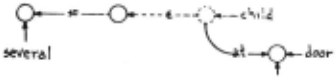
Fig. 1. ·several children were at the dcor·
le are r~garding "'" as a function fro· sets onto integers and "several" as a (fuzzy) ~Lcperty o: ouabers. If inst~ad Vt; regarded "s~v ;"\ ral" its~lf a~ e possible value of set size, then it would not bn possible to talk dbout lh~ siz;, ot the set, as ··· vould be aany valu~d (ey., " 6- e l.,~·Jnt Eet aiqht ba·e toth size "6" and siz.t' "several"). In the r,.:axt exa·ple "·any" i~ 9Xpr~s~~d in two parts, thA first b'.!ing an AR.l!£.1.!!1£ indic.1tor of ,;ize (ahout a doz.,n or aorc7), dnd tl'd Hecond cc·parinq 5~t size to an ayeraqe s~t siz~, as in ~artach ann VP.nn~eann (1q72). Tn th" con<Jtruction "avq I" is fi'<Jard~d as a function on cla·sds ot s~ts vhose valu~ is th~ average cardin3lity of th& sets in a given class of sets.
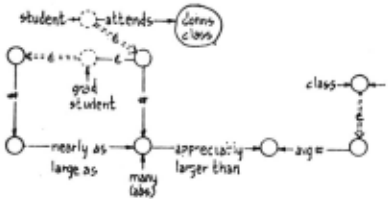
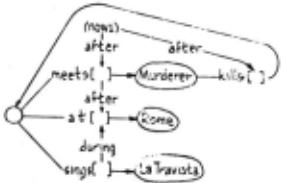
to conclude this Sdction ve bri~fly ind:cat~ tb~ special notation for ti··· ~~~n!~ of ti·~. unlik~ other conc~pts, are represented a~ p·irs of parentheses and !Et ~~v;ls of tiM~ as fairs cf squar~ brackets. Propositiona l links to such tim-= r.od·s ·r .. lab~lled T and TI r~spectivaly, Th~ lir.ks ·ay be supp:~ss·d altogther by flacing ti·es directly alon9~ide the prejicat~ tok~ns to vhich th · y a?ply. With this notatio~, coaplex tiae relaticns can b~ reprgsent~d ~uite conv~ni~ntly. Th~ s~nt~nce ''Whild be V4S in Roea, before he as t his aurd~r~r, he first sanq in La Traviatd" is diaqramaed in Fiqur~ 3, For univcr!ally quantifi ~ d tiae ve use brok~n parenth~s ~ s or brackats, in k~~ping vith the general quantification conventions.
Y, SlAT!S, EVENTS, ACTIONS, CASES, CAUSES, AND U':ENTIONS
Conceptual depe·ndency diagra·s and f[eferenc~ se·antics t~·plat ~ s ar~ capabla of expre~sing four sorts of a£sertiona:
- §l~!~~ - ascribing a ·odifier to an object or set of obj~cts at sc·~ ti·~;
- ~~ - ascribing a change of state to an object or set of objects at soae ti·€;
- ~£~l2n~; and (4) £A~·
~ooetheless, a sentence such as
The sun vas turning red and approaching the W~stern horizon. <5,1>
raises ·any questions. In <5, 1> the ·otion of the sun ~~ be don~ ~~ sca€body or so·~thinq vh~r~as its change of cclour £!!llll2~ b<' done by sooeho·ly o: so·~thing, Thus, u s i~g th~ <actor-acticn-obj~ct> for·alis· espous~d by both Schank and Wilks, ac~~s of behaviour vhich ~[e ex~ress~d by acticns ~~! have actors vher~as all other ·od~s of b~haviour £l!lln.!H have actors, In th<> cas'! of the (af ' r~rently) ·ovin~ suh in o~ ntenc~ <5.1>, onq is harrl Fress9d ~o identi[y th· actor; si·ilarly in the ~ent~nc~ "The breaker vas ·ovinq toward ~hor~.·· Cons~qu~ntly v~ are coapFlled to rcqard cdrtain onqoinq activiti~ s vhich intuitiv~ly just "happen" as instigat6d by so·eone or so·athing,>
Just as ve are co·pclled to [P.gard c~rtain cngoing activities as instigdted by ~o··body or so·et hinq, v"' are dcni~d th~ opt ior. of ["<Ja rd inq certain actions a~ havin9 an agent as shovn in
John vas hurting "ary by pullin'} her hair. cs. 2 >
In <5.2> tha "hurting" not b~ing an action, has no actor vhereas in
John vas dragging "ary by pullin~ her hair. <5.3>
the "dragging", insofar as it involves FTRANS'ir.g ~ have John as an actor,
ve ·ay vonder by vhat criterion ve draw ~he line hetveen vhat an actor ~l and vhat hf £~~· In <5,2>, according to Schank, ve are to r~qard the "hurtioq" as £!!.!.11;~.!!~ th<> "pullin9" action. 3ut the sa·e is true of P:r-.ANS' ir.q in <5. 3>. Furtherao::O>, even diract boJily dCticn such as ·ovinq ar. ar· can be ·iev~d as caused by ouscle contraction or, subjectively, as caused by an act of vill, eit"er of vhich again ··Y hava anteced·nt causes.
With respect to the <actor-action-obj~ct> for·alisa, it s~~·s to us that no structural pri·itiv~s should b~ associated vith actors a~ all. Inst~ad ve vill propose a neutral repr~ser.ta~ion i~ which EY~nts are expressed as sg~ue~cES of ~tates of th~ particiFants. The succ~ssive states si·ply express ''what ha~~en~d'', without ~xplicit cc~mi~me~~ as to "who did it". Hovev<!c, ~h'l ago.nt (s) in ~r; event can bP. identif io<d by :;uppl~·~n~ u y propositions, Thus the notion of an ·g~n~ can continue to b~ usa~ to aid interprP.tation !nrl inferenc~. Hovever, it vould b~ r~qarded as a ra~h·r "fuzzy" hiqhe: level concept, und~rstood by th~ syst·· in ter·s of the role of a supposed ag~r.~ vithin a sequ~nc~ of causally and tel.,cloqically relat~d states. Fer exa·ple, in th~ s~nt~nc~ "John uprooted the sapli~g" the t~r· agent vould b~ consider~d highly apflicabl ~ to John's role in the e¥ent vhile in tha s~ntenc~ ''Tha avalanch~ uproot~d the t[ee" its applicability to th~ [Ole o! the avalanchg vould b~ consid;r~d r~lativ~ly lov. Two factors deter·ining the degr<>o of applicability of the ter· "agent" to an obj~ct in a segu·nc~ of states (event) vould be the de9ree tt vhicn autooc·ous contrcl of its behaviour can be ascribed to the object and the <>xtent to vhich a stat~ of th~ obj~ct can b~ bald exclusivily responsible for initiating the sequ~nce of states,
Si·ilarly ve propose to separate ~hi so·etbing happened (causes, enabling conditions, reasons, explanations, justifications, and the lik·l fro· vhot. happened, As vith "ag~nts", this does not prev~nt us fro· including cau3al propositions in th~ representation and relying h~avily on the· fo" ioterFr~tatioo and inference. Hov~ver, ti·~ relations and chang~s of state, not causes, vill give cobe[Ence to a set o! propositions ss an "event".
We feel that Schank's inl~~Al r~lation b~tveen actions can and should be r .. pre~ented in ter·s of causation a~d intenti~n. For era·ple, if a syste· has a concEptualizatio~ to tho. ~ffect that John vas r7~ANS' inq the ball l!l PROP!':L' ir.g it, ther. this conceptualization should also e~p=o.~s that tho. FROPEL'ing vas S~2§i03 the P~RANS'in9. In fact, phrases ostensibly expressing instru·ontal actions often exprass no ·ore than causation, An exa·ple is the "ty" clause in
The effluents v~re killinq th~ fish by raising the t<!·perature of the vater. <5,4>
llhen there is a difte[enc~, it lies iD the ioti·ation of R~I~~ caus4tion. In
Jcbn voke "ary by bloving his Uu·pet.
fOrposive causation is expressed, vhile in
<5.5>
ftary woke up because John was blowing his truapet. <5, 6>
it is not. s~ntences <5,5> and <5,6> clearly chow that the inztruaental rPlation aaounts to a causal relation supplaa~nted by int9ntional states,
According to Fodor (1972), actions are to be thought of as a prope r subcla~s of ev~nts, Let us d~ter·in ~ vhr~h~r ~hi~ in th~ ca~~ for Schank'q notion of an action, and what dght justify thA special status of actions as oppos~d tc ~vents. Accordinq to Schank, a" action is soaething a noainal can b~ said to Q~~ins-At SO!~~!!nl (this is not a quote, but an intarpretation of ·schank's detinitior.). A study of his propos~d inferenc~s shows that in its~lf an action does not Express a definite chang~ in a situation; rather it expresses existEnce of a si~uation which i~!~2L2~~ change, and all actual changes aust oe illllll~· Foraulas for actions in ailks' th~ory are analogous although thay are not de~cribed as explicitly as Schank's priaitive acticn concepts, Actions, th ~n. expre~s !29s~-2!-~~~i9~! which proaote but do not guara~ted th~ occurrdnc~ · of ~vents. For ~xa1pl~, th~ actions FTRAN3, INGGST, ~OVE do not ~!Pr ~£~ changes in location; inst\!ad those changes ar.a priaary inferencas given that an actor is P!RANS'i~g. INGES!·inq, or ftCV~'ing so·~thing. syntact!cally, the relationship betv ~~n an ~~1, say a chanqe ir. locaticn, and the ~J&n, say PT~ANS, whose priaary inference is that event, corresponds quitE closely to the r~lationship be twe~o ~~~ and their l!!!~.l..s<.!lli§ r.spectiv<>ly. For exuple to say that John was PTRANS'inq hiasclt vith the !·sull that his location chang~d is quit~ analoqous to saying th~t be ~~-92in9 soaevher<> with the result that he ~2n! there.· In any cas~ the te[a "action" is nov S9en to be quito aisleadin~, since it noraally connotes the p~~~IJ~.!<~ of d~finite t!~Dl~· r~thAr than th<> oxistEnCd of a "dynaoic" situation which l~~i2 9iD~~1l events,
thus Schank's actions (contrary to th~ connotation of th~ tera) corr~spond ao·~ clos~ly to states than to events! ro say that A is PTRA~S'ing B is aerely to exprc~s a aca~ntary truth about ~h~ syst~· in which A and u participate, not a chang~ in that systea (which reoains to be inferr~d), This Yiev is co·pa t ibl~ vith th~ obs·rvation that ·a~y coaaon aodifi~r s expr Pns subtl~ blends of "passive" and "dynaaic" attribut us . The exaaples b~low bring to aind concept ual imag~ s that illu~trate a gradually incr~asing eaphasis on dyna~ics.
blue sky bright sun gloving (or luainous) candle burning candle bluing fir" billowing saoke
Schank's actions, and, as far as ve can deteraine, Wilks·, are "dynaaic states," O!: "actiwities," or "·odes of b~haviour" which ~ilii!l changes in certain attribut~s. Thus P~?ANS and ~ov: J2~1A!1 changes in location, INr.Es~ and EXPEL J!!llil1 changes in ccntair.aent relationships, and ftTRANS l!~iA1~§ cbang~s in awareness.
le believ~ that th~ recognition that "actions" in Schank's sense are ~s~~ntially states rather than events is iaportant, since it leads to a uniform view of all (truo) events as sequ~nces of states. In this wigw the need for identifying "actors" of events do~s not arise, nor is !t nece~sary to delin€ata the SFUricus boundary between "passiwa" and "dynaaic" states.
Ve now illustrate our representation of states and events, Nothinq new n ~eds to be added to th<> network nctation already us~ d in fiqures 1-3. W· regard any condit i on which c~D h~ld acaentarily (blue, acvin~, running, etc.) as ~1!~· Accordingly, any atoaic proposition which is ba sad on a tia-.-dcr<·nd.,nt pr .. dicate is a .l!llllJ.IS.1:2l<lli2!l · Pigure 4 show~ two concurr<>nt state profositions: aoaething (the rP.dness of the sun) was .i.!lSI:all!l.!l. throughout ~o·~ ti·~ interval and soaethinq el s~ (the distancf! b· ··· Pn th·! sun and the horizon) va s .II!Si'2~llll~ thro·1yhout the »aa .. ti.., interval.
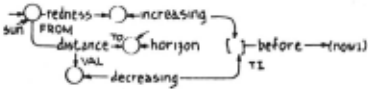
Actuslly there are two additional state propositions, concerned with tb~ 9xistenc~ cf uniqu~ walues of r? dn~ss and distance at all eca<>nt~ of tiae within th ~ ti·~ interval of int~ r~~t; th~s~ haw~ not been eade explicit since they arE cla~rly tri·ial an~ would clutter the diaqraa gratuitously.
~U involvo! a sh.l~ in state as "th9 last laaf fell frca the tree" illustrates. The definitiYP characteristic of state £b~~ is thE follcwing: if a systea has property A at tiae t1, and froper~y B at tiae t2, then A-->B is a change of stat< if and only if A and Bare autually exclusive proferti~s.· in fact a stat~ attribute such 4S colour which can assuae various values can consist~ntly be defined as a s~t of autually 9Xclusiv~ properties, <ach aeaber of the set b<>ing regard~d as a valu£ of the attribute. This adaits both qualitative attributes ~uch as cclour as vell as quantitative attributes such as location. figure 5 shows a siafle event invol·ing a sinqle cbanq~ of state
of a "systea" with one component (ftary), The tiae relation "then" iaplies iaaEdiate successicn of th~ tvo tiaa intervals. our r~presantation of one of Schank's standard sentences is shown in figure 6.
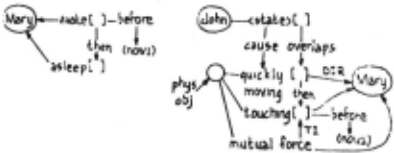
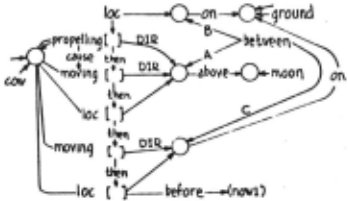
ln explanatory faraphras~ is the follovir.g. "So· · unknown aode of behaviour of John caus<>d scae object to aove quickly tcward ftary. Sub~u<>ntly the object reach~d ftary and exerted a fore~ on her.· Note that ve ha·e a state and an event here, viz. John 1 3 unknown £tate and the event of the object aovin q toward nary and striking her. In accordance witt ou!: earlier reaarks abcut causation, th~ causal conn9ctions betw~en John's state and thE ~.nsuinq e·ent does D9! aake John's state l!A.S of that ev~nt. Only exclusive and successive states of a fArticula~ systea of objects fora events. A natural inf~r~nc~ in Figure 5 would be that John ini~LJll~ hi~ ftary, i.e, that the aissing state of John is tha~ 1· 3 was Uili.9 to bring about the ev~nt in quest i on. W<> would r~present "trying" by th~ state predicate ·x bas acti·e goal y at tiaa t·, An additional exaapl e is shown ia Figure 7, The explanatory frtraphrasa qoAs ~s follows. ThA cvv was so·ovhera oro the qroun<l, prop<!llinq its .. lf towards a location above th., · oon: then it vas ·ovinq toward that location; th"n it was at that location; then it vas ·ovinq towards a plac~ of destination on the ~round, such that tha ·oon is b'!tvccn the place of d;,partur< and rlace of dc5tination ; th·n it vas at th~ ploc~ of destir.ation. Not ~ that ·~ovinq towards" cculd h·· ~ been repr~s~ nted in tt~ r·s of "dist4nc~ d~cr~asin~'' as in fiqur .. 4, An i·portant consequPnc~ of our vEry broad conceftion of stat~s is that nev co·ple· §!2~~ (·od .. s of behaviour) can be di'fin"d in ter·;; of r~~l~ involving pri·itive or already d~fin~d states. th~ ti·" of occurrence of ~hes~ eYents c·n ertend soae distanc· backward and forward fro· the aoaent at which th " n~v state is de fined to hold. lor eraaple ·walkin~· i s dafined in ter~s of aucce~sive states of aotion and displac··ent of th .. walkar·s feet an<! body ovar a ·perioJ of obs~rvation" l!ncc·pa~sin9 (say) tvo steps, since- !n instantan eous ·snafshet· ef a person is insufficiar.t for deciding· whethar or net that person is walk,bq (althou~h it aay of course s~pply enough cuas to pro·pt th .o .i!!i:ll"!Ul£.:! that thE p;~rson is valkin·J). A tenative ddfinition of ·walking" will te given balov.
Co·plex dynaaic states (·odes of behaviour) such as valkinq, ru~ning, dancing, tu·blinq, flickaring, ~tc., can be construct~d in teras of aore el ~ ·dntary stat~s. The co~structions a:· necesEarily as coaplex as the stat~s they describe. Coeplexity can result froa the intricate coordination of s .. v~ral siaultaneous activitie s ~.g. ·rollinq· ·xpr~ s s~s rotation and translat i on at ccord i ndt<!d rates), or fro· coaplEx t i m;> dependencies (e.g. flick~rinq), or frca both (e.g. ·val king" or even "building a snovun").
At ~his point the read<!r ·ay wond"r vhether v;> rropose to ·ake any us~ of "casas" in our afproach to repres~ntation. the ansv~r is y~s in the sens~ that w· inten<l to exploit fully t~e se·antic "prefere~ces· that any giv~n predicate induc<!s on its arquadnts. For exa·ple the predicat< "·ovir.q" pref~rs a physical object as its first argus~nt and a physical location as its second arqu·.,nt; ·h9 predicatd "has-ac~ive-qoal" pr·fers a sentient bein~ as itE first arquaent and a state proposition as its second argu·ent. Furth· r·ore, there are broad si·ilarities betv·an th.. argument prdfer~nces of different pr·;licates, For exaeple, several predicates pref~r ar.i·ate objects in cer~ain argu·ent positions. We certainly can (and ~oeet1··s do) ackncvledqa such sieilariti"s and give a rough indication of the sort of prefer~nces inYclved by using suggestive arqu·ent ·arkers such as ANI", THING, PLACE, DIPECTION, etc., instead of noncoa·ittal aarkers. such as 1., B, c, , · However, ve do not think that th<!Sd ·ark<!rs can b~ chosen so that they ¢Xpress not ·erely sirilar but i~ID11~1 arguaent rol"'s and seaantic preferences, no ·att·r in vhich Fredicat9 they occur. This viev is sufported by Bartsch and Venneaann (1972):
"··· ·case· is entirely a surface cateqory and not, as f'ill·ore (1968) suqgests, a cat~gory of aniYersal seaantics, Seaantic representations are based on FrOfOSitions, vbich consist of a relation (n-ary predicate with n>=O) vith a finite nu·ber of arqua<!nts filled either with constants or vith bound varial>l~s. The '·eaninq' of an argu·ent as arguMent is entirely deter·inod by its relation. Therefor~, no tvo arguaents have Fr9cisely the sa·e ~eaning, as arqu·ents. Thus, if the aeaninq of an arquaent as arguaent is called ~ case, then there are as aany cases as thcrd · are argu·ents, and this nu·ter, if it is finite at all, is a very large one."
Thus se·antic cases, while certainly useful heuristically in finding er inferring arqu·~nts of predicates hav~ no univ~ rsal or pri·itive status.
According to Schank's dictionary, if X !~l~~ to z (where l is huaon and z is a location) th ~ n X PTRANS 1s X by ~OHinq t he feet of X in t.l1· dir~ction of z. A aincr criticise of tnis fcraula i ~; that it rul~s out valkin'l on one's hand !; and kn···'!5, or valkinq on on"'" h'" "'" (aJ·i~tt<<lly a ratE skill). ~ore i·pcrtantly, thn for·ula · ·l·its runninq , skifping, hOfping, io·r·rinq, s hut flir.<J, anJ ny .. , skating. t·r., su~ably, ti: ·'"· tl··> dictionary Pntry i s not int~nd .. d to capture the full · ., aninq of "walking·· as v~ sE~· to understanrl it, ~ut o ~ ly those a F f e cts vhic~ ar - -ost ~ ss~ntial to l4nquaq ·· und<.rstanllinq and (i··e dia~e) inference.
Si·ilarly Wilks' for·ulas are also ince·plet~.· for exa·plE, it is correct to say tha~ D R I~K i·pl ie s ((*ANI SUeJ) (((FLOW STUFf) OBJ£) ((*HI B) (((::III S (*ANI (THhU PART))) TC) (9! CAUSE))))) but r.ot th ~ converse (which could &ean sc·eon~ vas rec~ivinq an eneaa). So again a selPction of linguistically iaportant features has aFf·rently b~dn ·adc.
We f~el that it is i·portant to for·ulate ·or ~ co·plEte aeaninq reprdsentations for two re·sons. First, ve believe that so·ewhat ·or~ ir.fcr··tion will be requirad fer ad~quate co·preh~nsion of "ordinary" discourse. Secondly, ~t mor a infor·aticn will sure ly be required to ~atch th ~ hu·an ability to describE concepts and rea~cn about thea. For exa·ple, supFose ve ask a reasonahl y articulate person to describe hu·an ·walking" l!Li! .ll ~~1l~_R9~· w~ ·ight elicit a~ leas ~ the fcllowing inior·ation: Each foo~ of the valk~ r repeatedly leaves the qround, ·oves fr ·e ly in ·hq walking directicn for a distanc~ co·parabl· to th ~ length of the valk"!r's l"gs (while staying clos" t o the ground), th~n is set down again, and reea ios i n rosition en the ground, suppo:tinq the valk<r, vhil d the ether foot goes through a si·ilar ·otiJn. =hd repetition rate is abcut cnc repetition per s~ccn~. The legs reeair. ·ore or less 9Xtended. Th9 body re·ains acre or less erect and is carriad fcrward at a fairly constant rate.
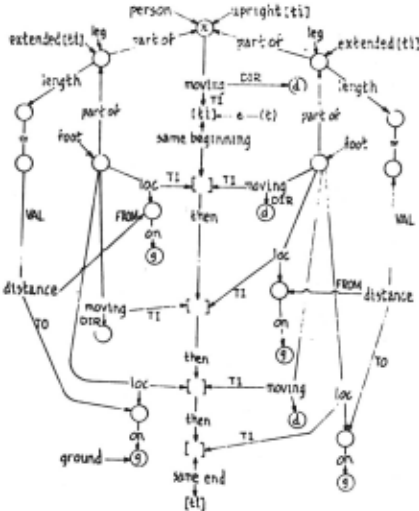
further details ceuld be added abou~ fl~xinq actions of f ~ <'t, kn<. ~s, and hips, the sliqht up-ar.d dovn ·oticn of th~ body, typical ar· ·ction, a~ t t forces "!XErt~d on the qround. Fiqure a shovs · network which describes "walkinq" (reqardad as a state pradicat9 vith three argum9nts besides tim~ ) along thE above lines. A few propositions have b~~~ o·itted so as not to clut~er th · diagraa. 1h~se ar ~ that Each foot is also above the ground (and clos~ to it) ~hile ·ovi ng, that ~ach foot is al s o supporting x vhile st.aticnary; that the duration of each of the unlabeled tia~ intervals [ ] i s approxi·ately half a second; and that tte ~pe·d of ·otion of th~ walker's body is apprexiaately constant. There is no difficulty in adding ~hes~ state profoSitions, except that the last requir<'s ·aoving· to have an additional arqu·ent, na·dly the speed of aotion. Note that [ti] is the "tim · interval cf observation" of th· valker, and that it contains t, the ti·e at which x is said to l> · valkinq. Thus "walkinq· is d4fined by behaviour i n the teeporal vicinity of th~ aoaent of predicatiJr., specifically about tvo seconds of ·otion allovinq about three or four steps.
A li·itation of our repr"'sentation of "walkinq" is that it is not applicable to unusual ·od3s of valkinq (e.g. on hands and kne~sl or to anioals. On e question this raises is how aany "kinds" ot valkinq should be rEpres~nt·d separately. Also, is there a repre~entation which exfr9ss as the co··on featur~ s of all kinds of valkinq? w~ have ~~teapted such a representation in Figure q, The repres<'ntation is bas9d on the followinq characteristics of valkinq ir. qeneral:
(1) it is done using li·bs that are a subset of the liebs of the individual involved in the valkinq; (2) the nu·ber ot li·bs invclv~d is greater than or
equal to t vo;
(3) at all ti·es so·e of the liabs used for walking are iD nonslidinq contact with the valkinq surfar. o (this is not the sa·~ as sayinq so·· ot thR li~h ~ are in contact with thA surtdc9 at all tio~sl;
(q) ··dch lisb u ·;t~d tor walkin'l i:< stationary on th·· walkinq surfac~ at so·~ tise and subs~quQntly is ·ovin(J for ~O ·· ~ ti·e; ancl (5t th~ indiwidual as a whole is in sotion in the
walkinq diroc~ion.
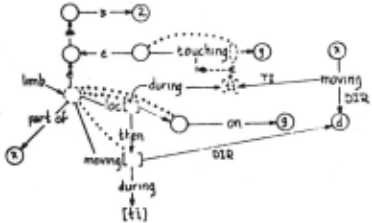
riq. 9. "· walkinq at tise t in direction d on aarface q"
Tbe interesting feature of our reprEs·ntation is tbe ase of quantification to describ~ thE rol~ of any nusber of leqs in the walkinq. N?te that without quantification describinq tL~ locosotion cf say, a sillipede would be ··ry tirasose.
l serious flav in our representation of "walking", and ona for which we haYo no ~yfitesatic roaedy, is that ve hawe iqnored the "fuzzinefis" Qf sany of the seaninq cosponP.nts. ror eza·ple, i t seess necEssary to put ~~~ constraints on the lenqtb of stride (lest a husan ·~lker be allovert to sine'! forward in silliset'!r incr·nents), yet to qiY ~ an exact distance would be absurd.
An i sport ant consequence of ccnc" ut ua 1 fuzziness, v~th r cqdrd to co~pl�r cor1c ~ pt definition, is that ve can no lonq4r drav a sharp boundary betve"n "·tractin~ th ·· !!:.:!!llL.9 of an utterance and ·aki!'ICJ f iObtlbl ~ .i!l~!.:ll.£!!~ on thol tasis of th~ d~riv~d ~ ·!aninq fitructure. thi~ is because ve only finrt the .I!I!l!!ill~ s ·Hininq of ~n utteranc~. for ~Ka·pl~, th ~ ut~dranc~ "Jchn built the hous~J" l?!~!.!ab!! !l( tH~ ! ; t:.ha t hC! built . a lar q~ , riqid·vall ~ J e!ICl~ . ;ur c vith ~ r?of, ~~patate rooas, etc.; but non~ of thi5 is c~rtain. ThP utt'-·:-a nc ·~ "John vas lauqhin ~ " ~l~Ell se~ns that h ~ vas producing a s~ri~$ of voic ~d sounds by !tlq~ ~ r ~1 exhalation of air, and that his facial ixpr~~sio n vas serry; but he siqht have laughed sil~n~ly, o ~ his facial expression sight have b·en d~risi·~ or even ho:;til a . If ve try to reduce sesantic uncertainty by ~·eluding fro· th~ ·e~a&inq" of a ters all but its absolut~ly sinisal contEnt, a~d ascribe everything els€ to inferer.c~. W€ find that this doesn't vork too vell.' translate under c3 ·-· go in the cas~ of "housa" all that would ~esain vould be a "partial ·~closure· - vhich acccesodat~s a fenced-off field, a shippinq crate, or a jacket.
In the case of "lauqhinq" ve vould perhaps be l~ft with "spassodic t~eathinq and intent tc tonvey aausesent," vhich could suqqast that John is asthaatic and dancing a jig.
finally ve vish to point out that aar.y (p~ rhap s sost) concepts can be understood in diff~r·nt kind s of vays. For ezasfle, in "John vas lis~eni r. q to th ~ incessant chirping of the crick· ts," is ·chirping" understood s i eply by its correspondenc· ~o a particular auditory sensation, or is it und~rs~ood as a rapidly fluctuating, ·?re or l~ss uniformly high-pitched sound, or even as . a cosplez variation of air pr'!ssura vith ti·e? "insky's (1974) rec·nt vork on "frase systeas" strcngly su~qests that th ~ kind cf understandinq of a cor.cept ve use at a ~iven tise is extres~ly task and context d'!pendEfit. :hi s certainly casts dcubt on th~ one-concept-or.~-formula apfroach to langu3ge understandinq.
YII. ADVnEIALS
our purpose in this section is to dr~v attention to thE sajor prcbl9a of repcsentino1 adwertial seaninqs. In p'lrticular ve consider eartsch and Venneaann·s (1972) approach, vhich s·~·s proeising but vill be seen to haYe serious defects.
Schank (1972) diagrass adnrbs as action sodifiers without furth er analysis. Apparently h~ bas net ccncerned hisself vith their seacinqs so far. In the case of sany adwerbs (as in the casg o! sany adj~ctiw~s) this neglect is probably justifi.,d, since sost of th~ eeaning content deriwes fros ferceftual proc~sses. For ezasple, in the s~ntenc~ ·nary valk'!d qrac~fully" it is difficult ~o paraphrase "gracefully" it sorR elesentary t~rss. Ess'!ntially va kncv qracbfulness vh4n ve see it. Thas pErceptual ur.d~rstanding n~eds to be supplea&nted only by a fev additional facts for languaqe cosfr~h~nsicn rurroses, such as th~ fact that qrac!ful sotion is generally pleasing, is sor~ or less the orposite of awkward aotion, is saooth aDd vell-ccordinated, and the like. Oth ~ r adverb i al sodifiers, hovever, clearly require s yst~satic analysis; "quickly" is a qood ezasplo>. This .tera appears to say soeethinq 4bou~ th~ ~.~~~~~of a n action or actiwity, coaparinq it to sose standard. ln adequate ·~aning repr~sentation tor "quickly" abould spell this out precisely.
eartsch and vennesann (1972) suq?e~t that adwertial sodifiers operate on v~rb aean~nqs in th~ sase sanner that adjectival eodifiP.rs operate on noun seaninqs. On~ frObl~· in this approach is best illustrated by the follovinq exaaple.
John ovns a large car.
John is runninq quickly.
<7.1>
<7.2>
Whereas ldrqil in <7.1 > hds 45 a r·Jfl"'r~nce S>:?t the set ot cars, and John's car is larqu in r~lation to the "average" for thdt sut. "runniny quickly" car. 10t be analyz~d so ~asily. tf the andloqy ·~r~ parf~ct tbeo th~ r~fPr~ncu set overatcd on by ··quickly'' would be the s··t of ·runninq"" (Vhdt<'v·, r that ·eans); tut clearly this set of runnir.qs aust b" furth~r r~strictud to th~ s~t of run~ings John is capable of pdrfcrmin4. !hus 11 1JUickly" arp·!d[fl to operdte net on "runtlin\J" <~lOot.!, but or: 11 John runninq·. As furtb~r exa·ples consid~r <7.3> and <7.4>.
The cheetah is runninq quickly. <7. 3>
Clearly "quickly" hure operates on ·running ant· and ·runninq chEetah" rPSFEC~ively.
Thus the nature of the ·runner· is beinq usdd to narrow the rcfer~nce set to which WE apply a ·easure function. tn <7.2> "quickly" ·odifi~s running with re~p~ct to John's runnings, cr, if ve don't k:1ov J"lhn, at least i:.o hu:nan rur.ninqs (assuain~ that John is huaan). In <7.3> and <7.4> the acasur~ function is appli<ld to the rur.r.ings of che<ltahs and ants respectively. Unfottuna:ely factor~ oth~r than ~t.e id~ntity or catogory of the runner car. also affPct the aeaning of ·quickly·, as shown ty <i.S> to <7.9>.
| John is running quickly on his hands ar.d knees. | <7.5> |
| Jchn is runninq quickly en th~ •oon. | <7.6> |
| Jchn i• runr.ing quickly in Chile. | <7. 7> |
| The ch~mtah is running quickly in the dense forest. | <1.R> |
| The c~e .. tah is running quickly en the plair •• | <7.9> |
The eff.:>ct of loc1l~ on th" aeaning of "quickly'' is E9en in the con~r~st t~tw~en <7.6> and <7.7> ~r.d tetvecn <7.8> and <7.9>.
!hug it apfears to us tnat th~ cont~xt woich det9rr.in~s the m~an1r.q of an ~dverbial modifi"r cannot bE circurscribed one~ and for all. in qeneral, adverbials must b· allow·d to interact with any specjfic and q-en-cral kncvl·ddg!" availo~l0 ah?ut the participants in (and setting of) an ~ct:on. Tnu;; the affroach of Zad·h (1972) to th~ trcatm~nt o! adtertial ''h~dges 11 lacks qenArali~y since h~ n~ids to specify tho> (w;;iqhted) comfOn~nts of · ac~ !uzzy ter· on vhich a h~~q~ ·ay OF~rat~ 2~££~~_12~-2!!· In our se·antic network, v~ would repr~�rnt <7.1> without the adver~ as follows.
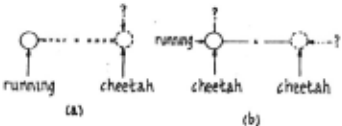
cbJ
(b) (a) (Ell) ((Ay)[cheetah(y) & ?(y) <·> x=y] & running(·)) (Ex) (rur.n i ng ( ·I &c h~ · ,ta h ( x) & ? (J) & (AJ'I [ chFetah (y) &? (y) =>·=y])
Piq. 10. "The cheetah is running."
(a) and (b) are bo\sed on alternativ~ (but equi·alen~) representations of d~finit~ descrir-~ions. Fiqur~ 11 then shows ~n atte·pt ~o repr~sent the adv~roial construction 1n <7.8> 1n keepinq with BarL,ch and V.>nn<'mann·s (1972) <J·>neral approach but taking into account t~e abov· connid~rations. In the c~pr~sentation v~ s how the explicit relation9hip b~tween th~ u p~~d of th0
cheet .. h's runninq a,; coMp~re·l to th<, avera·]~ sp·····.t of a ref~rence set of ~unninqs (by cheetahs in d~ns~ forests).
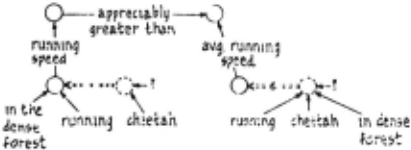
Unfortunately the rapr~sen~ation suffers fro~ ~ fatal flaw: the set of che~tahs runninq in d~r.s9 forests, tequir~d for co·parison, MAY W<lll ~e 9apty (if not, replace "dense foro>st· with "d~EF snow"). The ·refarence set· th~refore, if it existz at all, is net of this world but of some isaqinary worl1 which is cur concep~ion of bow hard cheetahs ~2~!1 find tha goinq if they !2~ to run throuyh for~~ts (or sno~). It reaains to be seen whether Dat~sch and 'enneaann·s AFproacb can be aodified to overco·~ these difficulties.
ve have taken a critical look at what wa consider to be the best approaches to a co·plet~ language und~rstandinq theory to dat~, naa~ly Schank's conceptual d~p~ndency thdory and Wil~s· preference seaantics. In ~oinq so, we expcs~d ·4ny probleas and suqqested plausibl~ aethods fer dealir.q with soae of thea. In particular, the r~pres9ntation of quantification and of tiae, the basic representation in teras of states and c·ents, th? dPfinition of coaplex concepts (aost iaportantly action concepts), tho; handling of ad verb ia 1 aodifiers, as well as the usa of tiae in r9presentations has been exaained.
In a coapanion Faper by Schubert (197U), notaticnal difficulti·s are ~liainated for such nec~ssary ccns":.ructions as logical c~r. nectiv:: .. ~, descriptions, quantifiers, Fropositional at~itud~s and other aodalities, as well as oth~r constructions not previously inccrForatdd in~o seaantic nets. tbi~ notation appears to be adequate for the ·stat-> based" conceptual repro;s~ntation hera proposed.
Ob·icusly auch wcrk reaair.s ~o be done. Ve hop~ our exposition and partial sclution of sev~tal aajor frobleas will help give direction to this wcrk.
REPEUNCES
Bartsch, B., and 'ennesann, T. (1972). ~!llS1£ ~!,YS1Y~Li· Athenaua Verlag, Frankfurt, Geraany. Evans, c. (1967). "States, Activitie·, anJ Perforaances·, Australasian Journal of Philosophy, 45, FP 293-308. Fodor, J. (1972). "Troubles About Acticns·, in ~!UJil.i,!;§..9!J.!.1.11.ULJ.!.!l.!l!!~.!l:t· D. Davidscn and c. Haraan (ads), D. Reidel Publishing Coapany, Boston, ftassachusetts Katz, J. and Fodor, J. (19611). "The Structur~ of Seaantic Theory·, in lh2-~liY£1Y~21-J.!t9Y!g!, J. Fodor and J. Katz (eds), Prentice-Hall, Englewood Cliffs, New Jerser. Lakoff, c. (1972). "Linguistics and llatural Loqic·, in §U!.O!i,!;§_.2!_l!ll.!!ill.J~~. D. Davidson and c. Haraan (eds), D. Peidel Publishinq Coapany, Bostcn, ftassachusetts ftcCarthy, J. and Hayes, P. (1969). ·soae Philosophical Proble·s fro· th~ Standfoint of Artificial Intelliqence", in ~achinLll!..t!:Jl!.li.!lll£.2· B. fteltzcr and D. ftichie (eds), American Elsc; vi"r Publishinq Co·Fany, New York, New York. ftinsky, n. (19711). "A frao~work for Representinq Knovled9e", Artificial Intelliq~nce Ke·o ~o. l06, A. I. Laboratory, "IT, Cambridge, ftassachusPtts. ftontaque, R. (1970). ··ne Proper Tr£atm~nt of Quantification in Ordinary !nlli&h", Departm~nt uf Philosophy, Univ~rsity of California, Los Anqul·n, Cali torn h.
- llontaque, R. pg72). "Praqe.ttics and Intensional Loqic", in ~~!!nli~~-21-M~1~!1-~A9~~~. D. Davidson and G, Uar·an (ed~), o. R~id~l rublishing Coapany, Bostcn, ~arsachusPtts
- Ouin~, v., (1'l60) · .!!21:Ull!L~!.· lilT Prt>ss, Ca·bridqe, ~~~ ~sachusetts.
- Rosser, J,, and '!'urquett .. , A. (1952) · .I!.U!.I.:..!.ll.!!f~ 12~1£~, Aest~rda·, North Helland.
- Schank, R, (1~72). "Concd~tu.tl D~pendency: A Theory of N.ltural Lanquaqe Understanding·, Cognithe Psychology, v 3, fP 552-631,
- Schank, R. (1973). "Identiticaticn of Conceptualiz.lticns Underlying Natural Lan~uag~". in ~.!£ll.ll!_.!!~~.l.L9.L1.!J.IU!!lh.!..J..!!.LU.Il.!l.l'i!~, R. Schank and K, Colby (dds), v. H. rr .. .,aan and Coerany, San Fr!ncisco, California,
- Schank, R,, Goldean, N., Heq<>r, c., and Riesbeck, c. (1973), ·~arqie: l'h··ory, Analysis, Response Generation, and Infer~nce on English", Third International Joint Conferenc~ on Artificial IntElligence, Sfii, llenlo Park, Califorr.ia, FP 255261.
- Schub~rt, L. (197q). ·on the Exp~o!ssi ve Adtquacy of Seeantic Nl!tvorks", TP.Jq-18, o .. part·ent of Comruting Science, University of Alberta, EdecDton, Alberta.
- llilks, J, (1973a). "Preference s .. eantics·, Stanford AI froject, llaeo AIII-206, Stanford University, Stanford, Calitcrnia.
- llilks , Y, (1973b). "Natural Language Inference", Stanford AI Pro1ect, lle·o AIII-211, Stanford University, Stanford, California.
- lilks, J, (1973c). "Undt>rst!nding Without P~oofs", Third lntarnaticn·l Jcint Ccnfero!nce on Artificial Intelligence, 5~1, llenlo Park, California, pp 270217.
- llinstcn, P, (1970). "Learning Structural Descriptions fro· Exaeples", PhD Thesis, lilT, IIAC TR-76, Caebridge, nassachuEetts
- Zadeh, L. (1965). "Fuzzy Sats·, Inforeation and Control, 8, pp j38-351,
- Zadeh, L, (1972). "A ruzzy-Set-1h·>oretic Int~rpr~tation of Linquis~ic H~dges·, Jcurr.al of Cybern-!tics, v 2, n 3, FP q-3u,
FCO'rNO':'ES
· ct. th· selectior.al restriction!! of Katz (1964).
2 Por a eora co·plet· d~scription see belov.
· This soeething i ncludes natural fo~ces in a vagu e unsp~cififd sens~.
· Unlike Schank ve do not regard "h~ vas gcing" and "he vent" as equiv~lent; v~ clai· that "h~ vent: there,· u~like "h~ vas going th~ra," affir~s that h~ ~i~ arrive at his destination, and that it is decidedly odd to say "he vent thera but didr.'t g~t there.·
· Por axaeple, A·solid, B·liquid; A·round, B·rac:tangular.
· Cf, Lakotf·s (1912) lexical decospositior. ttf''>S, ' It vould sees that the huean interrretativ~ process does not ~rocE~d on th· basis of the sinisal conceptualization foraed by eebadding thE aini·~l content of teras into the conc~ ptu~lization. ~ather tbe R~igjAJj l£~ il~! sugqas~s vhat ve could infer in addition to the ainieal content. This s· ~ ·s like a reasonable wiev on the basis of etfici .. ncy consideration3 as vall, It should be euch siapl .. r to insert probable infl!rences in a saeantic structur~ by direct reference to the vord definitions inst·ai of analyzing the sinieal represf'ntation and then looking for applicable inference rul~s.
- ln Of&que context is one vhich does net allov substitution of
referentially ~quiwalent expre3sions or do~s not allov existential quantification. This is a vell knovn protlee discussed at length by ouine (1960) aad in Artificial Intelligence by llcCarthy ani Hayes (1969) and lloora (1973).
· See Partee (1972) for details.
~
@inproceedings{ijcai1975p14,
  title     = {Toward a State Based Conceptual Representation},
  author    = {Cercone, Nick and Schubert, Lenhart K.},
  booktitle = {Proceedings of the Fourth International Joint Conference on
               Artificial Intelligence, {IJCAI-75}},
  publisher = {International Joint Conferences on Artificial Intelligence},
  editor    = {Patrick Winston and Carl Hewitt},
  pages     = {83--89},
  year      = {1975},
  note      = {Representation Of Problems and Knowledge},
  url       = {https://ijcai.org/proceedings/1975/14},
}
TY - CPAPER TI - Toward a State Based Conceptual Representation AU - Cercone, Nick AU - Schubert, Lenhart K. T2 - Proceedings of the Fourth International Joint Conference on Artificial Intelligence, IJCAI-75 PB - International Joint Conferences on Artificial Intelligence PY - 1975 SP - 83 EP - 89 UR - https://ijcai.org/proceedings/1975/14 ER -Copied
Machine-readable versions of this paper, for tools and AI agents:





