
The Role Of Hypothesis in Medical Diagnosis
Proceedings of the Fourth International Joint Conference on Artificial Intelligence. Miscellaneous Applications Of A.I.. Pages 856-861.
© 1975 International Joint Conferences on Artificial Intelligence
Abstract
Thia paper describee sole aepecta of a computer eystem for doing medical dlagnoala In the epeclalized field of kidney diseaae. A four-etep process which coneiets of disposing of findings, activating hypotheses, evaluating hypotheses locally and combining hypotheses globally ia eMamined for Its heurletic implications. The work attempts to fit the problem of medical dlagnoeie into the framework of other Artificial Intelligence probleMs and paradigms and in particular eKplorea the notions of pure search vs. heuristic methods, I inearity and interaction, local vs. global knowledge and the structure of hypotheses within the world o·f kidn•y disease.
- Fahl•an, Scott, "A Hypothesis-Fra•e System for Recognition ProbleMs,• ~-57, Artificial Intelligence Lab, M.I.T., CaMbridge, DeceMber, 1973.
- Fel lor, ~il liam, An lntrodyctlon 1Q Probability Ib.Gr..u. i.asllli Appljcatjont, Vol, 1, John ~iley and Sons, Inc.1 No~ York, 1968.
- Garry, G. A., A~ f2c CoMpyter- ~ Qjaqnosje, TR-44, Project MAC, M.l. T., Cambridge, September 1967.
- Garry, G. A. 11 il. Compyter Laboratgry 1QL Cl jnjcal Oecjsjon-Making, research proposal to NIH, March 1974.
- S. "A Frame~ork for Representing Kno~ledge,• in lbA Psychology 2f Compyter ~. P.H. ~inston, ed., McGra~-Hil 1: No~ York 1975.
- G. Rubin, Andee, "Hypothesis Formation and Evaluation in Medical Oiagnosia,• AI-TR-316, Artificial Intelligence Lab, M.l. T., Cambridge, January 1975.
- ~inograd, Terry, "Frame Repreaentationa and the Procedural/ Declarative Controversy,• in Bobro~ and Collins (eds.l, forthcoMing.
References were extracted automatically from the PDF and may contain errors.
Full text extracted automatically from the PDF; figures, tables and equations may differ. The PDF is the version of record.
Tl£ ROLE OF HVPOTI£SES IN I'EDICAL DIAGt«lSIS
Andee Rubin MIT Artificial Intelligence Laboratory CaMbridge, Massachusetts 82139
Abstract
Thia paper describee sole aepecta of a computer eystem for doing medical dlagnoala In the epeclalized field of kidney diseaae. A four-etep process which coneiets of disposing of findings, activating hypotheses, evaluating hypotheses locally and combining hypotheses globally ia eMamined for Its heurletic implications. The work attempts to fit the problem of medical dlagnoeie into the framework of other Artificial Intelligence probleMs and paradigms and in particular eKplorea the notions of pure search vs. heuristic methods, I inearity and interaction, local vs. global knowledge and the structure of hypotheses within the world o·f kidn·y
disease.
lntroduct jon
The practical importance of studying and developing computer aids for medical diagnosis is obvious. Recently, cognitive psychologists and A.l. researchers have also become interested in the stryctyre of Medical knowledge and the processes by which it is manipulated as eMamples of general knowledge structures and problem-solving processes. Thla paper summarizes work done investigating these concepts while studying the process of diagnosis within a limited set of diseases: those whose presenting symptom is hematuria, or blord in the urine. This study was done in conjunction with Tony Gorry'e group at M.l. T. <Gorry 74> and draws on previous and present work by Tony Gorry, Steve Pauker and Gerry Sussman.
Oescrjptjon g! 1hl ~
~~ can conceptualize the diagnoeia problem as one of a class of recognjtjon problems <Fahlman>. In particular, a medical diagnosis system is presented with a group of symptoms, signs, fac1e, teet results etc. and its job is to come up with a djagnosjs, an identification of a disease or several diseases whose manifestations most closely Match the condition of the patient.
Because of an interest in ~. the model of diagnosis which wi II be used here is one of the lltlil acgyjsitjon <Gorry S7> of facts about the patient. Thus, we require a diagnosis system to have hypotheses about the patient's diseaselsl at each moment and eKpect that these hypotheses wi I I change after the addition of each new piece of information. In this paper, I wi II concentrate on the hypothesis-generation and evaluation aspects of the diagnostic process, identifying several mechanisms which serve to MiniMize the nc1ber of hypotheses being actively considered at any one tiMe. Theae heuristic methods ·ay be new answera to the probleM of liMiting hypotheses in a potentially eMponentially-eMploding search space.
The following sections present these aspects of the theory: a representational strycture for algoa, syMptoms and diseases, the ~ eya.luatjon of hypotheses, jnteractjon between symptoMs which affects evaluation and g!gRal assembly of compleK hypotheses, which Includes a theory of cpherence dealgned to provide a way of coMbining local hypotheaea
into global ones
6aAlk Concepts ang Mechanjsms g! 1bl ~
Nodes in the knowledge net necessary to do Medical diagnosia pri.erlly represent causea and effecta. I have cal led a node which is primarily an eMplanation or cauee an elementary hypothesjs. Those nodes which are basically not causee, but rather raw data, are called fjndjngs; several typal of findings will be datailed later. Elementary hypotheaee are differentiated from findings by the fact that they are subject to a ~ eyalyatjon proceaa which determines how likely they are to be the diagnosis in light of the current data. Each elementary hypothesis is part of a ~which contains abnorMalities which are ~by the disease it repreaenta, 11 wei I as facts about a patient' a age, seK, race or family history.
Take, for eMample, the two sl i.cea represented in Diagram 1, URINARY-TRACT INFECTION and PYELONEPHRITIS. Each of theM is an elementary hypothesis. The finding· associated with URINARY-TRACT-INFECTION IUH I include FEVER, HEMATURIA, FREil.ENCY etc. Those associated with PYELONEPHRITIS include PUS-CASTS, PAIN !LOCATION FLANK! and IVP IRESLl.T SCAARINGI There are several other eleaentary hypothese· on the page: GLOMERULITIS and IRRITATION are included to i I luatrate that a single finding may eMist in~ slices. The symptoms of a disease (relevant findings) are connected to Its elementary hypothetil by pointers which have been left unlabelled, and should be read "is evidence for." The designations of EVIDENCE and EXPECTATION strengths, whose derivation ia eMplained below, are included with the diagram.
Some elementary hypotheses are eMamples of others- more specific designations of etiology. STREP PHARYNGITIS, SCARLET-FEVER and STREP-SKIN INFECTION are .all eMamples of STREP INFECTION. An ISA I ink goes from the ·ore specific eMample to the general category1 the CHOICE-SET of a category, its set of
eMamples·, is also indicated.
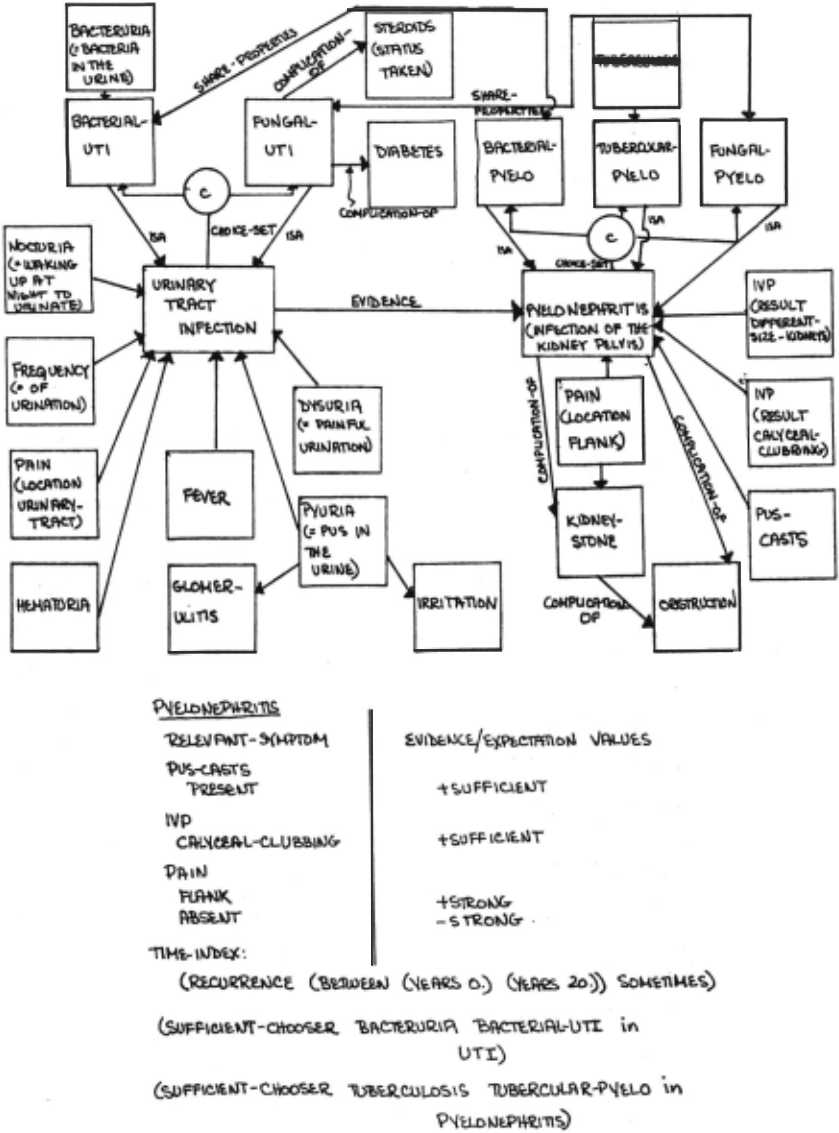
Elementary hypotheses can sometimes themselves be considered symptoms, eo that EVIDENCE and EXPECTATION pointers may connect them. In Diagram 1, UTI and PYELONEPHRITIS, both elementary hypotheses, are so related;the symptoms of UTI are a subset of those of PYELONEPHRITIS. There are also clearcut CAUSE relations between elementary hypotheses where the symptoms of the two diseases concerned are not in a subset/superset relation. In this case, the CAUSE relation is stated IMplicitly, ae In STREP-INFECTION CAUSES AGN. Similar to CAUSE I inks are COl !PLICATION I inke, ae in PYELONEPHRITIS is a COMPLICATION of STONE. In addition, elementary hypotheses may or may not be ULTIMATE-ETIOLOGIES. An elementary hypothesis which is an ULTIMATE ETIOLOGY is one which could stand alone ae a diagnosis, for which a more basic cause does not have to be sought or ie not known,
The syetem knows about several different types of findings: LAB-DATA, PHYSICAL-EXAM, SYMPTOM, FACT and FAMILY HISTORY. The process of deciding whether or not a particular patient finding is relevant to the symptom description in the knowledge network and thus relevant to the disease hypothesis is cal led !111lnQ: Ieee <~inograd> and <Minsky> for earlier usee of this terM in frame theory) It requires trying to fit a particular finding description Into a sometimes more general specification. The result of thie fitting process is that the finding-specification is either confirmed or djeconfjrmed, if the finding contains enough detail; if more information is needed to see if the finding fits the specification, the doctor often asks more questions.
The time of occurrence of the symptoms and the time relationships indicated in the knowledge net are also taken into account in fitting, as described in <Rubin>.
During the course of a diagnostic session, nodes of the data network change state with the addition of new information about the patient. ~hile finding specifications may be either confirmed or djsconfirmed, elementary hypotheses, because they are not directly confirmable, have a more complicated set of alternative states. ~hen a diagnostic session etarte, alI elementary hypotheses are jnactjye; that ie, no particular disease has been suggested by the patient's symptoms. As more data is presented, certain hypotheses become ~by virtue of their correlation with and abi I ity to account for the findings present. Once a hypotheeie it active, it is evaluated after the addition of every finding to see how well it fits the data so far and some score ie produced which represents the I ikelihood of that disease's being present. On the basis of thie process, a hypothesis may be accepted or rejected; in most cases, however, no definite decision will be made, but lte score wil I be modified to reflect the effect of the new data. An accepted elementary hypothesis is one for which the evidence is sufficiently specific to rule out any other cause for the symptom· present. For eMample, the presence of RED BLOOD-CELL-CASTS confirme the dia~noeie of GLOMERULITIS, making it an accepted hypothesis, but the very same finding maktl SICKLE-CELL-TRAIT a rejected hypotheeie. Finally, consideration of an elementary hypotheeis may be deferred until mort eupporting eymptome are known. Thla· proceee helpe reduce the number of concurrently-active hypothesee.
How does the magic traneformation from a bunch of eymptoma to a final diagnosis take place? The process seems to be divided into four steps: djepoejng, trjqgerjng, ~ eyaluatjon and~ assembling. This series of four atepe Ia performed after the addition of eech finding. A brief description of the four stages follows; the third and fourth will be discussed in more detail below.
l.Sometimea the cause of a finding is clear when the finding ie encountered! this ie most often the case when the eMplanation ie a FACT. In such a circumstance, the doctor djspoeee of the finding as a result of some alre~dy accepted etiology rather than trying to find a new eKplanation, For eMample, suppose a patient ie brought into the emergency room of a city hospital after en auto111obi le accident1 if hie . urine contains blood, the doctor should surely attribute it to abdominal trauma, rather than considering GLOMERULITIS.
2.Trjggerjng is a proceas by which an elementary hypothesis makes the transition from the inactive to the active state. A subset of the symptoms which are relevant to a disease are marked as triggers. ~hen a symptom is asserted to be present in the current case, it activates alI those elementary hypotheses for which it has been designated a trigger. For eMample, DYSURIA (painful urination) triggers URINARY-TRACT-INFECTION; NAUSEA by itself triggers nothing, as it is a common finding in many disorders.
3.Each elementary hypothesis hae an associated~ eyaluatjon function which produces a value representative of how I ikely the disease is to be present given the . dat~. Each of the hypotheses currently ~ct1ve 1s evaluated, taking the new finding 1nto account. The evaluation do~e at this stage le local in that the functions do not ask questions about the statue of other eleMentary hypotheses, or consider symptoMs other than those relevant to the disease hypothesis being evaluated.
4.The purpose of~ assembly, the fourth stage, is to arrange the various local elementary hypotheses into a larger atructure which is both coherent and adegyate. The rules of coherenc' have to do with the ways to connect various elementary hypotheses through links like CAUSE, COMPLICATION and EVIDENCE. An adequate hypothesis is one which accounts for alI the abnormal findings in a case and is the end goal of a diagnostic process.
~ Eyalyation
Any hypothesis-based theory needs a method for evaluating an eleMentary hypothesis - in this case, a single disease or syndroMe - in isolation. Correlations between symptoMs and diseases are the Major deterMinants of such evaluation. One such correlation is the conditional probability of a symptom given a disease. I have called such numbers EXPECTATIONS. In Bayesian terms they are PIS/DI !read "the probability of S given D"l, where Sis the syMptoM and D the part i cuI ar d i saase in question. These correlations, however, are alI djsease-center~; that is, they spring directly fro· the description of a dieeate. Mor~ useful diagnostic inforM~tion is symPtom-centered, since a diagnosis
proceeds froM symptoms to diseases.
This other more sophitticatea type of information Is what I have terMed EVIDENCE; in Bayesian terMs, it is the conditional probability of a disease given a symptom, or PID/SI. The compleMity of the transformation of information froM EXPECTATIONS to EVIDENCE (see <Feller>) makes plausible the Idea that part of a doctor'· eMpertiee lies in the translation of knowledge from the dltaaee-centered Mode to the symptom-centered mode.
A local scoring algorith~ must take into consideration both positive and negative contributions to the current hypo thee is. In genera I ·the presence of relevant symptoms !EVIDENCE! will add to the validity score of an elementary hypothesis, while their absence (VIOLATED EXPECTATIONS! will subtract from it. The presence of FEVER will add to the validity of STREP-INFECTION, while its absence will subtract. The scoring algorithm we developed takes into account both positive and negative evidence for a hypothesis and scores are normalized by being divided by their highest possible total score.
The scoring algorithm also takes into account differing strengths of properties, the inclusion of ISA Iinke and symptoms associated with a hierarchy of diseases, and age and seM of the patient, and operates with only four levels of EVIDENCE ISUFFICIENT,STRONG, MODERATE.~EAKI and four of EXPECTATION !NECESSARY, STRONG, MODERATE.~EAKI. Detai Is of the algorithM can be found in <Rubin>, but more important to the present discussion are the aspects of local evaluation which serve to reduce the number of hypotheses actively being considered at any given time.
A hypothesis may· be actjyated by one of its triggers. A hypothesis which is not active is not being currently considered or evaluated. This selective activation of hypotheses is one way to control the nuMber of diseases being actively considered at any time. Notice that this use of triggers is certainly a heurjstjc device, since the diagnoail for the particular case on hand May not be one of those triggered.
A second way of miniMizing hypotheses is to ~unlikely ones. One method of rejection is to include in a disease's slice rejecting symptoms whose presence precludes that disease's e·ietence. For eKaMple, the presence of RED-BLOOD-CELL-CASTS ~ ~ the diagnosis of SICKLE-CELL-TRAIT.
In addition, we can assign a priori probabi I ities to diseases. The age and seK of a patient affect this probability profoundly. Combioi~g age, aeM and disease leads to a useful number representing the probabi I ity of the disease occurring in a patient of particular age and eeK. If this number is especially low, we May consider it e for heuristic purposes and put the
hypothesis on the DEFERRED-LIST.
l.o~eract jon
The theory presented eo far haa been a ~ one. Such a theory aeeuMea that subparts of a problem can be treated independently and the solutions to those subproblems combined without alteration. Of course, there are interactions aMOng symptoms which contradict the linearity hypothesis. The three eKamples of non1 inearity described below illustrate some ways of dealing with interactions.
Both HEMATURIA and PROTEINURIA are EVIDENCE for GLOMERULITIS and G-U-TRACT BLEEOING. However, their relative severities differ in these two hypotheses. In G-U-TRACT-BLEEDING, we ewpect the ratio of HEMATURIA to PROTEINURIA to be near that in ·whole blood; for HEMATUIRA GROSS we ewpect PROTEINURIA LIGHT. In GLOMERULITIS, on the other hand, there should be relatively more PROTEINURIA than in G-U TRACT-BLEEOING; for PROTEINURIA MODERATE, we would eMpect HEMATURIA MICROSCOPIC or LIGHT. The approach I have taken to this interaction is to specify for each disease or state which combinations would tYll 11 gyl. Thus lAND !HEMATURIA GROSSI !PROTEINURIA LIGHTII precludes GLOMERULITIS, while lAND !HEMATURIA LIGHT! !PROTEINURIA HEAVYII precludes G-U-TRACT BLEEDING.
The ASLO (anti-streptolysin-01 titer often rises several weeks after a person has had a STREP-INFECTION, indicating that the body is fighting the infection with antibodies. Taking PENICILLIN to combat the infection, however, often squelches the antibody response. If a doctor were actively considering STREP-INFECTION, ASLO-TITER
(RESULT NORMALl ~ould represent a violated eKpectation. An ~ is sometimes avai I able for the absence of an eKpected finding; in this case PENICILLIN ISTATUS TAKEN! ~ould eKcuse a normal ASLO-TITER. The STREP-INFECTION hypothesis is evaluated as if ASLO-TITER ~ere not a relevant symptom ~hen penicillin has been taken.
T~o or more diseases may resemble each other in many of their crucial aspects; it i a part i cuI ar ly important to be able to tell them apart. Besides being a possible pitfal I in causing misdiagnoses, findings ~hich are shared among diseases can aleo be used heuristically tu avoid activating an undue number of hypotheses. Suppose diseases A and B share findings X, Y and Z, but are differentiated by O's occurrence in A but not B. If X andY are present, ~e can consider B but not A, provided there is also a piece of heuristic information (cal led a OIFFERENTIAL DIAGNOSISI ~hich activates A and rejects B if a is discovered.
llilli Auemb I y
Most of the diagnoses at ~hich doctors finally arrive are not represented by a single elementary hypothesis. Patients often have more than one related or even totally unrelated diseases. A final diagnosis may be GLOMERULITIS COMPLICATED-BY NEPHROTIC-SYNDROME or FGN and HYPERTENSION ESSENTIAL. Clearly ~e need some ~ay to discover and specify these more compleK hypotheses as ~ell as to combine pathological states ~hich are themselves elementary hypotheses Into a larger hypothesis ~hich postulates a single cause for alI of them. These concerns are handled by the ~ assembly stage of processing, ~hich puts together coherent and adegyate hypotheses. The processes in this stage are described in terms of matching a pattern (a template) and performing some action on the basis of that match.
A coherent hypothesis consists of t~o or more elementary hypotheses joined by "coherence I inks" ~hich include ISA, CAUSE, COMPLICATION-OF, DEVELOPS-INTO and EVIDENCE I inks. Coherent hypotheses are constructed out of already-active hypotheses and, perhaps, some inactive ones as ~elI, ~hich are activated in the course of constructing the larger hypothesis. Each type of coherent hypothesis can be represented as a "template" ~hich is placed on the patient's data structure; present findings, active hypotheses and necessary links are the structures ~hich must match. The action taken ~hen a template matches consists of joining the matched components together, along ~ith ne~ly-activated hypotheses. T~o coherent hypothesis types are described belo~.
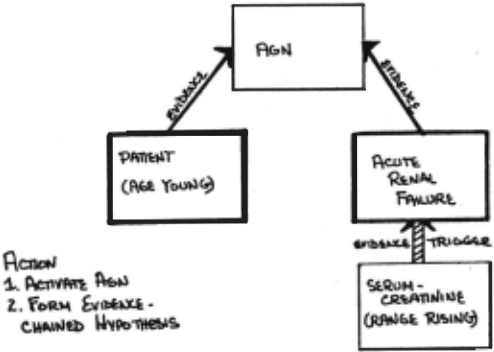
Symptoms are often not connected directly to their diseases, but to intermediately-general pathological states. It is thus important to be able to reconnect the symptoms to the actual disease; this is done via EVIDENCE-chained
hypotheses. They are formed ~hen t~o or more active elementary hypotheses have EVIDENCE chains ~hich intersect at a single etiology. For e~ample, if SODIUM-RETENTION and ACUTE-RENAL-FAILURE ~ere both active, ~e ~ould ~ant to unify them into a hypothesis ~hich postulated AGN. See Diagram 2 for an illustration of a template for this type of hypothesis.
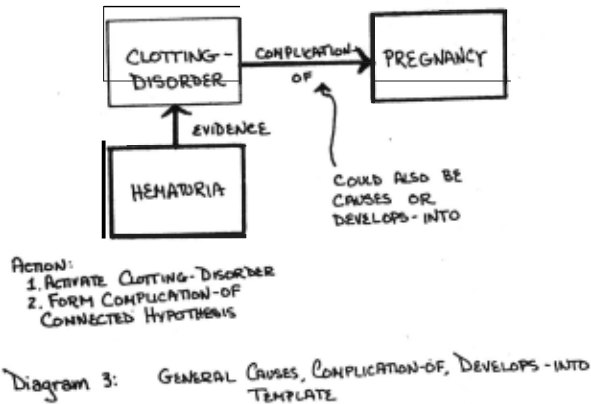
Forming a coherent hypothesis ~ith CAUSE, COMPLICATION-OF or DEVELOPS-INTO I inks may not involve activating any ne~ elementary hypotheses at all. If t~o active hypotheses are connected by a CAUSE, COMPLICATION-OF or DEVELOPS-INTO link, they may be joined into one composite hypothesis. More interesting is the caee ~here a ne~ elementary hypothesis muet be activated. A template for this situation is contained in Diagram 3. CLOTTING DISORDER is activated in order to provide the link bet~een HEMATURIA and PREGNANCY. In ~ords, ~e can activate an intermediate hypothesis ~hich has one (non-trigger) finding present and is also connected by a CAUSE, COMPLICATION-OF or DEVELOPS-INTO I ink to an active hypothesis. The ne~ly activated hypothesis provides a link between the two nodes.
Ultimately, the global assembly stage must come up with an adegyate hypothesis. The primary characteristic of an adequate hypo thea is i a that i.e accounts for all the abnormalities noted, while maintaining as much simplicity ae possible. An adequate hypothesis consists of several independent parts, each of ~hich is a coherent hypothesis. Each component must also be an ULTIMATE-ETIOLOGY or, in the case of more compleK coherent hy~otheses, it must contain some ULTIMATE-ETIOLOGY. In addition, alI acce~ted elementary hypotheses must be subsumed in the final diagnosis, either by themselves, or as part of a larger coherent hypothesis. For eKample, the follo~ing is an adequate hypothesis:
LGN
IOURATION IYEARS 1811 HYPERTENSION ESSENTIAL I~ATION I YEARS 51 I
FAMILY-HISTORY NEPHRITIS
Notice that the second component of this hypothesis is HYPERTENSION ESSENTIAL, not HYPERTENSION CHRONIC; this is because only HYPERTENSION ESSENTIAL is marked as an ULTIMATE-ETIOLOGY. HYPERTENSION CHRONIC is a symptom, not an eKplanation, ~hile HYPERTENSION ESSENTIAL is an eKplanation (actually the admission that no other eKplanation has been found!) Essentially, a process which bui Ids adequate hypothese· must oartitjon the symptoms into possibly non-disjoint subsets and account for each subset with some coherent hypothesis. Strategies for this partitioning (see <Rubin>) contribute further to the procesa of minimizing the number of active
hypotheses.
The area of medical diagnosis has been investigated as an A.l. probleM and a structure for medical kno~ledge proposed. The process postulated to act on that structure has as one of its goals the Minimization of the number of hypotheses actively consideren at any one ti·e. Local vs. global evaluation and linearity vs. ·interaction have also been studied ~ithin the contel<t of the theory.
Referenc11
1. Fahl·an, Scott, "A Hypothesis-Fra·e System for Recognition ProbleMs,· ~-57, Artificial Intelligence Lab, M.I.T., CaMbridge, DeceMber, 1973.
- Fel lor, ~il liam, An lntrodyctlon 1Q Probability Ib.Gr..u. i.asllli Appljcatjont, Vol, 1, John ~iley and Sons, Inc.1 No~ York, 1968.
- Garry, G. A., A~ f2c CoMpyter ~ Qjaqnosje, TR-44, Project MAC, M.l. T., Cambridge, September 1967.
- Garry, G. A. 11 il. Compyter Laboratgry 1QL Cl jnjcal Oecjsjon-Making, research proposal to NIH, March 1974.
- "A Frame~ork for Representing Kno~ledge,· in lbA Psychology 2f Compyter ~. P.H. ~inston, ed., Mc�ra~-Hil 1: No~ York 1975.
- Rubin, Andee, "Hypothesis Formation and Evaluation in Medical Oiagnosia,·
AI-TR-316, Artificial Intelligence Lab, M.l. T., Cambridge, January 1975.
- ~inograd, Terry, "Frame Repreaentationa and the Procedural/ Declarative Controversy,· in Bobro~ and Collins (eds.l, forthcoMing.
@inproceedings{ijcai1975p135,
  title     = {The Role Of Hypothesis in Medical Diagnosis},
  author    = {Rubin, A.},
  booktitle = {Proceedings of the Fourth International Joint Conference on
               Artificial Intelligence, {IJCAI-75}},
  publisher = {International Joint Conferences on Artificial Intelligence},
  editor    = {Patrick Winston and Carl Hewitt},
  pages     = {856--861},
  year      = {1975},
  note      = {Miscellaneous Applications Of A.I.},
  url       = {https://ijcai.org/proceedings/1975/135},
}
TY - CPAPER TI - The Role Of Hypothesis in Medical Diagnosis AU - Rubin, A. T2 - Proceedings of the Fourth International Joint Conference on Artificial Intelligence, IJCAI-75 PB - International Joint Conferences on Artificial Intelligence PY - 1975 SP - 856 EP - 861 UR - https://ijcai.org/proceedings/1975/135 ER -Copied
Machine-readable versions of this paper, for tools and AI agents:





