
l.Pak: A SNOBOL-Based Programming Language for Artificial Intelligence Applications
Proceedings of the Third International Joint Conference on Artificial Intelligence. Hardware and Software for A.I.. Pages 691-695.
© 1973 International Joint Conferences on Artificial Intelligence
Abstract
This paper describes a programming language for Artificial Intelligence applications which offers (a) a data base, in the form of a collection of labeled directed graphs where knowledge can be stored (b) pattern directed information retrieval and pattern invoked function calls (c) primitive statements which enable the user to construct flexible searching algorithms. The language is an extension of SNOBOL in its design and implementation and uses SNOBOL's string pattern matching facilities for its own (graph) pattern matching.
- McDermott, D.V . , Sussman, G.J. The CONNIVER reference manual. MIT AI Memo. 259.
- Sussman, G.J., McDermott, D.V. From PLANNER to CONNIVER: a genetic approach. FJCC, 1972, 1171-1180 .
- Hewitt, C. Description and theoretical analysis of PLANNER . MIT AI-TR-258, 1972.
- Derksen, J., Rulifson, J . F . , Waldinger, R.J . The QA4 language applied to robot planning. FJCC, 1972, 1181-1192.
- Swinehart, D., Sproull, R. SAIL. Stanford AI Project, Operating Note No. 57.2, Janaury 1972.
- Feldman, J . A., Low, J.R . , Swinehart, D. C . and Taylor, R.H . Recent developments in SAIL. FJCC, 1972, 1193-1202.
- Mylopoulos, J . , Badler, N., Melli, L., Roussopoulos, N. An introduction to l . pak, a programming language for AI applications. TR-52, Department of Computer Science, University of Toronto, May 1973.
- Griswold, R.E . , Poage, J . F., Polonsky, I . P . The SNOBOL4 programming language. Prentice-Hall, 1971 (second edition).
- Dewar, R.B . K. SPITBOL, Version 2.0 . Illinois Institute of Technology, 1971 . 10.
- Rumelhart, D., Lindsay, P.H., Norman, D.A. A process model for long-term memory. In Organization of Memory, Tulving, E. and Donaldson, W. (Eds.), Academic Press, 1972.
References were extracted automatically from the PDF and may contain errors.
Full text extracted automatically from the PDF; figures, tables and equations may differ. The PDF is the version of record.
1. Introduction
l.pak was designed and implemented in order to facilitate AI research at the Uni versity ~f Toronto. Its design was influenced by other languages designed for similar reasons such as CONNIVER[l,2], PLANNER[3], QA4[4], SAIL [5,6], and our decision to implement it as an extension of SNOBOL and keep it relatively inexpensive (in terms of the time and space required for the execution of programs).
This paper only discusses the main fea tures of l . pak, how they can be used, their relation to features offered by other languages for AI, and the success of the current imple· mentation. More details on the language are available elsewhere [ 7]. It is assumed that the reader is familiar with the basic feat ures of SNOBOL [8].
2 . The Data Base
The data base for each l . pak program con sists of a collection of directed, labeled graphs (hereafter graphs) such as that shown in FIG. 1. A list of transitive and/or intransitive edges is associated with each node, which define either properties of (the object represented by) the node or relations which hold between the node and other elements of the same graph.
A linear order exists for the nodes of each graph defined by special edges labeled NEXT. TYPE SUN
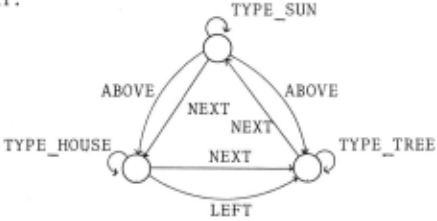
Edge labels (properties) consist of one or more a toms separated by underscores. The first atom is the attribute of the property, while subsequent atoms are its modifiers.
Information can be retrieved from the data base by matching (graph) patterns against it.
Patterns are specified in terms of se quences of path descriptions. For example, the pattern
- <$X,(LEFT AARB?Y), (FAR),$W> contains one path-description which will match paths that
- (a) Begin at the node which is the value of atom X ,
- (b) Move along an edge whose label has LEFT as attribut e and is followed by at least one modifier,
- (c) Move along an edge whose label has FAR as attribute,
(d) End at node $W .
If such a path connects nodes $X and $W for a particular data base, the pattern match succeeds and the modifier of LEFT is assigned to a tom Y , whi l e the graph pattern match returns $W , the last node visited during the match. Patterns are evaluated by the function SEARCH.
AARB is a special property pattern which will match any atom. l.pak offers several other built-in property patterns and operators similar to those offered by SNOBOL to help the user specify classes of edge labels in his graph patterns. Thus (graph) pattern matching is essentially driven by property pattern matching and can be easily implemented using the string pattern matching facilities in SNOBOL .
Note that there may be several paths which will match the same pattern. For example, the pattern match
SEARCH(<$X,(LEFT),(ABOVE FAR)>) could return node nl or n2 rn FIG. 2. The pattern match however will return just one of the two nodes.
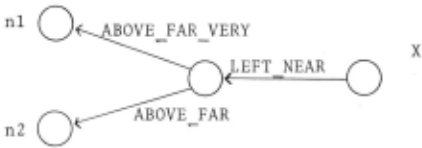
We will show later how to generate all the matching alternatives.
Information can be added to or deleted from the data base through the special functions ADD and DEL.
ADD's main function is to create new in formation with a graph as context. For example, the function call
ADD(<$X, (LEFT),(FAR) 1 ?W>)
will create enough new edges and nodes t o make the pattern match of its argument against the data base successful . In the process, a (node) value will be assigned to W . ADD will also perform a simple consistency-redundancy test for each new edge attached to a node, with respect to the edge list of that node. Thus an intransitive edge labeled TYPE HOUSE will not be added to the edge list of a node which already contains an edge labeled TYPE HOUSE TALL because it is redundant. -
An example of a DEL function call is DEL(<?X ,(LEFT) ,-$Y,(RIGHT) >) where the special operator 1 - 1 specifies that the node or edge it operates on must be deleted. For this function call, a pattern match takes place first, and if unsuccessful the call fails; otherwise the node $Y is deleted along with a ll the edges that point to or away from it .
l.pak also offers SNOBOL tables and arrays as means for representing information. Moreover, as in SNOBOL, the user can define his own data types. Explicit list facilities using CONS, CAR and CDR and list notation are provided. Expressions such as
$L = ($A, $B, $C, $D)
may be used to construct lists; here the value of L is a fou r element list.
3. Program Structure and Control
l . pak statements are similar to their SNOBOL cousins. For example, the statement A: DEL( <$X, (LEFT),-(RIGHT ABOVE)>):S(A)F(B) is labeled A , and will attempt to delete the edge whose label matched RIGHT ABOVE, if the pattern match of <$X ,(LEFT), (RIGHT ABOVE)> against the data base succeeds. If-the DEL function call succeeds, control is p assed back to A , otherwise control is passed to the statement labeled B .
Each l.pak statement will succeed or fail and this can be used for program control. Un less otherwise specified, control will pass to the next statement of a l . pak program . Thus backtracking as encountered in PLANNER and QA4 is only offered during graph pattern matching in l . pak. A different kind of backtracking will be discussed l ater .
4. Function Requests
4.1 . Explicit function reque s ts
l.pak functions can be define d through PDEFINE. For exam~le, the statement PDEFINE(NEW(X:NODEINULL,Y:PROPERTYIPATTERN,?Z)
W Wl,NEW)
defines a function named NEW with three formal parameters; the firs t must be of type NODE or have as value the null string, the second of type PROPERTY or PATTERN, while the third is called by result. Thus the statement . NEW($Xl,$Yl,$Zl)
will fail even before NEW is called because the third argument is not called by result, while
NEW($Xl, $Yl, ?Z l)
will proceed call if $Xl and $Yl is with the execution of the function is a node or the null s tring, a property or a (graph) pattern.
The specification of allowable types for each formal parameter does not mean that the type of function arguments is fixed inside a function call; it only helps to check whether the function request makes sense .
The same function name may be used inside several PDEFINE calls, thus giving the same name to several different functions. This means that a statement such as NEW($Xl,$Yl, ?Z)
may cause several function calls until one is found that succeeds. In fact, the function name specified by a function request in l . pak can be a string pattern, as in (THIAX)($X,$Y,?Z)
which will cause the call of any function whose name matches the string pattern (THIAX) (i.e., begins with TH or AX) and whose parameter description is matched by the argu ments of the f unction request.
This feat ure offers the user flexibility in specifying a f unct ion request similar to that offered by theorem provers where each axiom can be considered as a function without a name to be called whenever there is a s us picion that it may be of use .
Unlike SNOBOL, l . pak treats field desig nators of programmer-defined data types, array references and t able lookups as special cases of a function request~ Thus, if the user writes
CAR( $X )
l.pak will try to treat this as a fie ld desig nator, then as an array reference, then as a table lookup, and if all these attempts fail, it will start calling functions named CAR until one of them succeeds.
4.2 Implicit function requests
It is often the case that information not stored in the data base is act ually true in the universe of discourse. For example, a node may represent a hous e which has been recognized as one of the objects represented in a line drawing, and the question "Does there exist an object to the left of the house ? " may be asked . The user may attempt to answer it by writing
SEARCH(<$X, (LEFT* FCN),?Y>)
where X points to the nooe representing the house, and *,FCN are special modifiers to be discussed later. If the pattern match fails, either there is no such object, or it exists but it is not represented by a node in the graph where $X is imbedded. We would like to keep the value of the pattern match inde pendent of these two possibilities and have therefore introduced the notion of implicit f uncti on requests. Informally, such function requests will be invoked by the system in an attempt to construct information needed for the successful evaluation of a pattern match whenever the special modifier FCN appears at the end of a property pattern. * is also a special modifi er which specifies that modifiers that follow it should be treated differently by l .pak than atoms that precede it . In the previous example, if the sys t em has fo und no edges which leave $X and match LEFT (not LEFT* FCN), it will therefore call functions named LEFT with implicit argument $X , looking for one that succeeds.
Thus the pattern ma tch SEARCH( <$X , (DIMENSIONS AARB?Y AARB?Z AARB?W - _*_FCN) >)
will either match an edge label to the pro· perty pattern
DIMENSIONS AARB?Y AARB?Z AARB?W and will return its modifiers through Y, Z and W , or it will call a function named DIMENSIONS which has three formal parameters, all called by result, which will attempt to find the dimensions of $X . In this case the modifiers of the property for which we are trying to establish an edge were used a~ argu ments of the implicit function call, wh~le the attribute was used as a function name . In the example
SEARCH( <$X, (TYPE HOUSE TALL VERY * FCN)>) on the other hand, we may want to establish the existence of an (intransitive) edge labeled TYPE HOUSE TALL VERY by first calling the function-TYPE with only argument the node $X , then the function HOUSE with arguments $X and the output of TYPE, then TALL and finally VERY . In other words, an attempt to establish an edge in the data base may cause several function calls.
5. Generator Calls
Generators were introduced by PLANNER and used extensively by CONNIVER where they provide one of the most important language constructs. l. pak offers them too, as a method of generating alternatives.
A generator is defined by a piece of code and is assigned a name . For example,
GEN.INT, INTEGER;
$INT = $INT+l;
$DOMAIN = CONS ($INT, $DOMAIN) :(EXIT); END. INT;
defines an integer generator named INT. This generator simply considers th~ fi:st ~l~ment stored in its DOMAIN list (wh~ch ~s s~m~lar to CONNIVER's possibilities list), increments it by 1, stores the result in DOMAIN, and returns it as value. EXIT specifies that execution of this generator call is complete and that its DOMAIN list should be kept active for future calls.
A generator can be used once it has been bound to an atom. Thus
$X <= INT (5)
assigns the generator INT to X and initial izes its DOMAIN list to (5). Now whenever we write X< > , the INT generator will be evalu ated returning another integer. Note that there can be several active copies of the same generator, each bound to a different atom. For example,
$X <= INT(5); $Y <= INT(7); A: $OUTPUT= X< > + Y< >;
LT($0UTPUT,lOO) :S(A);
will assign to X the generator INT with its DOMAIN list initialized to (5) . It will also assign to Y the generator INT with its DOMAIN list initialized to (7). 5+7 will then be evaluated and assigned to OUTPUT. As in SNOBOL, any string assigned to OUTPUT is automatically printed . It is then checked whether the value of OUTPUT is less than 100 and if so 6+8 is added and printed, then 7+9, 8+10 etc.
In general, the user can pass within the angle brackets a list of expressions to be appended to the DOMAIN list of a generator each time he calls it. He can also pass an argument to be used for that particular generator call.
There are several built·in generators. For example, NODES will generate_all the nodes that lie at the end of a path wh~ch matches a given graph pattern. Thus if we write
$Z <= NODES(<$X, (LEFT),(ABOVE FAR)>) the first time Z< > is encountered with background the graph shown in FIG . 2, it will return, say, node nl , the ~ec~nd ~ime n~de nZ , and if it is called aga~n ~t w~ll fa~l.
6. More on Backtracking
In some cases backtracking (i.e., reset of the program state in case of failure) will not be necessary, but in others it will save the programmer considerable effort. l.pak allows a form of backtracking by extending the feature of declaring variables local to a function or a generator in several directions:
(a) All variables which appear in a function or generator body can be declared local for_a particular function or generator call by us~ng the keyword VLOCAL during the function defin ition or generator definition or binding . LOCALness may be specified as dependent on the success of failure of a function or generator call by using SVLOCAL or FVLOCAL instead of VLOCAL . Thus FVLOCAL defines a backtracking situation (i . e . , reset in case of failure) for program variables onl~ for t~e funct~on or generator it is assoc~ated w~th.
(b) Changes made to the data base can also be declared local by using SDLOCAL, FDLOCAL or DLOCAL.
If the user wants a reset of variables and the data base state, he can use SLOCAL, FLOCAL or LOCAL. This way he has some flexi bility in specifying exactly which changes in his program he considers reversible and under what conditions.
7. Examples
This section describes three simple l . pak programs which demonstrate the features al ready discussed and point out a few others that are not as important.
Suppose that we want to define a collec tion of functions named LEFT which somehow express adequately our own notion o~ what_LEFT means (geometrically) . These funct~ons w~ll be defined with respect to a list, $LIST, of objects and it will be assumed that there exists a function REL.LEFT which succeeds or fails depending on whether the object repre sented by its first argument is to the left of the object represented by its second argument.
First we give a definition of LEFT which postulates its transitivity
PDEFINE(LEFT(TAIL:NODE,HEAD:NODE)~_AUX, LEFT,DLOCAL);
BEGIN.LEFT;
$Z <= NODES(<$TAIL,(LEFT)>); $AUX = Z< > :F(FRETURN);
A: ADD(<$AUX,(TRIED)>) :F(B); IDENT($AUX,$HEAD) :S(RETURN);
B: $AUX = Z<(<$AUX,(LEFT)>) > :S(A)F(FRETURN); END.LEFT;
This function will be evaluated as follows for given $TAIL and $HEAD:
(a) z is bound to the NODES genera~or des cribed in section 5 with its DOMAIN l~st initialized to the pattern <$TAIL,(LEFT)> . Thus the first call . of Z will return a node to the LEFT of $TAIL which is assigned to AUX. (b) Each node assigned to AUX is labeled TRIED by ADD. If $AUX already has an intrans itive edge labeled TRIED, ADD fails (because it cannot change the data base) and another node to the LEFT of $TAIL is assigned to AUX. (c) It is checked whether $AUX is IDENTical to $HEAD, and if so the function call RETURNs; (d) Otherwise, another node to the LEFT of $TAIL is assigned to AUX and the new graph pattern <$AUX, (LEFT)> is appended to the
- DOMAIN list of Z .
When all the nodes to the LEFT of $TAIL have been considered, Z will start gener ating nodes to the LEFT of nodes to the LEFT of $TAIL, and this will be repeated until all the nodes to the LEFT of nodes ... to the LEFT of $TAIL have been tried. Because of the third argument of PDEFINE, all changes made to the data base will be erased when the call to LEFT is complete, also AUX, Z will be reset to the values they had before the function call.
Thus this definition of LEFT defines a breadth-first search of the graph where $TAIL is imbedded in an attempt to find $HEAD, and it has been formulated by using the generator feature. it is interesting to compare it with the following l.pak function which also postu lates the transitivity property of LEFT, by relying on graph pattern matching and implicit function requests:
PDEFINE(LEFT(TAIL: NODE ,HEAD: NODE) , SLEFT);
BEGIN.SLEFT;
SEARCH(<$TAIL,(LEFT),$HEAD>) :S(RETURN); SEARCH(<$TAIL,(LEFT), (LEFT* FCN), $HEAD>) :S(RETURN)FTFRETURN);
END.SLEFT;
Here it is first checked whether there is an edge with attribute LEFT connecting $TAIL to $HEAD, and if this is not the case, it is checked whether there is a node, say nl , such that there is an edge with attribute LEFT con necting $TAIL to nl , and nl and $HEAD can be connected with an edge labeled LEFT. In checking for the latter condition, the us e r has specified that implicit f unction r equest s involving LEFT-named functions are allowed. This is a recursive definition of transitivity for LEFT in other words. The searching algor ithm it defines is depth-first and may enter an infinite loop for graphs representing geo metrically strange worlds.
The second definition of LEFT accepts two nodes as arguments and succeeds or fails de pending on whether the object represented by the first node is to the LEFT of the object represented by the second
PDEFINE(LEFT(TAIL:NODE,HEAD: NODE)A B, TLEFT);
BEGIN.TLEFT;
SEARCH( <$TAI L,(REPR AARB?A) : $HEAD,(REPR-AARB?B)>)
- : F (FRETURN) ; REL.LEFT($$A,$$B) :S(RETURN)F(FRETURN); END.TLEFT;
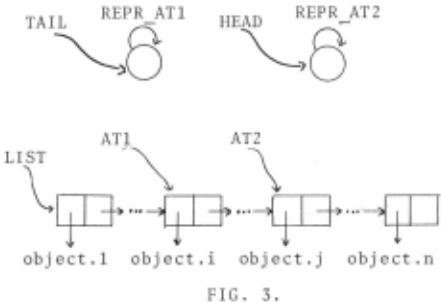
The graph pattern match executed by SEARCH finds the atoms which modify REPR on intransitive edges associated with $TAI L and $HEAD and assigns them to A and B respec tively. '·' specifies the end of one path description and the beginning of another. The values of the two atoms assigned to A and B are the elements of $LIST represented by $TAIL and $HEAD (FIG. 3). Once these atoms are found, REL.LEFT can be HE\_, a called with arguments the objects object.i, object.j, represent ed in some way.
A third possible definition of LEFT as a generator returns nodes representing objects to the LEFT of a given node $TAIL which is passed as message to ·the generator, and is also a global variable :
$LEFT <= LEFTDEF(#$TAIL)
This statement assigns to LEFT the generator LEFTDEF with its DOMAIN list initi alized to the unevaluated expression $TAIL ('#' keeps its operand unevaluated until it is encount ered at execution time, and is therefore similar to the SNOBOL unary operator '*'). Below we define LEFTDEF.
GEN.LEFTDEF, NODE;
GA: $LEFTDEF = SEARCH(<$LEFTDEF,(NEXT) >); IDENT($LEFTDEF , $TAIL) : S(FRETURN); SEARCH(<$TAIL ,(LEFT * FCN),$LEFTDEF>) -- :F(GA); $DOMAIN = ($LEFTDEF) :(EXIT);
END.LEFTDEF ;
Whenever this generator is executed, LEFTDEF is fi rst assigned the value of TAIL (this is done automatically by the system). Then the NEXT node is found and assigned to LEFTDEF; NEXT defines a circular order on the nodes of the graph where $TAIL is imbedded, and we are using it here in order to traverse the graph. It is checked whether $LEFTDEF is IDENTical to $TAI L, which would mean that we are back at the starting node and there are no more nodes to the LEFT of $TAIL ; if not, it is checked whether the current value of LEFTDEF is to the LEFT of $TAIL. Implicit function requests are allowed for this check. If the answer is negative, control returns to the statement labeled GA and another node is assigned to LEFTDEF, otherwise the DOMAI N list of LEFTDEF is set to ($LEFTDEF), a one-element list, and we EXIT. Next time this copy of LEFTDEF is called, search will resume with the NEXT node in the graph where $TAIL is imbedded until they have all been cons idered.
The user can now write SEARCH(<$X,(LEFT * FCN),$Y>) or SEARCH(<$X, (LEFT-*-GEN) , ?Y>) and expect the system to either fi nd the necessary information in the data base or to call the appropriate functions or generators (depending on whether the special modifi er is FCN or GEN) in an attempt to construct it .
8. Discussion
l . pak has been implemented in SPITBOL [ 9 ] , an efficient version of SNOBOL . SPITBOL uses both a compiler and an interpreter, offers most SNOBOL features (in particular the func tion EVAL), plus a few more, has a very fast garbage collector and handles user-defined data types very efficiently. It requires approximately -50K bytes and runs several times faster than the BTL implementation of SNOBOL.
Some of the reasons that led us to choose SNOBOL over other candidate l anguages are listed below:
- (a) It offers pattern matching facilities . This has helped the design and implementation of graph pattern matching; moreover, SNOBOL users will have no difficulty adapting to the graph pattern matching formalism since it is an extension of string pattern matching.
- (b) It offers tables and user-defined data types . These features were used extensively during the implementation of the l .pak system, and are offered by l.pak at very little extra cos t .
- (c) SNOBOL's control structure is unusual but flexible and well-suited to AI applications programming. l.pa k offers most of that control structure, in addition to the various shades of the LOCAL feature, function requests, gener ator calls etc.
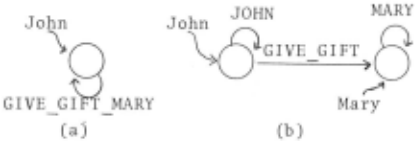
Labeled graphs have already been used for the representation of knowledge (e.g . , Palme [10], Rumelhart et al [11]). l.pak graphs have the additional feature however that the user has a choice of representing a piece of information structurally or as a property . Which form he chooses should depend on how often the parts of this piece of infor mation will be retrieved and manipulated inde pendently of each other. For example, the statement "John gives a gift to Mary" could be represented (rather crudely and with various subtleties of the sentence's meaning ignored) by the graph shown in FIG. 4(a), 4(b) or 4(c), depending on whether we will be referring explicitly to the gift or Mary and their properties, or will simply refer to them as parts of a property John has.
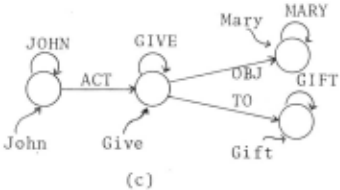
Unlike PLANNER etc., 1 . pak 1 s data base offers only partial associativity. This may be inconvenient for the user in certain cases, but it offers him more control over his data base's thirst for memory space . More con vential data structures (arrays, tables, user de fi ned data types) are also available in l . pak a t very little expense for the l.pak system since they are mostly handled by SNOBOL.
Graph pattern matching offers many features found in PLANNER in that a similar backtracking mechanism is used and implicit function requests can be considered as con sequent theorem calls. If the user agrees with Sussman and McDermott's criticism of PLANNER's backtracking [ 2], he can switch to a programming style favoring generators where he has more control over the backtracking mechanism he uses. We feel that both features will be found useful .
The l . pak implementation uses both a compiler and an interpreter and requires a minimum of -140K (this includes -50K for the SPITBOL system) . There are plans to use l.pak for question-answering, scene analysis and natural language understanding to test it and find which features are useful and should be made more prominent and which ones should be modified.
Acknowledgements
We would like to thank Carl Hewitt for several useful suggestions, also Walter Berndl for helping us with the implementation and portions of the design of l.pak. This research was partially supported by DOC and DRB grants.
@inproceedings{ijcai1973p86,
  title     = {l.Pak: A SNOBOL-Based Programming Language for Artificial Intelligence Applications},
  author    = {Mylopoulos, John and Badler, Norman I. and Melli, L. and Roussopoulos, Nick},
  booktitle = {Proceedings of the Third International Joint Conference on
               Artificial Intelligence, {IJCAI-73}},
  publisher = {International Joint Conferences on Artificial Intelligence},
  editor    = {Nils J. Nilsson},
  pages     = {691--695},
  year      = {1973},
  month     = {8},
  note      = {Hardware and Software for A.I.},
  url       = {https://ijcai.org/proceedings/1973/86},
}
TY - CPAPER TI - l.Pak: A SNOBOL-Based Programming Language for Artificial Intelligence Applications AU - Mylopoulos, John AU - Badler, Norman I. AU - Melli, L. AU - Roussopoulos, Nick T2 - Proceedings of the Third International Joint Conference on Artificial Intelligence, IJCAI-73 PB - International Joint Conferences on Artificial Intelligence PY - 1973 SP - 691 EP - 695 UR - https://ijcai.org/proceedings/1973/86 ER -Copied
Machine-readable versions of this paper, for tools and AI agents:





