
On a Local Approach to Representation in Problem Solving
Proceedings of the Third International Joint Conference on Artificial Intelligence. General Problem Solving. Pages 612-616.
© 1973 International Joint Conferences on Artificial Intelligence
Abstract
The common feature of all of the problems discussed in this paper is that, in their initial formulation, they have a large number of elements with different names, and for this reason the problems seem to be difficult. However, the first attem~ta to solve the problems give the necessary heuristic informat.ion for simplification of the problem description and a reduction in the number of different names for the elemente. We could say that the desire to cut down the number of names is a "global idea•: but the choice of names and the algorithm of naming are contained in the first attempts. It is important to stress that the reduced description obtained is not always useful for the solution of the original problem, but it turns out to be useful for some of such problems.
- McCarthy, J., "A Tough Nut for Proof Procedures," Stanford University AI Project Memo No. 16, 1964.
- Nilsson, N. "Problem Solving in Arti- ficial Intelligence," 1971 McGraw-Hill.
- SIGART Newsletter, No. 36, October 1972, pp 9-27.
- Stefanuk, V.L., "Collective Behaviour of Automata and the Problems of Stable Local Control of a Large Scale System," Proceedings of the II IJCAI, London, 1971. IJCAI
- Simon, H.A.; Siklossy L.A. (editors), "Representation and Meaning," Prentice- Hall, Inc., 1972, pp 423-425.
- o~ ~~( S. Washington Downtown Seattle (Simplified Plan) 617
- Yesler Way Jackson St.
References were extracted automatically from the PDF and may contain errors.
Full text extracted automatically from the PDF; figures, tables and equations may differ. The PDF is the version of record.
ON A LOCAL APPROACH TO REPRESENTATION IN PROBLEM SOLVING
V.L.Stefanuk Institute for Information Transmission Problems Academy of Sciences U.s.s.R. Ul. Aviamotornaya 8, a Moscow E-24 u.s.s.R.
Set of Descriptive Terms: Representation, "Tough Nut" Problem, Local control, Inva riant description, Simplification of description, Reduction of names
Abstract
The common feature of all of the problems discussed in this paper is that, in their initial formulation, they have a large num ber of elements with different names, and for this reason the problems seem to be difficult. However, the first attem~ta to solve the problems give the necessary heuristic informat.ion for simplification of the problem description and a reduction in the number of different names for the ele~ mente. We could say that the desire to cut down the number of names is a "global idea·: but the choice of names and the algorithm of naming are contained in the first attempts.
It is important to stress that the reduced description obtained is not always useful for the solution of the original problem, but it turns out to be useful for some of such problems.
This paper shows that local attempts to begin to solve a problem can be very useful, as sometimes they let one simplify the pro blem description and thus facilitate the solution of the original problem.
We feel that each time some heuristic is formulated (for instance, "try to occupy and to keep the center" in chess), it is formulated not because we know how to solve the total problem (how to win in chess), but as a result of studing some local subproblems. Of course, as this heuristic is formulated on the basis of some local consideration, its usefulness for the whole problem should be separately proved (theo retically or experimentally).
Tough Nut and Other Similar Problems
One of the most interesting problems showing the importance of a good. representa tion is the "Tough Nut" problem.1,2 The problem, briefly, is to prove the impossibi lity of fully covering a chessboard, with two diagonally opposite squares removed, using domino pieces. The black/white colo ring of the board leads to the simple solution.
One could reason that the successful coloring of the board in this case is simply an "insight" which is a rather natural thing for a person familiar with the chess board from his childhood.
Here we will try, however, to look at this matter from a different point of view and to show how one could "make a guess" about the board coloring, without appeal to purely human experience.
The difficulty of the Tough Nut problem in its initial formulation lies in the fact that one is given with the board descri~tion simply as a two-dimensional field. II Cij II , i,j = 1, ··· ,8, of square cells (w~th · C11 , Cas removed), and the right decision about placing the first pieces is completely unclear because the end result is not eas~ly seen.
Indeed, the only way to describe our actions (positioning of the pieces on the board) is to display the names ( Ci. ) of covered cells. Tn the original formUlation of the problem all of the cells have diffe rent names. Such a naming allows only the strategy of solving the problem using a complete search and does not serve as a base for pruning the search tree.
From this point of view, the idea of somehow reducing the number of different names seems to be very reasonable, as it could bring out some information about "identical" positionings. In other words, we see that the only way to achieve a more or less uniform description of our actions is to reduce the number of names used.
The extreme case: one name is used for all of the cells. This gives us a highly uniform description because our different actions (positionings) differ only in the number of covered cells. This naming obvious ly could help one only in solution of the simplest problems.
Using two names one could get a less tri vial but nevertheless a very uniform descri ption of the following situation: "a domino is put somewhere on the board." It is easy to see that it could be achieved only for a certain assignment of the two names to cells--namely chess assignment. Then we indeed come to invariant description of the board.
To clarify these ideas and to display the limitations inherent in this approach we consider a number of other similar problems.
Other Examples of Similar Problems ( The Problems of Enlargement )
In all the problems below we will follow our chain of reasoning--using a small number of different names for elements of a problem and then getting a certain assignment of the names to different elements in a way which will give us an invariant description of our actions. We'll see that the procedure of assignment has a very simple "algorithmic" character.
- Let us decide to present a certain
array of square cells as a sum of elements not of the "domino" form

rn
as in the Tough Nut problem, but of the form

Here the chessboard consideration can not be directly applied. However, using two names 0,1, one could achieve, for instance, the following invariant description:
| 0 | 0 | 1 | 0 | 0 | 1 | 0 | 0 | 1 |
| 1 | 0 | 0 | 1 | 0 | 0 | 1 | 0 | 0 |
| 0 | 1 | 0 | 0 | 1 | 0 | 0 | 1 | 0 |
| 0 | 0 | 1 | 0 | 0 | 1 | 0 | 0 | 1 |
| 1 | 0 | 0 | 1 | 0 | 0 | 1 | 0 | 0 |
| 0 | 1 | 0 | 0 | 1 | 0 | 0 | 1 | 0 |
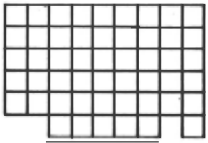
With this description it is easy to show the impossibility of building the array
-
using a combination of "enlarged cells"

Obviously, we could not get an invariant description in this case using more than three names for the cells. For three names 0,1,2 one can get the following invariant "coloring"
| 0 1 | 2 | 0 | 1 | 2 | 0 | 1 2 | |
| 1 2 | 0 | 1 | 2 | 0 | 1 | 2 | 0 |
| 2 0 | 1 | 2 | 0 | 1 | 2 | 0 | 1 |
| 0 1 | 2 | 0 | 1 2 | 0 | 1 | 2 | |
| 1 2 | 0 | 1 | 2 | 0 | 1 | 2 | 0 |
| 2 0 | 1 | 2 | 0 | 1 | 2 | 0 | 1 |
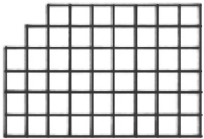
which also indicates that a combination of such cells could not be used to construct the following array It can be easily seen that to get a suita ble coloring in this case, it is necessary and sufficient to get a corresponding colo ring of the following 3 x 3 array:

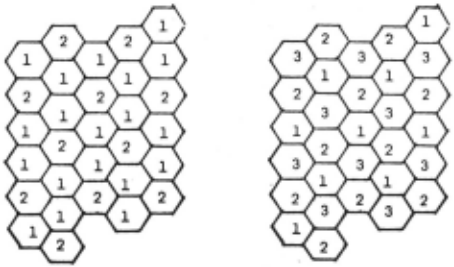
2. In the same manner it can be shown that in case of hexagonal cells it is impossible, using the blocks

"to build" from them the following array of such cells, both using two or three names:
3. Suppose we are to prove 5 that: "A 6 x 6 x 6 cube cannot be constructed from bricks that are uniformly 1 x 2 x 4 in size."
Obviously we need not consider bricks so that they are not parallel to the sides of the cube. Similarily, a brick should be positioned only in an n-unit distance from the sides (n = 0,1,2,3). Taking this into account we can consider an assertion equiva lent to the previous one:
"A 6 x 6 x 6 cube, composed from 1 x 1 x 1 subcubes cannot be presented as a sum of blocks of the subcubes which are 1 x 2 x 4 in size."
Using two names ("black" and "white") for subcubes we easily come, for instance, to the following invariant descriptions {again, The latter description obviously does prove the assertion, as the number of black and white subcubes are not equal.
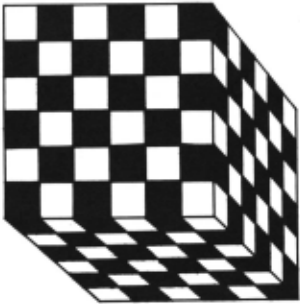
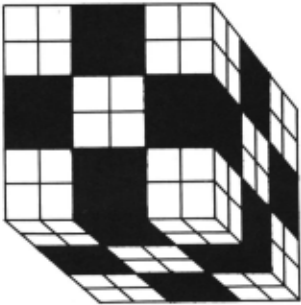
An approach to this problem in [5] is one that we call "insight." Indeed, the solution of the problem there is introduced with the phrase: "Imagine the cube to be made up of 2 x 2 x 2 cubes. Give each such cube the coordinates i,j,k (1 i,j,k 3), in the usual way. Color black the cubes whose coordinates add up to be an odd number; color the remaining cubes white." (It is interesting to note that guite similarly the "Tough Nut problem" in [5J from the very beginning is referred to as "the checkerboard -domino problem.")
4. We saw ·that the received description does not always help one in deoision making. Moreover, does not always exists even one such invariant (simplified) description. As an example, consider the problem of building an array of squared cells as a sum of enlarged elements It is obvious that with such blocks one coul not find a non-trivial invariant description of the a~ray EB


So in this way we unable to show that the array

could not be presented as a sum of such bloc The last example is a case when local considerations do ·not permit one to get the "global answer." Note, that in all examples used in this paper we used the idea of ~ettin2 an invariant descrintion in the stage of assignment of small number of names to different elements. Of course, some other consideratione(like simmetry) could be used too. Though these considerations are beyond of the scope of present paper, and will be given somewhere else.
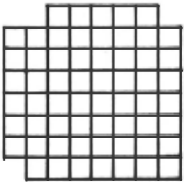
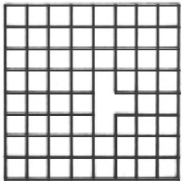
5. Anticipating one of the possible questions concerning the last case, we will give one example more. Considering the following enlarged blocks

with the same local approach we could achieve as an invariant description the chessboard coloring that shows that it is impossible to build from such blocks either of the two fol lowing arrays:
liote on the "Chessboard Coloring"
The following discussion is based mainly on the author's intuition, and is not vital to the rest of the paper.
Previously we have mentioned that it is natural to think that it is the chessboard that gave us a hint of how to solve the Tough Nut probleml. We tried above to show that one could come to the idea of proper coloring from the purely local consideration in writing down the results of our actions while problem solving.
Maybe it would be interesting to think a little about why the chessboard was painted in the usual manner.
One can think that this coloring is not very necessary. Indeed, in all modern chess playing computer programs 3 this black-and -white coloring usually appears only on a computer display for the convenience of human · beings and it is not taken into account in the computer program itself, even though in chess theory there exists notions of, for example, the black-field bishop and white -field bishop. However, the black~field bishop always will keep track of the black field even if it doesn't see the colorl
Below we will give one of the possible considerations, explaining how such a colo ring could follow again from the local con sideration of reducing the number of diffe rent names used for the chessboard fields. (In computer programs we have 64 names for the cells. In common chess notation, used, for instance, in the USSR, each row is numbe red (1,2, ··· ,8), and ea.ch .. column has a letter name (a~b,c,d,e,f,g,h).)
Note first that the white player in chess has an advantage of one movel However,. it would not be true to say that white usually wins.
We think that the reason for it lies in the fact that the first-move-advantage is partially compensated for by the initial po sitioning of chess pieces, which is not perfectly symmetrical. The initial position is only mirror simmetrical (the kings are opposite each other).(The author discussed that hypothesis with an experienced chess player, who noticed that he felt that in a central symmetrical chess game the move of the white king pawn could almost surely lead to a win. Unfortunately, at this time, we haven't any experimental varification of this supposition.)
So, we beleive that we gave an unswer why in chess there is only mirror symmetry.
Note, now that this mirror symmetry re quires a certain convention on how each play er should put his pieces on the chessboard. It is not difficult to see,that for black -and-white boards this convention has the most simple form, allowing partners to put their pieces on the board independently (otherwise, we have to use more than two names for board cells . ).
Local Control of Taxis in a City
We are now going to consider the represen tation problem for quite a different area- that of traffic in the city. We will see that the idea of using a small number of names for elements is applicable here too,and that concrete assignment of the names could be again founded from local attemts to solve the problem (like positioning of a piece in Tough Nut) and a desire to get uniform descri ption of our actions. The main difference from the previous problems we see in the fact that here "names" have quite an obvious physi cal interpretation. This makes the traffic problem more r~lated to other problems of local control.
In the last paragraph we will give a table of correspondence between the two classes of problems.
1. Imagine a city with cars of two kinds- taxis and others. A taxicab that knows apri ori the exact location of demands (therefore for him there is no problem of"search for a demand") will be considered to be a non -taxi. That is, in accordance with our defi nition, a free taxicab must search for de. mands and be ignorant of demand locations. We will consider below only this idealistic taxi problem.
The most detailed description for this problem (analogous to that for the Tough Nut problem) is the case where all the cars in the city (taxi and non-taxi) have individual names (for instance , their registration numbers).
In the other extreme case (trivial descrip tion), all the cars are indistinguishable. Limiting them to two to three names, let us think about their appropriate assignment. The action here is the choice of direction for a free taxi when it approaches a street crossing. Let us consider one cross-street. Locally, it is obvious that if one of the taxis has just left the place where it re ceived a passenger and it comes across a free taxi, it is very important for the latter to learn, that the car he has just met is a taxi, and, that the taxi is occupied.
So from this local consideration, it follows that for the choice of actions (direction) one might use the following names:
* = non-taxi
0 = free taxi
1 = occupied taxi
Taking into account these names, we could hope that the taxi might find a demand quicker than in a case of a blind search. It is only a heuristic idea, gained from purely local considerations, and it is not clear now whether it would work for the problem as a whole.
2. This problem was simulated on a SIGMA 5 computer of the University of Washington. We will not present here the details of the program. As an example , downtown Seattle was used, with appropriate ("natural") locations of demand (figures near street crossings at the picture at the end of present paper).
The number of demands was initially fixed and the total time for their full satisfac tion was computed (no new demands allowed).
The total time up to the moment of picking up the last passenger was calculated for different cases:
- All the cars in the City have the same name (*) (each taxi moves in a purely random way) ·
- The~e are non-taxis (*) and taxis (each taxi moves in a direction from where it sees the .minimal number of taxis).
- There are two names: cars (*) and non-occupied taxis (0). (Taxis move in the direction from where they see the minimal number of free taxis.)
- There three names: *, 0, and 1. (Taxi moves as in Case C, but if there are ties, it goes in the direction of the maximum number of occupied taxis.)
Initially all the taxis were placed in a cer tain location in the city (marked + at the picture). In the following table we give the total time (in a fixed measuring system) for different numbers of taxicabs in the city.
| K | A | B | c | D |
| 25 | 16.8 | ! 12.8 | 14.3 | 12.0 |
| 50 | 11.70 | 6.95 | 6.61 | 6.54 |
| 100 | 9.38 | 4.45 | 5.25 | 4.02 |
| 200 | 5.73 | 2.67 | 3.25 | 2.70 |
Thus we can see from the table that it is reasonable to use the names that we have got ten from purely local considerations, having in mind the global problem of minimization of total time required for fulfillment of all demands.
3. Perhaps it is appropriate to make seve ral general remarks concerning this taxi problem itself. We are making use of the names of care for local control of their movement around the city, but the very same names are convenient for passengers waiting for taxis. For this reason we have speeial signs on the cars-- taxi, free/occupied. Such signs are different for different countries and even for different cities and companies.
In London, a taxi has a very special "ancient" shape, quite different from the shapes of other cars. In New York a taxi is a bright yellow color. In Seattle, Washin gton, the color and means of showing whether or not a given taxi is free depends to a certain degree on the company, and there is no standart rule. Now we can see that these signs could be important for taxi drivers themselves and therefore it may be desirable to standardize them.
Conclusion
The distinction between two classes of problems, considered in first and the third paragraphs of this paper, is an obvious one. The first covers exclusively problems of mathematics of combinatorial nature; the second--a "real-life problem." Below we give the correspondence between them.
Elements
Squares of a board (cubes,hexagonale)
Cars
Elementary Actions
Positioning of a piece Choice of the direc tion for a car to go at a street crossing
One name--Trivial Description
It is of interest only for the simplest problems (i.e.,to pro ve the impossibility of covering with two square dominos a board containing an odd number of squares).
The only possible decision--a random choice of the direc tion--Case A (the largest total time).
Two or More Names
The local considerati- The thoughtful consi ons of positioning for deration of local a piece is used for assignment of the names sical hints" let us There are no "physical achieve a good assig hints" for how to do it, instead we have a We need not consider desire to get a uniform any "stupid" assign description of an ele- ment. Though, in mentary action, inde- automatical problem pendent of the place on the board (invari- several possible loant).
Acknowledgement
We wish to express our thanks to Professor A.D.C.Holden and Professor M.Damborg, Univer sity of Washington, and to the members of Electrical Engineering and Computer Science Departments. They were always ready to help during my research visit to the University.
@inproceedings{ijcai1973p76,
  title     = {On a Local Approach to Representation in Problem Solving},
  author    = {Stefanuk, Vadim L.},
  booktitle = {Proceedings of the Third International Joint Conference on
               Artificial Intelligence, {IJCAI-73}},
  publisher = {International Joint Conferences on Artificial Intelligence},
  editor    = {Nils J. Nilsson},
  pages     = {612--616},
  year      = {1973},
  month     = {8},
  note      = {General Problem Solving},
  url       = {https://ijcai.org/proceedings/1973/76},
}
TY - CPAPER TI - On a Local Approach to Representation in Problem Solving AU - Stefanuk, Vadim L. T2 - Proceedings of the Third International Joint Conference on Artificial Intelligence, IJCAI-73 PB - International Joint Conferences on Artificial Intelligence PY - 1973 SP - 612 EP - 616 UR - https://ijcai.org/proceedings/1973/76 ER -Copied
Machine-readable versions of this paper, for tools and AI agents:
 Welcome
 Future Conferences
 AI Journal Division
 IJCAI Proceedings
 About IJCAI
 IJCAI Awards