
Steps Toward Automatic Theory Formation
Proceedings of the Third International Joint Conference on Artificial Intelligence. Theorem Proving and Logic: 2. Pages 121-128.
© 1973 International Joint Conferences on Artificial Intelligence
Abstract
This paper describes a theory formation system which can discover a partial axiomization of a data base represented as extensionally defined binary relations. The system first discovers all possible intensional definitions of each binary relation in terms of the others . It then determines a minimal set of these relations from which the others can be defined. It then attempts to discover all the ways the relations of this minimal set can interact with each other, thus generating a set of inference rules. Although the system was originally designed to explore automatic techniques for theory construction for question - answering systems, it is currently being expanded to function as a symbiotic system to help social scientists explore certain kinds of data bases.
- Plotkin, G. D. "A Further Note on Inductive Generalization," in Machine Intelligence, Vol. 6 New York, New York: American Elsevier Publishing, 1971.
- Lawler, E. L. "Covering Problems: Duality Rela- tions and a New Method of Solution." J. SIAM Applied Math, XIV (Sept. 1966), pp. 1115-1132.
- Brown J, S. Unpublished Doctoral Dissertation, University of Michigan; or ICS TR #17, University of California at Irvine.
- Brown, J. S. "Question Answering Through Parsing" ICS TR #24, University of California at Irvine.
- Ash, W., and Sibley, E. H. "TRAMP: an Interactive Associative Processor with Deductive Capabilities~ Proceedings ACM National Conference. Las Vegas, August, 1968.
References were extracted automatically from the PDF and may contain errors.
Full text extracted automatically from the PDF; figures, tables and equations may differ. The PDF is the version of record.
Introduction
For over a decade researchers in AI have been designing question- answering systems which are capable of deriving "implicit" facts from a sparse data base . Whether these systems use an axiomatic theorem proving approach or a procedurally oriented approach, they all must eventually face the problem of characterizing the generic knowledge or structural redundancies of their particular domain of discourse . Even the simplest of such domains contains countless subleties which somehow must be captured before a complete characterization can be achieved.
In this paper we discuss the problem of automat ically constructing such a characterization. Our research has not been directed toward a theoretical 1 investigation of this general problem as in Plotkin but rather towards constructing and experimenting with a prototype system. which has been applied to large and structurally rich domains . We will provide numerous examples to show what is involved in forming conjectures about "apparent" structural redundancies in a given data base (model) and how such conjectures can be heuristically validated. The search for structure is inherently combinatorial . We will there fore discuss some ways to control the combinatorial explosion involved in forming and validating struct ural conjectures. Finally, we will discuss ways in which such a system might be used to help a social scientist discover structural theories about a set of observatidns over some "world". Indeed, our eventual aim is to expand this system into a tool for such uses.
Problem Definition
Before describing our system, a definition of the vague term "structural redundancies" is in order. Let us consider a data base consisting of the com plete extensions of a collection of binary relations R = jR 1 ... Rn .f. That is, for each Ri E R the data base contains all the triples (x Ri y) for each (x,y)ERi· The structural redundancies of this data base fall into three basic categories . The first category occurs where one of the relations is
STEPS TOWARD AUTOMATIC THEORY FORMATION
John Seely Brown Information and Computer Science Department University of California Irvine Irvine, California
intensionally definable in terms of other relations in this data base . For example, suppose we have the three relations of Grandparent, Parent, and Spouse, each extensionally defined over some fixed universe P of people. Then, assuming the extensions of each relation are complete, we could discover the struct ural redundancy that for every (x,y)E C.randparent there exists a z such that:
(x,y) E Grandparent iff (x, z)EParent and (z ,y) E Parent
or Grandparent = Parent/Parent where "/" denotes composition. If we represented the extensions of all the relations as a directed labelled graph, then for every arc of the form:
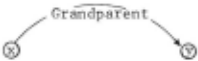
there would be a path of the form "Parent - Parent" bridging the triple (x C.randparent y) i . e . :
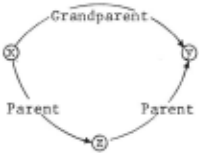
In other words, if"C.randparent =Parent/Parent "holds, then the data base graph will always have a path of length two whose labels are "Parent" and "Parent" bridging every arc labelled "Grandparent" .
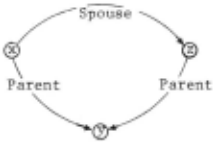
An intensional definition of a relation can also be recursive as would be the case with the definition of Parent in terms of Spouse, e . g . :
Parent = Spouse/Parent
In this case, for every arc of the form (x Parent y) there are two other arcs of the form (x Spouse z) and (z Parent y), i . e . :
The second kind of structural redundancy occurs where the existence of a path in the graph forms a sufficient but not a necessary condition for some other arc to exist . For example, suppose we augment our data base to include the extensions of the Sib ling and Cousin relations over the same domain P. We would then discover that for every path of the form (x Sibling z) and (z Cousin y) there was always an arc of the form (x Cousin y) . Such a pattern would lead to the rule:
Sibling/Cousin => Cousin
The third and simplest kind of structural redundancy occurs where the relation itself has cer tain logical properties such as:
Transitive Symmetric Reflexive
Irreflexive
The first two kinds of redundancies cover how a given relation interacts with other relations in R, whereas the last kind covers only how a relation interacts wi th itself.
The structural patterns comprising all three categories form the basis of a logical theory (or axiomatic characterization) of the data base in the following way :
Initially, the data base consists of the com plete extensional definitions of all the given rela tions. After our system discovers all the intension al definitions of the relations, then some subset of these relations can be selected (to be called the atomic relations) from which the e~tension of all the remaining relations can be derived. The extension of a non-atomic relation can be computed by knowing only its intensional definition in terms of the selected atomic relations. Consequently, the extensional definitions of all non-atomic relations can be dis carded with no loss of information. In addition, the extensions of the atomic relations can be pruned by using structural properties in the second and third categories. For example, if an atomic relation is symmetric, then half of its extension can be eliminated without loss of information. With respect to the two structural redundancies:
Parent = Spouse/Parent Spouse symmetric
half of the parent and spouse extensions can be like wise discarded. What remains after all tre redundant extensions have been eliminated is a kernel set of extensions.
The structural rules defined by the set of inten sional definitions, the logical properties of the atomic relations and the implicational statements in conjunction with a kernel set of extensions suffice to determine the complete extensions of all the relations. These rules plus the kernel -set of data form a logical theory of the original extens ional relations. Note that the complete extensional set of relations is necessarily a logical model of the resultant "theory". The fact that this model (or equivalently -- the extensionally defined rela tions) is finite, as far as our system is concerned, presents the interestin~ situation that our system will often produce numerous rules that hold fer this finite collection of data but which appear to be idiosyncratic. That is, if the collection of data is really a sample from some potentially infinite model, then of course numerous "rules" may be found that might prove to be false when the data base is enlarged.
* Techniques to select the atomic sets are not discussed here but are discussed at length in Brown3.
On Discovering Intensional Definitions
The basic idea underlying the discovery of in tensional definitions is quite simple. Suppose we are trying to discover all the possible definitions of Ri E R. Since Ri exists in the data base, it has a set of 2-tuples which represent its extension. We commence our process by arbitrarily choosing one of these 2-tuples (xi·Yi) and then searching for all possible simple directed paths that start at Xi and end at Yi · We then delete the intermediate nodes of each such path leaving only an ordered list of the labels of the path which we will call a Labelled Path Sequence (LPS). The end result of this process is a list of distinct LPS's, each stemming from at least one specific path from Xi to Yi· (Several xi - > Yi paths can collapse onto one LPS.)
Depending on storage limitations etc., we repeat this process several times, choosing a different 2-tuple from Ri 's extensions for each repetition. In this manner we construct. a collection of lists 1:

where each L represents all the distinct LPS's xiyi bridging the 2-tuple (xi,yi).
From these lists we create some conjectures con cering Ri's intensional definition by forming the intersection of all the L iists, i.e.: xiyi
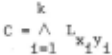
(Computing this intersection can be quite costly, so some care is required in choosing a good data struc ture for these lists). If thig intersection is non empty, then the LPS's that lie in this intersection form the first set of conjectures and are therefore passed to the verifying procedures to determine if there are any counter-examples to these conjectures. If an LPS survives this check then it represents an intensional definition for Ri. For example, suppose R 1 - R 2 - R3 is an LPS which is in common to all the Lxy's. It is then conjectured that Ri = R1/R2/R3. The intermediate nodes that were removed from the var ious paths underlying this LPS are possible bindings for the extensional variables z1,z2 in the expression:

On the other hand, the verifier determines whether for every x, y, and z1 and z 2 that satisfy the right-hand side of the above expression, the 2-tuple (x,y) is necessarily contained in Ri's extension. If this is not true then the conjectured definition is consider ed to be "over-general".
A more interesting case arises when the intersec tion of all the Lxy's is empty. In such situations there is no simple compositional definition for Ri. Instead, its definition (if there is one) must involve a disjunct. An obvious strategy to pursue is to keep intersecting the Lxy's until the intersect becomes empty. At that point, undo the last intersection, leaving a non-empty intersect. Then, starting with this removed list, recommence forming the intersection with it and the next list and so on. For example, suppose we have L1,L2,L3,L 4 ,L5,L6 as six lists of LPS's with the following properties:
We are left with three sets of non-empty intersec tions, namely L12,L34,L56· The conjectured defini tions for Ri would then be of the form:
Thus an intensional definition of Ri would be a dis junct of relational compositions .
A moment's reflection on the above intersection process reveals that the outcome of these intersec tions can be critically dependent on the order in which the lists are intersected. For example, the lists L1,L2,L4 might very well form a non-void inter section and likewise the lists L3,L5,L6· If this were the case, we would then have unfolded a simpler set of conjectured definitions of the form:
Ri = any LPS from L 124 V any LPS from L 356
A dramatic example of this effect follows.
Given a moderately large data base of several hundred 2-tuples over thirty kinship relations, we were trying to discover some definitions of "Parent". The resultant intersections computed with the original ordering of the LPS lists (using a consider ably more sophisticated algorithm for choosing what list to merge next) led to the disjunctive sets of conjectures found in Table la. However, a further search revealed a still better ordering yielding the conjectures found in Table lb.
TABLE la
Conjectural Definitions for Parent Under Initial Ordering
Grandparent/Nephew
Grandparent/Niece
Grandparent/Cousin/Nephew
Grandparent/Cousin/Niece
Grandparent/Son/Sibling
Grandparent/Nephew/Sibling
Grandparent/Nephew/Brother
Grandparent/Brother/Niece
Grandparent/Offspring/Sibling
Grandparent/Daughter/Sibling
Grandparent/Niece/Sibling
Grandparent/Niece/Brother
Grandparent/Sibling/Niece
Grandparent/Sibling/Nephew
Grandparent/Sister/Nephew
Spouse/Grandparent/Nephew
Spouse/Grandparent/Niece
Sibling/Uncle
Sibling/Sibling/Uncle
Sibling/Offspring/Grandmother
Sibling/Son/Grandmother
Parent _ Spouse/Sibling/Uncle V Sibling/Uncle/Cousin
V
Sibling/Uncle/Sibling
Sibling/Offspring/Grandparent
Sibling/Offspring/Grandfather
Sibling/Son/Grandparent
Sibling/Son/Grandfather
TABLE lb
Conjectural Definitions for Parent Under "Optimal" Ordering
Mother
Mother/Sibling
Spouse/Father
Wife/Father
Mother/Daughter/Father
Spouse/Father/Sibling
Wife/Father/Sibling Father Father/ Sib ling Spouse/Mother Husband/Mother Father/Daughter/Mother Spouse/Mother/Sibling Spouse/Mother/Sibling
Parent
v
Having great faith in Occam's Razor, we only attempt to verify conjectures that emerge from the minimal number of disjunctive intersections. Finding an optimal grouping of the L lists that lead to this minimal property is combina~orially equivalent to the classical covering problems , However, unlike many covering problems, a fairly simple heuristic turns out to be quite satisfactory (see Brown3 for
more details).
A grouping for these lists which leads to the minimal number of non-null intersections induces a clustering of Ri's extension (i.e group together all the (x,y)'s that generated the LPS's of each disjunct). Often this clustering can indirectly induce a clustering or even a partition on either Ri's domain or range. This clustering should reflect some "internal" structure of the objects themselves. Considering the above Parent example reveals that the clustering of 2-tuples induced by the definitions of Table lb shared the property that the first component of each of them were female. Likewise, the first component of the other 2-tuples were all male. But, as far as the system knew, no object in the domain had any distinguishing characteristics whatsoever. Thus, in some sense, the system had unfolded the necessary information to conjecture two unary predicates theretofore completely unknown to it. Justification of these predicates often requires supporting evidence which may be forthcoming if, in considering other relations, similar clusterings
are induced.
Discovering Rules of Inference
We will concern ourselves only with discovering inference rules of a very restricted form. These
rules will be either of the form:
- R1/R2/ ..· /Rn => R
(where R itself could be also on the left)
or of the form:
In the latter case, the relations under the ver tical bar denote a required context before this rule can be applied. The similarity of these rules to context free and context sensitive grammars is not accidental. In fact, these inference rules are directly usable by the question-answering system
detailed in Brown~
Discovering the first type of inference rule would appear to be straight-forward. We need merely locate a sequence of relations whose compositional extension is contained within the extension of R. The problem, however, lies not in finding such seq uences but in finding "useful" sequences. Although we have no way of making this distinction precise, we realize that in creating an axiom system for a question-answerer we often want more than just a minimal independent set of axioms. We want axioms that enable us to answer "usual" questions without undue inferencing. Believing that typical questions often relate to subparts of the intensional defini tions we sought ways to use the structure of the relations themselves in isolating potentially "useful" rules.
One way to isolate these rules would be to use the intensional definitions themselves. Specifically, any recursive definition is a particularly good can didate, such as:
Another way te generate potentially useful rules would be to discover definitions for a particular relation which turn out not to cover R's extension when their defining subspace is enlarged. An example of such a definition might be:
Cousin = Sibling/Cousin
(Sibling/Cousin => Cousin)
which could arise from a data base in which every family had two children. But again, the key problem is finding ways that the structure of a relation can, itself, delimit "interesting" subsets of its own ex tensions so that we don't have to rely on chance for · providing such subspaces.
Determining Subspaces for the Discovery of I~~renc~ Rules
One way in which the structure of a relation can induce a natural partition on its extension is by possessing a disjunctive definition. This, as men tioned above, splits the relation's extension into groups of 2-tuples covered by the particular disjunc tive terms. For example, using the Parent example,
we are lead to form the trivial rules:
Father => Parent Mother => Parent Husband/Mother => Parent
Wife/Father => Parent
However, the disjunctive definition underlying these rules has the property that the two disjuncts are disjoint. That is, if (x,y) is satisfied by one of the disjuncts, it necessarily is not contained in the other. By searching for disjunctive definitions whose disjuncts can overlap, and in which one of the disjuncts covers a maximal portion of the given relation's extension, we discover such rules as:
Parent/Sibling => Parent Sibling/Offspring => Offspring Offspring/Spouse => Offspring
Father/Cousin => Uncle
Another way t o utilize the structure of a r ela tion in isolating subspaces stems from the co-occur r ence of compositional sequences in a given disjunct of its definition. For example, in considering a data base of over five hundred facts, we discovered
the standard definition of Brother-in-Law:
Husband/Sis/Spouse Brother/Spouse V Husband/Sib/Spouse V Spouse/Sister/Spouse Husband/Sister Husband/Sib Spouse/Sis t er
Let us consider the last disjunct which asserts that:
- Husband/Sister = Husband/Sibling
- Husband/Sibling = Spouse/Sister
- Husband/Sister = Spouse/Sister
Line 1 suggests that in the "context" of "Husband" the relations "Sister" and "Sibling" function equivalent l y , or we could say that:
- Sister => Sibling
- Sibling=> Sister,
when conditioned on the left with "Husband". Clear l y , the notion of "context " is quite important for, although the rule "Sister => Sibling" could be independently discovered from the definition "Sibling = Sister V Brother", and hence would always be true, the rule "Sibling=> Sister" is, in general, false. Using the expanded form of this rule i .e., (x, Sib ling, y) => (x, Sister, y) we see that the rule is true whenever x is a female. One way to guarantee x's femininity is to require that x be in the range of the "Husband" relation. In other words, the Husband relation delimits a subset of the domain of "Sister" and "Sibling". When restricted to this subdomain, these relations coincide (we again stress that the data base cont ains no such unary predicates as Male or Female).
A considerab ly more subtle example of the powers of contextual constraints is manifested in two defini tions for "Nephew" that emerged from one of our data bases:
- Nephew _ Brother/Niece
- Nephew _ Son/Parent/Niece
The rule of inference which follows from this is:
At first glance, the right-·hand contextual relation (Niece) seems quite unnecessary, for a son of a parent would seem to be a brother. However, in ex ploring the "Son" relation with our system no such rule emerges. This is because the path seeking pro cess underlying the construction of LPS 's prevents the forming of paths with loops. Consequently, the possibility of the "son of a parent" being himself is necessarily prevented. However, in checking the over-generality of this definition, the verifier checks the entire extension of this conjecture and thus detects the need for an inequality predicate. However, in the context of "Niece", it does survive because the reflexive (self-looping) cases of "Son/Parent" are necessarily male and hence fall outside this context!
The use of "context" can be more subtle than the mere delimitation of the domains or ranges of relations. For example, when we were exploring a definition for Uncle, two disjuncts always co-occur red (a strong hint of the existence of structural cause). The definitions were:
Uncle _ Brother-in-Law/Parent Uncle = Husband/Sister-in-Law/Parent
At first glance, we might think that:
"Husband/Sister-in-Law => Brother-in-Law"
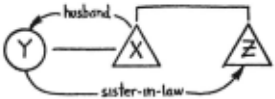
Considering Figure 1, we realize that although (y,z)E Sister-in-Law, that (x,z)f Brother-in-Law. However, the correct rule of infer ence requires a right context of J "Parent" (i.e., demanding that z must be a parent to someone):
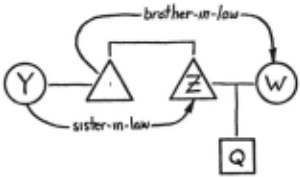
Husband/Sister-in-Law! => Brother-in-Law Parent
Given the situation shown in Figure 2, we see that if z is a parent to q then in fact z must also have a spouse (say) w. Hence x would be a Brother-in-Law to w. In other words, the right hand context of "Parent" forces z to have a spouse w simply by asserting that z is the parent of q.
On Checking for Over-Generality
The result of intersecting the LPS lists is a collection of conjectural definitions for the part icular relation R under study. A property of any such conjectural definition is:
As mentioned before, the problem of over-generality lies in verifying the converse of this property:
At first glance, the verification seems straight-for ward: simply compute the extension of the conjectural definition and test for its inclusion in the extension of R. If it is included, then the conjectural defini tion has been verified. The problem of efficiently performing this computation is th5 concern of associa tive memory processors like TRAMP and, as sueh, will not be discussed here. Such verification is obviously possible, but it is expensive for large data bases.
We were primarily interested in developing heur istic techniques that could be used to efficiently detect over-general conjectures. After these heur istics were applied, exhaustive techniques could be applied to the few remaining definitions so as to remove any doubt about their validity .
Our heuristic procedures are based on the con cept of "the inverse image of x with respect to a binary relation R" informally defined as the set of all y's such that the range of x overlaps the range of y.
Def: The inverse image of x with respect to a binary relation R, denoted IR(x), is:
(note that inverse images do not form equivalence relations on the domain of the given relation). In a similar manner, we can define the inverse image of x with respect to a conjectural definition of R.
Our heuristic procedure picks an object x in the domain of the relation R being defined and com putes both the sets IR(x) and I"Def"(x). It then checks to see if the set I"Def"(x) is equivalent to the set IR(x). If not, it rejects the "Def"; other wise it chooses a new x from R's domain and repeats this procedure until the domain of R has been exhaust ed. A faster but less complete version of this heuristic doesn't bother to exhaust R's domain but chooses only one element from each inverse image class. These checks are only heuristic since they do not take into consideration the local connections of the relations within each inverse image class, but that is precisely why they are fast!
An example of the power and limitations of this heuristic may be seen from another data base (of over a hundred facts) analyzed by this system.
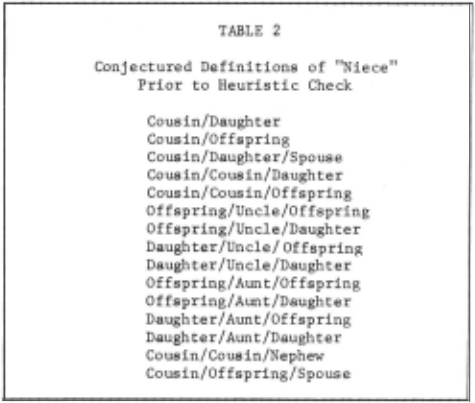
The definitions for the binary relation "Niece" were first explored. Table 2 lists the conjectural definitions resulting from intersecting the LPS lists. These definitions were then subjected to the above heuristic check which resulted in the definitions given in Table 3. Of the original fifteen intensional definitions eleven were rejected by our check and the remaining definitions were all correct.
TABLE 3
Conjectured Definitions of "Niece" Remaining After Heuristic Check
Daughter/Aunt/Daughter Daughter/Aunt/Offspring Daughter/Uncle/Daughter Daughter/Uncle/Offspring
The need for developing heuristics for speeding up the verification of conjectured definitions is better appreciated when we understand the complex interactions between the generation of conjectures and their subsequent verification. In fact, there is a constant switching of control between these two phases. For example, suppose the first set of definitions conjectured were subsequently disproved in the verification phase. Then all the paths in the data graph that lead to these conjectures would have to be temporarily "blocked" and a new set of conjectures would have to be invented. These new conjectures would then have to be verified, and so on, until all the conjectures passed the verification phase.
Our experiments have revealed that, for most of our test data, this process of conjecturing, verify ing and blocking is often repeated a dozen or so times before a set of conjectures are formed which cannot be disproved within the data itself : Conse quently, our system must typically verify many more conjectures than appear in the final output.
Some Experiences
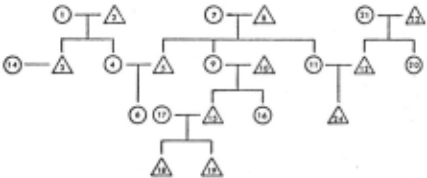
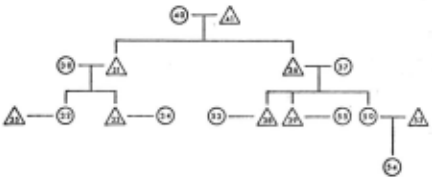
We have applied this system (implemented in L 6 on a 16-K PDP-9) to several types of data, the most common of which is kinship data. We primarily worked on kinship data because, although we know what to expect, the richness of its structure can present many challenges. Also, by choosing a domain that is intuitively understandable, it is easier to spot the more subtle relationships among the obvious. Altho ugh this domain is trivial in many respects, it was a great surprise to us to take a reasonably large data base, generated-- for test purposes -- from the family tree shown in Figure 3 below, and perfoFm a search for all the structural relationships that might have passes unnoticed from our biased viewpoint.
Figure 3
Family Tree Underlying an Extensional Data Base of Approximately 580 "Facts"
e
Two types of patterns could appear. On one hand, definitions might emerge that reflected idiosyncracies of this particular data which would "disappear" if we considered more data. On the other hand, completely valid definitions might appear which were logically equivalent to ones we already knew, but which might be "simpler" relative to some criterion. Both types of unexpected patterns may be seen in the first set of definitions discovered for the Uncle relation on this data base (see Table 4). Clearly the first two of these definitions reflect the idiosyncracy that every uncle is married. The third definition which is complete yet involves no disjuncts and as such might be considered simpler than the standard two disjunct definition:
TABLE 4
First Definitions of Uncle
- Spouse/ Aunt
- Husband/Aunt
- *3) Brother-in-Law/Parent
Uncle
- Spouse/Sister-in-Law/Parent
- Husband/Sister-in-Law/Parent
- Brother-in-Law/Spouse/Parent
It was not until these definitions were manually over-ridden* and indeed a fair number more before our system came up with the "traditional" definition.
Appendices 1 and 2 give a feeling for the sur prising multitude of structural definitions found on this data base. For example, Appendix 1 contains some of the three hundred definitions of "Uncle"which were discovered just on the above data base. The second appendix reveals the first set of definitions discovered for some of the other kinship relations. Note, for example, the seven universally valid definitions for "Cousin".
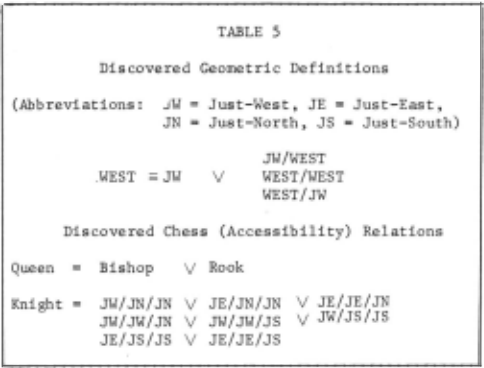
No t all our experimenting has been limited to kinship relations. Another domain that has been analyzed was made up of the extensional definitions of the accessibility relations between squares on a chess board for the various chess pieces. More pre cisely, the data base consists of a universe of 64 objects -- representing the squares of a chess board -- and a collection of extensionally defined rela tions. Some of these relations are geometric (e.g. East, Just-East, Positive-Diagonal) and the others are chess moves represented as binary relations. For example, (x,y)E Knight means that a knight can move in one step from x to y. The task was to discover the definitions of the legal moves of the various chess pieces in terms of the other chess pieces and/ or in terms of the geometric relations. Although space precludes a thorough description of our find ings, we indicate below some of the discovered definitions:
Weaknesses
There are several limitations to our system that deserve further attention. The first concerns the difficult area of characterizing when something cannot be true. All the definitions and axioms in vented by our system express positive assertions. That is, our system never discovers the crucial fact that siblings can't marry and hence a father cannot be an uncle to his own child. Of course , we can hedge this problem by including just the right additional relations which cover precisely what can't hold over the original set but this quickly gets us into a combinatorial explosion . For example, we could include the relation "Non Uncle" whose extension is the complement of Uncle and then perhaps we could uncover:
Father => Non-Uncle.
Somehow such a solution see~s unpleasing since once the positive assertions have been characterized one might hope that they could be combined with a few negative assertions to imply all the potential negative assertions.
The second major limitation is that our system expects its sample data base to be complete, i.e. missing no data and containing no erroneous data. There are numerous ways to circumvent this limitation, some of which have been implemented. For example, the verifi cation phase not only checks a conjecture but isolates, for any rejection, the counter-examples . The user can then decide whether or not to over-rule the verifier by deleting from the data base these "counter-examples." However, a considerably more provocative approach to the problem should be possible. Relying on Occam's Razor, we might consider the entire set of discovered definitions and see how a particular set of changes on the data base affects the complexity of not only the definitions of the relation under study, but also the collection of definitions for all the relations. Since altering a given relation's extension affects not only its own definition but also the definitions of all the other relations definable in terms of this relation, we would expect a dramatic global simplification for the "correct " changes to the data.
Further Plans
In addition to exploring the above issues we plan t o investigate how to achieve more of a syner gistic effect between the user and the computer in seeking the underlying structure of his data. The system is being re-implemented in LISP on a PDP-10 in hopes of having a friendlier environment for exploring the symbiotic uses of this kind of a theory formation system.
Acknowledgement
I am deeply indebted to Dr. Robert K. Lindsay for defining this research problem and for helping me understand some of its ramifications.
(1)
(2)
( 3)
(1)
Uncle
Uncle
Uncle
Cousin
v
v
Sibling/Father Brother/Father Fath-in-Law/Husband/Cousin Sibling/Father/Sibling Brother/Father/Sibling Sibling/Spouse/Mother Sibling/Husband/Parent Sibling/Husband/Mother Brother/Spouse/Mother Brother/Husband/Parent Brother/Husband/Mother Sibling/Fath-in-Law/Spouse Brother/Fath-in-Law/Spouse
Spouse/Sister/Parent Husband/Sibling/Parent Husband/Sister/Parent Bra-in-Law/Sister/Aunt
Appendix 2
Synopsis of Discovered Definitions for Data Base Underlying Figure 3
Offspring/Uncle Offspring/Aunt Offspring/Spouse/Aunt Offspring/Husband/Aunt Offspring/Spouse/Uncle(*) Offspring/Wife/Uncle(*) Offspring/Sibling/Parent Offspring/Bra-in-Law/Parent
Offspring/Sis-in-Law/Parent
* Starred definitions represent definitions ~hat are not universally valid but are valid for the given data base.
@inproceedings{ijcai1973p16,
  title     = {Steps Toward Automatic Theory Formation},
  author    = {Brown, John Seely},
  booktitle = {Proceedings of the Third International Joint Conference on
               Artificial Intelligence, {IJCAI-73}},
  publisher = {International Joint Conferences on Artificial Intelligence},
  editor    = {Nils J. Nilsson},
  pages     = {121--128},
  year      = {1973},
  month     = {8},
  note      = {Theorem Proving and Logic: 2},
  url       = {https://ijcai.org/proceedings/1973/16},
}
TY - CPAPER TI - Steps Toward Automatic Theory Formation AU - Brown, John Seely T2 - Proceedings of the Third International Joint Conference on Artificial Intelligence, IJCAI-73 PB - International Joint Conferences on Artificial Intelligence PY - 1973 SP - 121 EP - 128 UR - https://ijcai.org/proceedings/1973/16 ER -Copied
Machine-readable versions of this paper, for tools and AI agents:





