
A Contextual Recognition System for Formal languages
Proceedings of the First International Joint Conference on Artificial Intelligence. Linguistic and Contextual Methods in Pattern Recognition. Pages 597-608.
© 1969 International Joint Conferences on Artificial Intelligence
Abstract
This paper describes work in progress aimed a t obtaining a practical recognition system by filtering the noisy output of an inexpensive character classifier through multiple stages of context analysis to produce high-quality final output. The s y stem is designed to process the text of handprinted formal languages, such as programming languages and mathematical notation. The system is syntax-directed in that a contextual processor for a particular language is constructed by a one-time, algorithmic analysis of the language grammar. The resulting analysis engine massages the classifier output by successive vocabulary matching, namespacet clustering, and syntactic analysis to produce as output a syntactically valid interpretation of the text, with as many errors corrected as possible. A more complete description of the system can be found in Darden.
- Darden, S. C., "A Contextual Recognition Sys- tem for Hand-printed Formal Languages," TSN-1, Computation Center, The University of Texas at Aus~in (January 1969).
- Duda, R. 0., P. E. Hart, and J. H. Munson, "Graphical-Data-Processing Research Study and Experimental Investigation," Fourth Quarterly Report, Contract DA 28-043 AMC-0190l(E), SRI Project ESU 5864, Stanford Research Institute, Menlo Park, California (March 1967).
- Duda, R. 0., and J. H. Munson, "Graphical-Data- Processing Research Study and Experimental In- vestigation," Fifth Quarterly Report, Contract DA 28-043 AMC-0190l(E), SRI Project ESU 5864, Stanford Research Institute, Menlo Park, Cali- fornia (June 1967).
- Duda, R. 0., and P. E. Hart, "Experiments in the Recognition of Hand-printed Text: Part II -Context Analysis," AFIPS Conf. Proc., Fall Joint Computer Conference (1968).
- Irons, E. T., "An Error-correcting Parse Algo- rithm," Comm. ACM 6, 11, pp. 669-673 (November 1963).
- Unger, S. H., "A Global Parser for Context-free Phrase Structure Languages," Comm. ACM 11, 4, pp. 240-247 (April 1968).
- Floyd, R. W. , "The Syntax of Prog'ramming Lan- guages -A Survey," IEEE Trans. EC-13, 4 (August 1964).
- Vossler, C. M., and N. M. Branston, "The Use of Context for Correcting Garbled English Text," Proc. ACM 19th National Conference, paper D2.4-l, D2.4;.13 (1964).
- Casey, R. G., and G. Nagy, "An Autonomous Read- ing Machine," IEEE Trans. EC-17, 5, pp. 492- 503 (May 1968). -607-
References were extracted automatically from the PDF and may contain errors.
Full text extracted automatically from the PDF; figures, tables and equations may differ. The PDF is the version of record.
Introduction
This paper describes work in progress aimed a t obtaining a practical recognition system by fil tering the noisy output of an inexpensive charac ter classifier through multiple stages of context analysis to produce high-quality final output. The system is designed to process the text of hand printed formal languages, such as programming lan guages and mathematical notation. The system is syntax-directed in that a contextual processor for a particular language is constructed by a one-time, a l gorithmic analysis of the language grammar. The r esulting analysis engine massages the classifier output by successive vocabulary matching, name spacet clustering, and syntactic analysis to pro duce as output a syntactically valid interpretation of the text, with as many errors corrected as pos sible. A more complete description of the system
can be found in Darden.l
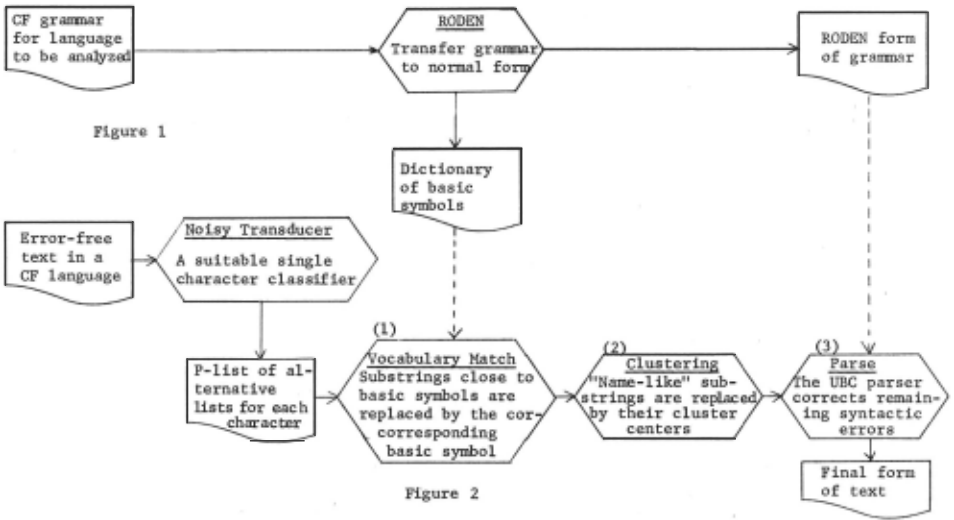
Figure 1 depicts the process by which the sys tem "learns" the language that is to be recognized. This knowledge comprises a convenient representa tion of the grammar and a dictionary of basic sym bols which occur in the grammar (e.g., DIMENSION, CONTINUE, .·· ) ·
Figure 2 depicts the resulting analysis engine, which accepts as input the output of a single character classifier, in the form o£ a list of lists of alternatives for each character. This system is designed to exploit three types of redundancy exhibited by the class of languages under study:
vocabulary redundancy results from the grammatical specification of a set of strings (basic sym bols) which have a high ~ priori probability of of occurrence;
statistical redundancy results from the high proba bility of multiple occurrence of members of the name-space of such languages;
*This work was supported in part by a grant from Texas Instruments Incorporated and in part by Public Health Services Grant GM15769 (NIH).
tThe collection of names, occurring in the text, which are supplied by the author of the text, i.e., identifiers.
* 2 Following Duda and Hart, we refer to this data structure as a "P-list"; the alternative lists are called "L-lists." Each alternative list is composed of a list of pairs (£.c) where £ is a character and c is a confidence proportional to the logarithm of the probability that £ is, in
fact, the correct character.
Stephen C. Darden The University of Texas at Austin Austin, Texas
structural redundancy results from the gramma ti cal constraints on concatenation of well-formed strings.
All three types of redundancy are necessary to successfully clean-up garbled text. Indeed, there are certain errors (such as recognizing XMAX as YMAX) that can only be detected by con sidering semantic redundancy (resulting from the property of these languages that only a fraction of the syntactically valid strings are meaningful, either~ priori or in context). It is hoped that uncorrected-error rates on the order of 1% can be achieved without introducing the staggering com plexities of semantic analysis.
Related Work
A lucid discussion of past approaches to the use of contextual post-processors to improve the performance of pattern classifiers is contained in the recent paper by Duda and Hart.3 We shall not duplicate their efforts here.
The use of an error-correcting parser as a contextual post-processor was first suggested by Irons. 5 The FORTRAN context analyzer of Duda and Hart is a specialized instance of such a processor which has proven the soundness of the idea. They have developed a formal decision-theoretic solu tion to the utilization of context and have shown that the application of syntax analysis does not do violence to the formal approach. Our own work in this area was well underway before we became familiar with their investigation.2,3 We have naturally been influenced by their contributions and have noted the points in the body of this re port where our development has profited from their efforts.
The unbounded-context parsing system des~Tibed in this report is a major departure from classi cal parsers such as that described by Irons, which do not take into consideration sufficient context to make reliable error-correction decisions. The parsing ststem most similar to ours is reported by Unger. In the final chapter of this paper we discuss possible extensions to the unbounded context parser which derive from the quick-checks used by Unger.
A Normal Form for Context-free Languages
This section describes a particular represen tation for context-free (CF) grammars that has been developed to satisfy the needs of an error correcting parser.
When a human context-analyzer is given the task of correcting a sample of garbled text
(e.g., Figure 3), he is usually able to immediately select the appropriate linguistic pattern (e.g., (for statement) or (conditional statement) in the example) to be used in a more detailed analysis of the text. He abstracts from all the noise, the presence of the for _ : = _ step _ until _ do, and if then else patterns. The main purpose of the ~rmal form~to give to the parser this global view of syntactic structures.
| TOR EUP FDQ KAF 5 | I T J s 1 2 | := 1 ; - I • I | STEP I2G9 6J88 5567 ) 8 FZ | ONTIL N DO V[I) := 0; I VM22F H OU YLli ; - D: ) YHJT6 V GD UC2T , u, I KV5J[ W Q JIT2 0 1UWFGM8 J, p SE F Q 1 s |
| TF SK 15 28 IT J F | Y X - * 4 | R TH=N P 2K8V Q J~'6W A 5MFM NEH 4G | C020 IT ELSE X GUTU F2 6GIF Y FDJD SF FF6= * 6 5 15 =E5G 4 0 2 6688 T 8[ 6 J | := X+l ; = Y*l *=, 4TI ) |
The casual reader will probably wish to skip the remainder of this section, referring back as needed from the discussion of syntactic analysis. The normal form will hereafter be abbreviated as RODEN-form (for Regular, Operator, Disjunctive, Embedding, Normal). In the following, it is as sumed that the reader is familiar with the rudi ments of context-free languages. The survey by Floyd6 is recommended as an introduction, and it has a comprehensive bibliography.
A RODEN-form grammar G comprises a set of rules A ~ a in 1-1 correspondence to a vocabul ar y of non-terminal symbols (see example G2 below). The genatrix, A, is a non-terminal. The pattern, a , is an expression constructed from the vocabu lary of non-terminals together with the vocabulary of basic symbols, and the operations of concatena tion (or conjunction, denoted by juxtaposition), disjunction (denoted by j), replication (or finite closure, denoted by superscript * ) , and selection (denoted by superscript 0 ; selection is identical to the disjunction of the empty string with the single operand of the selection operator).
Both left and right recursion have been elim inated in favor of replication by iteration. In addition, each pattern a is in operator form; i.e., there is no derivation a ~> ¢ulu 2 m where U1,u 2 are non-terminal symbols. Finally, each pattern is in disjunctive normal form; i.e., all disjunc tion operators occur at the highest level, and the disjuncts are ordered by descending redundancy (presence of head or tail basic symbols, minimum number of basic symbols).
An example should serve to give the flavor of the RODEN-form representation. G 1 is the usual CF-grammar for ALGOL arithmetic expressions; G 2 is the equivalent RODEN-form grammar.
Observe that (a) disjunction, and its asso ciated branching and backtracking, has been almost eliminated; (b) subgoals are uniquely determined by delimiting basic symbols (thus the operator normal form requirement); and (c) if self-embeddfug subphrases were properly suppressed, the parser could immediately assign a complete parse at the current level using all occurrences of the pattern' s basic symbols, in the entire text under cons ideration.
Gl
(aexp) ~(simple aexp ) l (if clause) (simple aexp )
(if cl ause)~ if (Bexp) then
(s impl e aexp ) ~ ( term)l ± (term)l (simple aexp)
2: ( term)
( term)~ (f actor ) l (term)*/7 (factor )
( factor )~ (primary ) i (f actor )t(primary )
( primary~ (unsigned number ) l (variable ) l
(function de~ignator ) l( ( aexp ) )
G2
For example, the string X+Y+(N+l)*M
cannot be parsed directly as a (simple aexp) be cause the embedded + would lead to the assignment of ( term) to both ( N and 1 ) * M. Rather, the parser should see the string as
wher e the embedded substring is not "visible" at t he current level.
In order to characterize this suppression pro cess we need to introduce the concepts of admis sibl e basic symbols and their associated minimal cover lists. Briefly, if A ~ a , a basic symbol t is said to be admissible with respect to the gena trix A if either
- ( a) t does not occur in a or
- (b) for each instance of t E a one of the fol lowing two conditions is satisfied:
- a is of the form t0 (or 0t). That is, a corresponding instance of t in any valid ground-derivation* a of A is uniquely determined by matching t to the head (or tail) of cr .
- a is of the form 0too. Then either (i) there is no subphrase B E a such
*A ~> oo is said to be a ground-derivation if oo is composed entirely of basic symbols.
- (ii) if B occurs in a , and if B ~> Tj t j.J. is a valid ground-deriva tion, then this derivation must have the form
where X is a non-terminal and [ # ] are basic symbols distinct t t from t. The pair of bracke ts [ , ] are said to cover the lower t t level occurrence of t. If, however, t = [ (or t = ]) , then a must satisfy the additional con dition a = 0too = TJ [ A ] !J. where t t B E A and t does not appear in any ground-derivation of either TJ or IJ.·
When an admissible basic symbol tis of type (ii), the set of bracket pairs, which uniquely delimit lower-level instances of t, is called the minimal ~ list for t. For example, in grammar Gz we can show tha t + is admissible with respect to (simple aexp ) , by condition (ii). We observe that B in this case can only be (term) and tha t there are only three ways to obta in a + in a ground derivation from B:
We shall consider only the simplest case:
where we see that the+ in( . . · (term) + (t erm) .·· ) is indeed "covered" by the pair of brackets ( ·.· ). In a similar fashion, the other two cases lead to the discovery of the additional pair of brackets [ ].
We shall say that a basic symbol is admissible in a grammar if it is admissible with respect to every genatrix of the grammar.
When every basic symbol of a gr ammar is ad missible, a valid parse is obtained by preprocess ing every text segment for a well-formed nest of minimal covers for all the basic symbols of a pattern, before ass-ociating the basic symbols to corresponding occurrences in the t ext. Each covered segment is pushed down one level to be analyzed by subgoals descended from the current level of analysis. The existence of such nests also provides another powerful consistency check on the text, permitting the cover processor to correct many errors involving the covering brackeu themselves.
Our parser requires that every basic symbol of a RODEN-form grammar must be admissible. How ever, in general, CF-grammars may contain non admissible symbols. Furtunately, for the CF-gram mars in common use, this is not a problem. All basic symbols in FORTRAN and LISP are admissible. In ALGOL, the set of symbols if, then, else, for, : = do are inadmissible due tothe""""C<mst~io~ which permits
In actual practice, this construction almost never appears. Indeed, in ALGOL-68, the problem has been eliminated by providing conditional statements wifu a closing basic symbol: 1£-then-else-fi.
In summary, the RODEN translator transforms a broad class of CF-languages to RODEN-form; in the process, basic symbols are examined for admissi bility and their corresponding lists of minimal covers are associated with the proper genatrices. Additionally, lists of basic symbols occurring in the final form of the handle are associated with the corresponding genatrix, and a dictionary of all basic symbols is compiled. This dictionary is then analyzed for any entries which can be "ex tended" (hence the term extended dictionary). That is, each word is examined to see if every occur rence of this word, in strings of the language, is contained in some larger unique context. For ex ample, ignoring spaces, this leads to the replace ment, in the dictionary, of all LISP functions (fun ) by ( (fun ) , of all FORTRAN verbs (verb ) by :(verb ) , of FORMAT by FORMAT(, etc. (: is used as a column 7 indicator, ; is an end of line in pro cessing FORTRAN).
III. Simulation of a Single-character Classifier
Data for testing the context analysis system are provided by a computer-simulated character recognizer. The input to the simulator is error free text from the language to be investigated. The garbled output is in the form of a P-list for the context analyzer.
The operation of the simulator is controlled by a confusion matrix (constructed bo approximate the error maps reported by Duda and Munson3 for their TOPO 2 program), a noise factor, and a "con sistency" factor.
On the assumption that classifiers can be ~ structed so that the correct character will almost always appear among the first few entries of the output alternative list, the confusion matrix has about six non-zero entries for each character.
The noise factor controls the undetected-error rate of the simulated classifier. The consistency factor is a measure of the probability that, given two alternative vectors for the same character, a character which occurs in one vector will appear in the other vector. The reliability of the inter string distance measure (see 4.2), used by the sys tem, improves as the mutual consistency of alter native vectors increases.
IV. Context Analysis
The first two phases of the context analysis system are aimed at reducing the combinatorial complexity of the task to be performed by the syn tax analysis phase. Since, in principle, all ex cept name-space errors can be corrected by syntax analysis, care is taken to ensure that the dic tionary matching and clustering do not introduce errors; however, neither is foolproof.
4.1 Extended-dictionary Matching
The strategy of extended-dictionary* matchmg (box 1, Figure 2) is similar to the table look-up method used by Vossler and Branston.8 Spaces are treated as error-free characters, and each substring of length n delimited by spaces is pro cessed in turn. The substring is matched against all possible dictionary entries of length n, n-1, · .· , k until the first entry is found which is closer than a fixed minimum distance to a (possi bly proper) substring of the current object P list. The lower limit, k, on the length of entties to be matched is established experimentally. Pre sently, with up to 35% noise and 50% consistency (see Section Ill) in the simulated data, a value of k = 2 has been found to introduce no erroneous matches in the processing of LISP, ALGOL, and FORTRAN texts.
The distance, d, between a dictionary entry
and a P-list of the same length
is given by
where
provided that every £i corresponds to a cik for some k; otherwise, d = oo, If a satisfactory match is found, the text P-list is modified by replacing the corresponding L-lists by singleton L-lists containing the letter of the dictionary entry paired with the highest possible confidence. This replacement is a level zero suppress operation.t For example, the P-list
*Recall that the extended dictionary contairn the basic symbols of the language (e.g., begin, end, ... ) .
tin each case, the deleted entries have been
where the associated confidences are suppressed for clarity.
4.2 Name-sEace Clustering
The clustering procedure (box 2, Figure 2) em ployed by the system is related to the methods em ployed by Duda and Hart3, but necessarily differs in several ways due to the requirements of handling a variety of languages. The strategy is based on the assumption that a sufficiently sensitive clus tering method can discriminate names without ~ priori knowledge of the context in which names are likely to occur. This assumption obviously depends on both the length and average number of occur rences of names in the text. It is more important for the algorithm to identify at least one instance of all of the names than to locate ali of the oc currences of each name. Those occurrences which are overlooked will very likely be found by the pattern associating routines which use the diction ary of known names compiled during this pass.
Typical performance of the method is indicated by the results of clustering analysis on a 272character ALGOL program. The output of the simu lated character classifier exhibited an uncorrecarl error rate of 33 . 1% and a consistency factor of 48.8%. The results are given in Table 1.
| Name | Ntunber of Occurrences | Ntunber Identified | Unified SEelling |
|---|---|---|---|
| I | 8 | 6 | I |
| J | 6 | 2 | J |
| K | 5 | 2 | K |
| N | 5 | 5 | N |
| RAD | 3 | 3 | QAD |
| TRY | 2 | 2 | TR2 |
| BASE | 3 | 3 | BASE |
| FIND | 2 | 2 | FING |
| PERM | 4 | 2 | PFRM |
| ORDER | 5 | 4 Table 1 | ORDER |
descended from an auxiliary pointer on the L-list. This auxiliary list is used to restore the original structure if the selected entry is later found to be invalid and has the structure
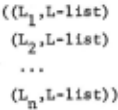
where Li is the integer-level ntunber at which the decision to suppress the associated L-list was made. We shall refer to this operation as the sup press operation.
Thirty-one out of forty-three total instances of all names were identified, including at least one instance of every name . After syntax analysis two instances of the name 'I' were incorrectly identified as 'J'; all other instances of names were correctly recognized.
4.2.1 SamEle collection. The clustering algorithm processes the entire text for "name-like" substrings, constructing as many groups as needed of identical length samples. Presently, a P-list is treated as a possible name if
- (a) it contains no spaces,
- (b) it contains no characters classified as delimiters (this information is input along with the RODEN-form grammar) whose confidence exceeds a fixed value,
- (c) a letter is among the alternatives for the first position,
- (d) no longer P-list satisfying (a)-(c) con tains it.
Since most formal languages define names in this way, this definition is built into the clustering program. It is clear that this sampling procedure will collect a number of strings which are not names at all, but substrings of names, composites of names and other symbols, etc. The assumption is that these undesirable strings will form de generate singleton clusters of their own and will be ignored in the unification step at the end of this procedure. In the example described by Table 1, six such strings were collected by the sampling procedure; all formed degenerate clusters and were discarded.
4.2.2 Clustering. The clustering procedure is applied to each group of identical length sam ples in turn. First, a set of "representatives" is selected from the sample. The procedure for locating the representative samples is similar to that used by Casey and Nagy9 to select an initial set of centers for the clustering stage of their recognition system. The first sample is chosen as the first representative. The sample having maximum separation (defined below) from the first is taken as the second representative. Similarly, the remaining representatives are chosen to be those with the maximum minimum separation from those already selected. This procedure is itera ted until a sample is selected whose separation is less than a fixed minimum distance. It is as sumed that at this point an instance of each name of length n has been located.
The success of this procedure is in large measure dependent on the performance of the dis tance function, defined for two P-lists U and V where If in any position no two characters correspond, then d(U,V) = oo, If, in general, two alternative vectors for the same character have a reasonable high consistency, then this should be a richer dDr tance measure than a simple sum of the highest con fidence corresponding characters.
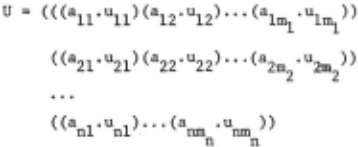
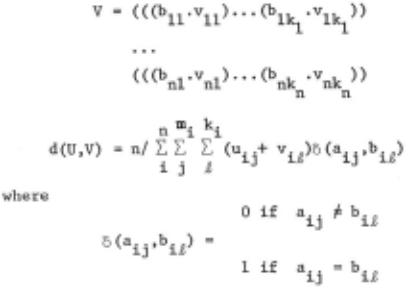
The final stage of the clustering procedure is very simple: each remaining sample is assigned to the cluster with the closest representative.
4.2.3 Unification. When all clusters of a given length have been established, a unification procedure is applied to all but singleton clusters to select the highest confidence common spelling for each. Then, as in the dictionary matching, each cluster member is replaced in the text P-list by this common spelling. The deleted L-list entries are suppressed at level zero.
While there are certainly many refinements which can be incorporated into this procedure, our philosophy is to apply effort where the greatest returns appear to lie, and this is in the syntactic analysis phase. The only improvements currently planned for the clustering phase are (a) a refined distance measure which will attempt to detect the presence of prefixes (suffixes) (e.g., xmax, ymax) and give relatively more weight to the contribution of the prefix (suffix) to the distance; and (b) the dynamic computation of the center of a cluster as new members are added.
4.3 The Parse Graph
In order to follow the next section on syntac tic analysis, it is necessary to have in mind the parse graph which represents the current state of that analysis. The overall structure of the parse graph is, naturally, a tree. The nodes of the tree have a branching structure which corresponds to the RODEN-form meta-operator at the node (thus there are conjunctive, disjunctive, iterative, and selec tive nodes). In addition, there are phrase nodes (e.g. (statement)) and terminal nodes (e.g., begin). Associated with each node are a number of indica tors which describe the state of the parse repre sented by the subgraph descended from the node. Among the possible entries are those which give the value of the basic symbol match, the number of ch~ acters in basic symbols which selected this node, and the level number of the parent cover for covering brackets. The entries relevant to error recovery are: left- and right-extensibility indicators, left- and right-truncation indicators, and an en try which reflects the detection of an invalid covering bracket assignment.
4.4 Syntactic Analysis
By combining the unbounded-context parser and a particular RODEN-form grammar we obtain an error correcting parsing system which is nearly free of back-tracking. Through hierarchical consistency checking, the parser is able to discard fruitless paths inexpensively and is able to correct many errors before exploring the detailed structure of the text. At each level the parser associates with the current object P-list (cr) an instance of the current pattern (p) on the basis of corre sponding basic symbols. The method employed causes the pattern to be self-positioning. This property, together with the fact that all.basic symbols of the pattern have been mapped w1th a high average confidence to the P-list, improves the parser's probability of success in selecting the correct recovery steps when errors are de tected.
. 4.4 1. The basic strategy of parsing. In the following, the parser is considered to be ana lyzing a with respect to the current subgoal G. G may be a phrase (a single non-terminal), a basic symbol, or a skeletal instance of a pattern assigned by a higher-level goal. If G is a pat tern (p), then M and S are the associated minimal cover lists, and basic symbol lists, respectively.
If G is a basic symbol, it has already been matched to the text at a higher level (by the as sociation procedure), so the parser simply reports the value of that match.
If G is the phrase (identifier ) , the parser invokes a special process which attempts to ex ploit the relatively high a priori probability of occurrence of identifier dictionary entries.
If G is any other phrase, the parser retrieves the pattern, p, associated with G, and matches the pattern to the text in the three steps of covering, association, and resolution, described below.
If G is a pattern, the parser applies itself recursively to each subpattern of p. In the case of disjunctive patterns, the parser returns the first disjunct to achieve a satisfactory match . In the case of conjunctive patterns, failure of a subpattern causes the parser to invoke the recov ery procedure appropriate to the type of failure. The details of failure recovery are discussed be low. On exhausting all subpatterns of p, the parser invokes a scoring procedure to evaluate the success of the analysis for G. Errors which have been detected in disjunctive structures are re ported to the parent goal at this point. In con junctive patterns, comparison of the bounds of the substructure to the bounds of G reveals the pre sence of L-drop and R-drop errors (see Error Re covery and Correction below).
4.4.2 Analysis of the (identifier) phrase. The special processing of identifiers serves to compensate for the lack of structure of this phrase type, as defined for most languages. Otherwise, virtually any text segment would satisfy the syn tax of (identifier). It is assumed that the iden tifier dictionary contains an instance of every identifier.
First, a is matched to all identifier dic tionary entries of the same length. If a suffi ciently good match is found, the parser reports the value of the match. This failing, the process attempts to determine if a is a head, tail, or proper substring of a valid identifier occurring in the text P-list which includes a. If an identi fier is found which matches the P-list in a neigh borhood of a, the parser reports the appropriate type of add or drop error.
- Matching patterns to the text. As in dicated above, when the parser begins analysis of a new subgoal, which is a phrase, the matching of the pattern associated with that subgoal proceeds in three successively more expensive steps, cover ing, association, and resolution. Each step~ be successful before entering the next, and each has its own error detection and correction tactics.
4.4.3.1 Covering. The list, M, of minimal covers associated with p, is retrieved. If M is empty, the algorithm proceeds to the association step. The covering process accepts the text P-list, the bounds of G which delimit the portion of the P-list to be considered, and the cover list M of the form
of n distinct pairs of covering brackets. The covering procedure is given the task of finding the highest confidence well-formed nest of these brackets.
The procedure presently under investigation abstracts from the text P-list a list (called a B-list) which has an L-list for each possible oc currence of any of the brackets. Each such L-list has the entries: the bracket together with its confidence, (B,U), and a null character,¢, repre senting selection of a symbol other than the bra cket, together with a confidence which represents the effect of suppressing the bracket, (¢,V) (note the example below). If there are K brackets on the original L-list, there are K+l entries on the new L-list. For single-character brackets, the non-bracket confidence, V, is simply that of the highest confidence non-bracket character on the original L-list. For multiple-character brackets _ V is the average of the highest-confidence non bracket characters. This latter measure has not been tested, since the extended dictionary-matching procedure has never failed to correctly classify a multiple-character basic symbol which was also "· covering bracket.
The cover procedure selects a nest from the B list by generating, by descending number of brackem
(strings with equal numbers of brackets are ordered by descending total confidence), all possible strings, taking the first well-formed nest.
If a well-formed nest is found, the portions of the P-list bounded by each bracket pair are suppressed one level by combining that portion of the P-list with the new operator, >'<cover* .
For example, consider processing the P-list
for the covers associated with (arithmetic expres sion) in ALGOL, where M contains the bracket pairs ( ) and [ ] . We have the B-lis t
The algorithm selects the correct nest and transforms the P-list to
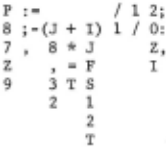
which is represented in list notation as: (((P.40) ... ) ((SP.lOO)) ((:.SO) ... ) ((=. 60) ... ) ((SP.lOO)) (*COVER* S (((LP.30)) ((J .3S) (8.1S) (, .3) (S.2)) ((+.4S) ... ) ((!.30) ... ) ((RP.4S))) ( (/. 60) ... ) ((1. 60) ... ) ((2.3S)(¢.20)(Z.lS)(I.3)) ((;.SO) ... ))The form of a P-list entry for a covered sub~ structure is (*cover* (length) P-list) where (length) denotes the number of character positions in the suppressed P-list. Note that in the new P list, the four L-lists which contained brackets have a new structure: those containing the selec ted brackets have been replaced by singleton lists, and the brackets have been suppressed in the other two lists.
4.4.3.2 Association. This is the critical step in unbounded-context parsing. Association establishes the correspondence between an abstract representation of the text, in the form of an ordered list of principal basic symbols, and an ab stract representation of the global structure to be as signed to the text, a RODEN-form pattern.
The success of the method depends on the abil ity of the association procedure to "spread the risk" of selecting a particular pattern over a suf ficiently large number of characters in the text,- thus the need for eliminating recursion and adja cent non-terminals in patterns in order to bring to the surface the principal basic symbols which serve to identify the occurrence of that pattern (for example, note the explicit structure of (aexp) in example Gz of Section II). Another important property of the method is that the pattern is auto matically positioned with respect to o. Thus, mis& ing delimiters, which cause the bounds on a phrase to be set incorrectly, are detected by noting that the pattern was successful in matching the inter ior of the bounded text. Similarly, erroneous de limiters are detected by noting that the pattern has been truncated on one or both ends by an in correctly positioned bound. For an example of the latter, consider the processing of the (for state ment ) of Fig. 3: after the first two phases of context analysis, the P-list might have the form
| o --- (statement) | (statement) |
|---|---|
| FOR I := 1 STEP I | I ) I 1 UNTIL N DO V[I] ·= 0 L I D C T U I 2 0 p Q |
The erroneous ";" has caused a higher-level goal to partition the string into two (statement ) 's. The high confidence head match of (for statement ) to FOR ·= will cause the association procedure to immediately report an "R-add" failure (i.e., a delimiter is hypothesized to have been "added" just beyond the right end of o).
The task of the association procedure is to process the bounded segment, o , of the P-list to produce a skeletal instance (N) of the pattern p.
First, a process is invoked to construct from o and B, the basic symbol list (W) for p; i.e., W is a list of occurrences of these basic symbols. The elements of Ware triplets ( (symbol ),(value ) , (po inter)) where (value) is the average confidence that the string found at (pointer ) in o is, in fact, the basic symbol (symbol). Symbols found at the head and tail of o are tagged with special ~. ~ indicators so that patterns which require head and/or tail symbols can distinguish them.
All possible occurrences of basic symbols of more than one character will be found on W. An unpleasant problem is encountered if all possible single-character symbols are also included: errors may be introduced which will not be detected by the subsequent context-free analysis. For example, in any algebraic language, the symbol which would be selected from the alternative list for some operator, such as *, will be the first operator in the hierarchy which occurs on the list. That is, if a+ appears as the lowest confidence en try on an L-list for *, then the expression will parse as a + ~. and the error will never be de tected. The following approach seems to circum vent the difficulty: when processing a single character basic symbol, which is classified as a delimiter, an L-list is selected only if that delimiter has higher confidence than any other delimiter which may appear on the L-list. De limiters which are missed with this procedure are detected as drop errors in subsequent syntactic analysis and corrected by the recovery procedure.
The second step in the ·association process has the task of selecting and expanding elements of the pattern p. The match is controlled by the list W, of occurrences of basic symbols . Briefly, the association procedure sequences through W, from left to right. The elements of W serve to select a subpattern of p if a correspondence can be established between the basic symbols of each. Selected subpatterns are appended to the growing skeletal node, N. Iterative and selective pat terns, if not selected, are appended with an X (unexpanded) indicator in the event that they may be needed in subsequent drop recovery. In rare cases, on exhausting the pattern, a string erron eously recognized as a basic symbol may result in a partially satisfied conjunctive pattern accom panied by unused symbols on W. (E.g., an erron eous do in processing a (for statement ) in ALGOL could-read to an unsatisfied :=, with the :=and the correct instance of the do left on ~-.) These cases are corrected by sequencing through the pattern (the match is now controlled by the pat tern) and W from right to left, searching W for an instance of each unsatisfied symbol in the pattern. If all of these can be satisfied, and W is still not empty, we examine the remaining entries on W for symbols which are both in the proper order (position in o) and have higher con fidence than a symbol already selected. If such an instance is found, the original symbol is re placed.
If in a conjunctive pattern a head or tail match is obtained, then the right-extensibility (R-add) or left-extensibility (L-add) indicators, respectively, are set at the node. The R-add in dicator at a node specifies that the assoc.iated pattern is satisfied with the portion of the P list bounded by G but that the remainder of the pattern can only be satisfied by matching more of the P-list to the right. Thus, if an error has, in fact, been detected, it must be an erroneously recognized basic symbol (an "add"), which caused the right bound of G to be incorrectly positioned. Similarly, the L-add indicator specifies a pos sible incorrect left bound.
4.4.3-3 Resolution. I f the association process was not able to correct all detected er rors, the parser reports the failure to the parent node. Otherwise, a procedure is invoked, given N and the bounds of G, to set the bounds for the sub phrases of N. Then the parser is applied recur sively to N. If the recursive call reports an er ror involving a covering bracket assigned at the current level, the parser restarts the cover, asso ciate, resolve process with the next valid cover nest in the sequence (see "cover conflicts" below).
* 4.4.4 Error recovery and correction. The only (syntactically-correctable) errors which re main to be considered are those which cause the incorrect positioning or positing of subgoals. When the parser reports a failure in the analysis of a subpattern, the indicated failure is of four main types, cover-conflict, add-failure, drop f a ilure, or total failure.
The treatment of failures is, of course, de termined by the context of the type of pattern in which the error is detected. In disjunctive pat terns, the failure may simply indicate a syntactic dead-end, i.e., incorrect positing of a subgoal. Therefore, error processing is postponed until the entire disjunctive pattern is scored ,in hopes that a subsequent disjunct will succeed. This strategy proves to be reliable since the most difficult pat terns to satisfy, i.e., the most redundant, are matched first.
4.4.4.1 Add-failures. An add-failure occurs when a substring has been erroneously recognized as a basic symbol, at the current or higher level, resulting in the assignment of a phrase to a sub string which has been truncated at one or both ends.
The strategy of add-failure correction is to back the failure up the parse graph until
- (a) a conjunctive branch point is encountered where an adjacent iterative or selective node can be removed along with the basic symbol which is presumed to be the source of the difficulty; or
- (b) a disjunctive branch point is encountered where the parser can postpone the error recovery (the effort could be wasted on a syntactic dead-end).
4.4.4.2 Drop-failures. When a basic symbol is missed by the association process (i.e., a drop error), the result is an improperly bounded sub goal. The error is detected at a lower level, when the subgoal is analyzed, as a left-drop (L-drop) or right-drop (R-drop). The stragegy of drop re covery is to back up the parse graph until
- (a) a context is encountered which permits the introduction of a new iterative phrase to cover the unrecognized text; or
- (b) basic symbol which delimited the subgraph containing the drop is encountered, per mitting the parser to replace this in stance of the symbol with another instance in the unrecognized portion of the text;or
*For examples, see Darden. 1
- (c) a selective node is encountered, allow ing the parser to abandon the recovery effort, or
- (d) a disjunctive branch point is encountered, allowing the parser to postpone error re covery.
4.4.4.3 Cover-conflicts. Since the cover generation algorithm produces covers ordered by descending total number of brackets, cover error~ are detected during an attempt to suppress a bas~c symbol which is also a bracket belonging to a cover established at level K. When this condition is detected, the parser sets the "request recover indicator" at the current node. As with the other error indicators, this information is backed up the parse graph until the parser either shifts to another successful analysis path at a disjunctive node or reaches the phrase node at level K where the culprit nest was assigned. At this point the parser restarts the cover, associate, resolve pro cess with the next valid nest in the sequence.
4.4.4.4 Total failure. A total failure is usually an indication of a syntactic dead-end or is the first indication of an add-error. The strategy of total-failure recovery is to back up the error indication until either a disjunctive branch point is encountered, permitting the par ser to try another analysis path, or a conjunc tive branch point is encountered. In the latter case, the recovery investigates three possibili ties: first, that the unsatisfied conjunct was an erroneously expanded iterative phrase; second, that one or more basic symbols, which delimit the conjunct, are mispositioned (i.e., a comb~ned add/drop error has occurred); and third, ~f the conjunct which failed occurs at the head or tail of the pattern, then a higher-level L-add or R add is assumed and reported to the parent node.
In the first case, we must have a pattern fragment ... ~y ... , with possibly one of a ,y null and ~ an iterative subpattern. The basic symbols which selected ~ are suppressed at the current level and the text segment reanalyzed as an ay.
In the second case, we must have a pattern fragment of the form ... at~ ... where only one of a,~ failed. Since we have symmetry, assume that ~ failed. If the recovery is to succeed, t must be an add-error and must have been dropped in the text bounded by ~. Therefore, we suppress t and search for the highest confidence occurrence of a t in the text bounded by at~. If found, we re analyze the text segment with the new assignment. The process is continued until there are no more t's to try or a successful parse is obtained. If errors still remain, which are only head or tail errors, then it is assumed that the third case holds, and the appropriate error is reported.
4.4.5 Scoring the complete node. When the parser completes the analysis of a particular node, the scoring procedure is invoked to eval uate the success of the analysis. The process ing of a disjunctive node will not reach this stage unless all the disjuncts reported some type of error. In this case the parser attempts to se lect the most promising path for error recovery by replacing the disjunctive node by the subnode re porting the highest basic symbol match score (ties are broken by taking the subnode with the largest number of selecting characters). If all subnodes reported total failure, then total failure is in dicated for the node.
The scoring of conjunctive nodes is straight forward. The basic symbol match score has already been recorded by the association process. The complete node score is simply the logical product of the scores of all the subnodes. Iterative and selective nodes are simply given the score of their respective subnodes.
Summary of Context Analysis
The context analysis system comprises three phases. The first phase (extended-dictionary matching) replaces substrings of the text which are sufficiently close to basic symbols in the dictionary. The second phase (Name-space cluster ing) attempts to discriminate an instance of every name in the text and to assign a common spelling to all occurrences of the same name. The third phase (Syntactic Analysis) applies a strategy of unbounded-context parsing and hierarchical consis tency checking to achieve reliable partitioning of the entire text into simpler subproblems. The main path through the parser accomplishes the matching of patterns to the text by successive covering, association, and resolution processes. Identifiers are given special treatment. Error detection and recovery is based on the discovery of either par tial matches (e.g., head or tail matches) or matches which are properly contained within the bounds assigned to a subgoal.
V. Discussion
This paper has been concerned with the methods employed in a syntax-directed contextual post-pro cessor for the detection and correction of charac ter recognition errors. We conclude with a few observations about these methods and about possible directions for future work.
The high reliability of the extended-diction ary matching process follows from the fact that dictionary entries of the same length are gener ally quite distant from one another (in the sense of a Hamming-distance) and from arbitrary strings which may occur in the object language.
If one is satisfied with the assignment of a common spelling to all occurrences of the same name, the name-space clustering performs satisfac torily. Even if this spelling is different from that intended by the author of the text, if the name is local to the processed text, then the re sulting program is semantically equivalent to the original. However, the author of the text may be dismayed to find that every occurrence of his vari able MIN has been changed to MOM.
It is clear that if the .present strategy and tactics prove inadequate to achieve our goal of a 1% overall error rate, that there are a large number of extensions which can be expected to further enhance its performance. These generally involve improvements in the parser's handling of local context, for we are fairly confident that the parser has a firm grip on global syntactic structure.
The principal techniques currently employed in hierarchical consistency checking involve the parenthesis-counting of minimal cover nests and the basic-symbol matching of the association pro cess. Many additional checks are possible: for example, constraints on the minimum and maximum (where maxima exit), lengths of substrings,6 checks for valid prefixes and suffixes and for substrings which ~annot appear in the tentatively assigned subgoal.4,6
There are two extensions which we are parti cularly interested in investigating: (a) The de tection of prefixes or suffixes in identifiers. The intrinsic nature of clustering methods is to group very similar samples. Thus is it likely that a method which associates all instances of BUFFER will also group tog·ether all instances of both BUFFER! and BUFFERl. However, the distance measure should be able to recognize the cases where two strings have tail (head) substrings which are quite distant relative to the root sub string and give proportionately more weight to the tail (head) contribution to the distance . (b) The concept of a name needs to be extended to include names (such as arrays or functions) which nearly always occur with some accompanying struc tures (e.g., MATRIX[ ... , ... ] or FUN( ... , ... , ... )). The recognition of this structure will help both in discovering instances of the name and in cor recting errors in the accompanying bracket struc ture.
A final observation is that the unbounded context parser's grasp of global structure may well prove sufficient for the system to discover the language membership of a piece of garbled text. That is, if the system contains RODEN-form grammars for ALGOL, FORTRAN, LISP, and SNOBOL, the parser could determine which grammar to apply, based on an initial analysis of the text by each grammar, taking the most redundant grammars first.
Acknowledgements
The author wishes to thank his colleagues at The University of Texas at Austin, and especially Dr. Woodrow W. Bledsoe and Dr. E. M. Greenawalt.
@inproceedings{ijcai1969p52,
  title     = {A Contextual Recognition System for Formal languages},
  author    = {Darden, Stephen C.},
  booktitle = {Proceedings of the First International Joint Conference on
               Artificial Intelligence, {IJCAI-69}},
  publisher = {International Joint Conferences on Artificial Intelligence},
  editor    = {Donald E. Walker and Lewis M. Norton},
  pages     = {597--608},
  year      = {1969},
  month     = {5},
  note      = {Linguistic and Contextual Methods in Pattern Recognition},
  url       = {https://ijcai.org/proceedings/1969/52},
}
TY - CPAPER TI - A Contextual Recognition System for Formal languages AU - Darden, Stephen C. T2 - Proceedings of the First International Joint Conference on Artificial Intelligence, IJCAI-69 PB - International Joint Conferences on Artificial Intelligence PY - 1969 SP - 597 EP - 608 UR - https://ijcai.org/proceedings/1969/52 ER -Copied
Machine-readable versions of this paper, for tools and AI agents:





