
A Conceptual Parser for Natural Language
Proceedings of the First International Joint Conference on Artificial Intelligence. Linguistic Research Relevant to Artificial Intelligence. Pages 569-578.
© 1969 International Joint Conferences on Artificial Intelligence
Abstract
This paper describes an operable automatic parser for natural language . It is a conceptual parser, concerned with determining the underlying meaning of the input uti li zing a network of concepts explicating the beliefs inherent in a piece of discourse.
- Quillian, R., "The Teachable Language Compre- hender: A Simulation Program and Theory of Language", Bolt Beranek and Newman, Cam- bridge, Massachusetts, 1969.
- • Schank, R., "A Conceptual Dependency Repre- sentation for a Computer-Oriented Semantics", Ph.D. Thesis University of Texas, Austin 1969 (Also available as Stanford AI Memo 83, Computer Science Department, Stanford Univer- sity, Stanford, California, March 1969).
- Schank, R., "A Notion of Linguistic Concept: A Prelude to Mechanical Translation", Stan- ford AI Memo 75. Computer Science Depart- ment, Stanford University, Stanford, Califor- nia, •December 1969.
- Schank, R., "Outline of a Conceptual Seman- tics for Generation of Coherent Discourse", TRACOR-68-462-U, Tracor Inc., Austin, Texas March 1968.
- Thorne, J., Bratley, P., and Dewar, H., "The Syntactic Analysis of English by Machine" in Machine Intelligence III, University of Edinburgh, 1968.
- Walker, D., Chapin, P., Geis, M., and Gross, L., "Recent Developments in the MITRE Syntac- tic Analysis Procedure", MITRE Corp., Bedford, Mass., June 1966.
References were extracted automatically from the PDF and may contain errors.
Full text extracted automatically from the PDF; figures, tables and equations may differ. The PDF is the version of record.
1. Introduction
The parser described in this paper is a con ceptual parser. Its primary concern is to expli cate the underl ying meaning and conceptual rela tionships present in a piece of discourse in any natural language . Its output is a language- free network consisting of unambiguous concepts and their relations to other concepts . Pieces of dis course with identical meanings, whether in the same or different languages, parse into the same conceptual network.
The parser is not a syntactic parser in that its output is not concerned with the syntax of the input language . It be~rs some similarity to certain deep structure parser s4,7,12,13 only insofar as all these parsers are concerned to an extent with the meaning of the piece of discourse being operated upon. However, the conceptual parser is not limited by the problems inherent in transformational gram mar (such as the difficulty in reversing transfor mational rules and the notion that semantics is something that 'operates ' on syntactic output). Also, the parser does not have as a goal the test ing of a previously formulated grammar7,13 so that the underlying theory has been able to be changed as was warranted by obstacles that we encountered.
The intention of this work is to handle natural language utilizing a semantics-based system, and thus our paper bears some similarity to the work of Quillian8. However, the conceptual dependency framework, though semantics- based, is intended to function as a more complete linguistic system. Thus, a grammar of a language is employed.
The grammar of the system is bipartite . The first part is a universal grammar exemplified by the conceptual rules employed by the system. The second part is language- specific and is made up of realiza tion rules intended to map pieces of the conceptual network into linguistic items . The realization rules may be used for both parsing and generating. However , it is not necessary to use all the real ization_ rules i n order to parse. That is, the
*This research is supported by Grant PHS MH 06645 - 07 from the Nat ional Institute of Mental Health, and (in part) by the Advanced Research Projects Agency of the Office of the Secretary of Defense (SD-183).
system is capable of making sense of a piece of language containing only a few words that it knows since its conceptual framework is capable of making predictions . Thus, it can understand while using only a few realization rules, whereas it would need a great many more to map the same structure back into language . This phenomenon is similar to that observed in a man attempting to learn a foreign language .
The network produced by the parser contains conceptualizations . A conceptualization is a statement about a single conceptual subject . The subject may be abstract or concrete ; it may be one thing or a combination of things . The statement may tell what the subject is , what it does , what is done to it , etc. Furthermore , the entire concep tualization may be qualified as to time and place of occurrence, reasons, causes , consequences, and explanations . The numerous conceptualizations in a discourse are interrelated not only by casual, log ical, spatial and temporal ordering, but also by anaphoric references and by multiple mention of the same concepts .
Several conceptualizations may occur in a single sentence, and wor ds from several sentences may be required to complete one conceptualization. Furthermore, information from some conceptualiza tions in a discourse may serve to disambiguate the interpretation of other conceptualizations . Con sequently, the parser is not inherently sentence bound.
2. Domain and Capabilities
The parser is being used to understand natural language statements in Colby's on- line dialogue program for psychiatric interviewing 2 , but is not restricted to this context . In interviewing pro grams like Colby's, as well as in question- answer ing programs, a discourse-generating al gorithm must be incorporated to reverse the function of the parser. The conceptual parser is based on a lin gui stic theory that uses the same rules for both parsing and generating, thus faci litating man machine dialogues .
In an interviewing program, the i nput may con tain words that the program has never encountered, or which it has encountered only in different envi ronments. The input may deal with a conceptual structure that is outside the range of experience of the program, or even use a syntactic combination that is unknown . The program is designed to learn new words and word-senses, new semantic possibili ties, and new rules of syntax both by encountering new examples during the dialogue and by r ecei vi ng explicit i nstruction.
Underl ying Theor y
The parser is based on the Conceptual Depen dency model of language9. In this model , a con ceptualizati on is a network of l inguistic con ceptslO that fall into the following conceptual categories:
Governing categories
- PP An actor or object; corr esponds roughly to a syntactic noun or pronoun.
- ACT In English, corresponds syntacticall y to verbs, verbal nouns (e . g., gerunds ) and certain abstract nouns .
- LOC A noun denoting the location of a con ceptualization.
- T Denotes the time of a conceptualization.
Ass isting categories
- PA PP- assister; corresponds roughly to an adj ective.
AA ACT- ass ister ; an adverb .
Most words or idiomatic phr ases in a piece of discourse r epresent one or possibly several con cepts in the network, and therefore f all i nto the categories above .
However , connectives such as conjunctions , prepositions , punctuators, auxil i aries , and deter miners are intended l inguistically to represent the structure r ather than the content-of the net work. They serve in a parser to disambiguate the parse . In a generator , they are generated so that the hearer will have cl ues to disambiguate the discourse. He ther eby can under stand what meaning was intended by the speaker .
The Conceptual Dependency model is stratifi cational insof ar as it involves ~mapping from one level t o another (e . g., see Lamb6) . It s highest level is an interlingua consi sting of a network of language- free dependent concepts . (The dependency considered here is partially der ived from the no tions of Hays3 and Klein5, however the dependen cies are not at all restricted to any syntactic criter i on. ) The linguistic process can be thought of , in Conceptual Dependency terms , as a mapping into and out of some mental representation. This mental representation consists of concepts related to each other by various meaning- contingent depen dency links . Each concept in the network may be associated with some word that is its realizate on a sentential level .
The conceptual categories and relationships of the system are arrived at by studying a one- by one analysis , identical to the way in which a per son hears a sentence . According to the theor y, as each word is input , its representation is deter mined and then is stored until it can be attached to the concept which directl y governs it . The rule-of- thumb in representing concepts as depen dent on other concepts is to see if the dependent concept will further expl ain its governor and if the dependent concept cannot make sense without its gover nor .
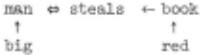
For exampl e, in the sentence, "The big man steal s the red book," the anal ysi s is as follows : 'The' is input and stored for possibl e use in connecting sentences in par agraph, i . e . , in this case , 'the ' specifies that 'man ' has been referred to ·previousl y. Next, 'big' is input . But 'bi g ' cannot stand al one conceptual ly, and it is stored until its governor appears . 'Man' can stand alone and is modified conceptually by 'big', so it is stored as a governor with its dependent .
'Steals ' denotes an action that is dependent on the concept that is doing the acting. A con ceptual ization cannot be complete without a con cept acting (or an attribute statement) , so a two way dependency l ink may be said to exist between 'man ' and 'steal'. That is, they are dependent on each other and govern each other. Every concep tualization must have a two-way dependency link.
Next , 'the' is stored as before as is 'r ed ' . When 'book' is input , 'red ' is attached to it as before , and the whol e entity is stored as dependent on 'steal s' as the object of t he action (repre sented by a horizontal singl e arrow) .
The entire structure is as foll ows :
The categories assigned to these concepts are as foll ows :
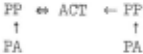
This system, with more symbols and categories added, has been made to effect a set of rules which can account for all possible conceptual iza t i ons . The relations inherent in these concep tualizations are intended to provide a system for representing the meaning of a sentence in any l anguage , in l anguage-free t erms . (Language enters into the conceptual representation onl y in a naming capacity. ) A list of the allowable con ceptual dependencies is presented in the Appendix. In addition to dependencies , other relations are allowed by the theory, e . g. , conjunct ions , dis junctions and comparatives .
This conceptual framework can be used to write realization rules for any language and rules for English have been written9. The realization rules are responsible for placing the entities realized from the conceptual level in the correct grammatical order to form a sentence . These rules are then the parsing r ules for a particular lang uage .
The system for analyzing a sentence into its conceptual representation works backwards through the realization rules of a language . In places where either of two rules could apply, the system can build upon both of them, aborting if one anal ysis leads to an impossible conceptual structure, or producing multiple analyses for ambiguous sen tences . All conceptualizat ions are checked against a list of experiences to see if that part i cular part of the con3truction has occurred be fore . If the construction has not occurred, or has occurred only in some peculiar context , this is noted. Thus , in the construction 'ideas ~ sleep', it is discovered that this connection has never been made before, and is therefore meaning l ess to the system. I f the user says that this construction is all right, it is added to the mem ory; otherwise the construction is looked up in a metaphor list or aborted. The system thus employs a record of what it has heard before in order to analyze what it is presently hearing.
In order for the system to choose between two analyses of a sentence both of which are feasible with respect to the conceptual rules (see Appendix) a conceptual semantics is incorporated. The con ceptual semantics is a data base which limits the possible conceptual dependencies to statements con sonant with the system's knowl edge of the real world. The definition of each concept is composed of records organized by type of dependency and by conceptual category of the dependent . For each type of dependency, semantic categories (such as animate object, human institution, animal motion) are delimited with respect to the conceptual cate gory of a given concept, and defining characteris tics are inserted when they are known. For example, concepts in the semantic category 'physi cal object ' all have the characteristic 'shape '. Sometimes this information is intrinsic to the particular concept invol ved, for exampl e , 'balls are round' .
The semantic categories are organized into hierarchical structures in which limitations on any category are assumed to apply as wel l to all categories subordinate to it . The system of semantic categories and a method of constructing semantic files is discussed more fully in a pre vious paper9.
In the present system, the files are con structed by incorporating information derived from rules presented as Engl ish sentences . The program parses each of these sentences, observes which dependencies are new, and then adds them to the files .
4. Conceptual Analysis
In the Conceptual Dependency theory on which our program is based, the parsing procedure begins by looking up the conceptual category of a word. If the conceptual category is either PP or ACT, the concept evoked by the word being considered is placed directly into the conceptual network. Otherwise the concept is queued until a permissibl e conceptual governor enters the system. Preposi tions , conjunctions, and determiners are similarly queued. A permissibl e conceptual governor is one whose category is on the left hand side of a conceptual rule (see Appendix) and where the depen dency effected by the use of that rule is allowed by the conceptual semantics. 11 (An example of the conceptual semantics is given in the Appendix. )
If a permissible conceptual governor has been found for a queued concept , the queued concept is placed in the network with the appropriate depen dency. A governor is not placed directly in the network unless it satisfies the conceptual seman tics with respect to its dependencies .
Ambiguous interpretations of a piece of dis course are built up if more than one conceptual rule may apply. If the conceptual semantics dis allows an interpretation, the dependency is aborted. I f more than one network remains after the conceptual semantics have been checked multi ple anal yses are built up. Semantic ambiguity (that i s , multiple meanings for a word) is also handled by the conceptual semantics . If a word connects to more than one concept, each concept is checked for the appropriate possibilities of dependence. The concept that fits according to the semantics is the word- sense chosen. If more than one concept fits, more than one network is buil t up. The semantics are checked as each de pendent is added, so it is possible to abort a multiple network at a later poi~t in the parse.
As an exampl e of the strategy employed in the theory it is illuminating to follow the parse of an example sentence. Consider:
'The tall boy went to the park with a girl'.
The machine tries to simulate the behavior of a human in perceiving this sentence. Thus, it is continually operating and making hypotheses as each word enters the system.
When 'The' enters, it is hel d in waiting as it may be a l ink to a previous mention of the next PP which will enter the system. That is, 'the ' would be replaced by 'a ' in an ordinary dialogue if its specific referent were previously unmentioned or unknown.
'Tall' i s marked as a PA. It is therefore queued until a rule that uses PA as a dependent can apply. Since 'boy ' is a PP, it is placed directly in the network. Previous networks gen erated by the user are searched for an instance of 'boy ' to which the 'the' refers and a link is made if one is found. The conceptual r ule 'PP ~ PA' is keyed by the real ization rule 'PA PP: 2; l 2 t l
the numbers are place markers representing rela tive position in the piece of discourse. The PA is below the line to indicate that this dependent is an attribute of its governor. The 'PP ~ PA' semantics for 'boy' are checked to see if the con junction ' boy~ tall' can exist . Since the sys tem knows that any animal can have height the connection is allowed and our network looks as follows :
(The check with the semantics is made at ever y connection but from now on we wi l l onl y ment i on it when i t is necessary. )
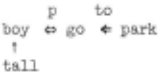
When 'went' is operated on it is transformed into 'go-p' (p means past ) and since 'go' is an ACT the realization r ule that appl ies will connect it to a previous PP by a two-way l ink. The 'p' modifies the two-way link and is moved over it . We now have the following :

'To', the next word into the system, is queued since it may be a preposition or part of an infinitive. If the next governor encountered is not an ACT, 'to' is a preposition and is trans lated into a 'to' link. <=
.'Hie <= link ~s _pb!!!pOSi L1ona1 deyleliden cy. When the link is written horizontally, it represents a dependency between an ACT and a PP where the dependeht is not the object of a direct action. Vertical prepositional dependency specifies additional information about a concept that is only indirectly an attribute of that con cept (e . g. , a location rather than a physical attribute) . Prepositional links may have many different forms, each represented by a tag (e . g. , "to", "of") written over the link. Prepositional dependency is different from simple dependency in certain specified ways, one being that strings of prepositionally dependent PP 's may exist whereas this cannot exist with simple dependency.
When 'the' is encountered it is treated as before . 'Park' is marked as both a LOC and a PPLoc · However, the system will demand the PP interpretation since 'to LOC' is not allowed; by definition, LOC's can only modify two-way links . 'Park' is then placed in the network giving :
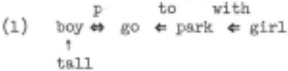
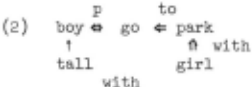
'With' is held in waiting as a <= link un til the PP to which it connects is encountered. 'A' is ignored and the construction 'w~th girl ' is made. We are are now faced with the prob lem of where to attach this construct . A problem exists since at least two realization rules may apply:

The probl em is resolved by the · conceptual semantics . The semantics for 'go ' contains a l ist of concep tual prepositions . Under 'with ' is listed'any movable phys i cal object ' and since a gir l is a physical object the dependency is allowed. The semantics for 'park' are also checked. Under 'with' for . 'park ' ar e l isted the various items that parks are known to contain, e . g. , statues, jungl e gyms, etc . 'Girl ' is not found so the net work (l) isall owed while (2) is aborted.
with
Although ' <= girl' is dependent on 'go' it is dependent through 'park'. That is, these are not isolated dependencies since we would want to be able to answer the question 'Did the girl g.o to the park?' affirmatively. I n (2) the below-the line notation indicates that it is the 'park with a )9.r.l '- as ~ :to:.a:nother '.park'~ ..Now i.t. may we"ll be t'he case tna"t this ls w"hat was · 1ntended. The conceptual semantics furictions as an experi ence file in that it limits conceptualization to ones consonant with the system's past experience. Since it has never encountered 'parks with girls' it will asBume that this is not the meaning in tended. It is possible, as it is in an ordinary conversation, for the user to correct the system if an error was made . That is, if (2 ) were the intended network it might become apparent to the user that the system had misunderstood and a correction could easily be made. The system would then learn the new permissible construct and would add it to its semantics . The system can always learn from the userlO and in fact the semantics were originally input in this way, by noticing occurrences in sample sentences . *
Thus, the system purports to be analyzing a sentence in a way analogous to the human method. It handles input one word at a time as it is en countered, checks potential linkings with its own knowl edge of the world and past experience , and pl aces its output into a language- free formul ation that can be operated on , realized in a paraphrase, or translated.
5. Implementation
The parser is presentl y operating in a l imited form. I t is coded in MLI SP for the PDP- 10 and can be adapted to other LISP processors with minor rev1S1ons . The algorithm used differs from the theoretical analysis given in the previous section because a computer program must deal with machine l imi tations and must cope with special cases that may be encountered in the input .
*Sylvia Weber and Kenneth Mark Colby of Stanford University prepared most of the initial data for the semantic files .
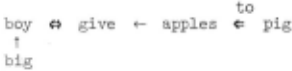
Rather than building up the network structure a little bit at a time during the parse, the pro gram determines all the dependencies present in the network and then assembles the entire network at the end. Thus , the sentence 'The big boy gives apples to the pig.' is parsed into:
- boy t big
- 2 ) boy ~ give
- gives f- apples
- to 4) give $ pig
and then these are assembled into:
The input sentence is processed word-by-word. After "hearing" each word, the program attempts to determine as much as it can about the sentence before "listening" for more. To this end, the network is built up a little at a time as each word is processed. Furthermore, the program anti cipates what kinds of concepts and structures may be expected later in the sentence. If what it hears does not conform with its anticipation, it may be "confused", "surprised", or even "amused" .
I n case of semantic or syntactic ambiguity, the program should determine which of several possible interpretations was intended by the "speaker". It first selects one interpretation by means of miscellaneous heuristics and stacks the rest . In case later tests and further input refute or cast doubt upon the initial guess, that guess is discarded or shelved, and a different in terpretation is removed from the stack to be pro cessed. To process an interpretation, it may be necessary to back up the scan to an earlier point in the sentence and rescan several words. To avoid repetitious work during rescans, any infor mation learned about the words of the sentence is kept in core memory.
The parse involves five steps : the diction ary lookup, the application of realization rules, the elimination of idioms , the rewriting of ab stracts , and the check against the conceptual sem
antics .
The di ctionary of words is kept mostly on the disk, but the most frequently encountered words remain in core memory to minimize processing time. Under each word are listed all its senses . "Senses" are defined pragmatically as interpreta tions of the word that can lead to different net work structures or that denote different concepts . For example, some of the senses of "fly" are:
fly 1 - (intransitive ACT): what a passenger does in an airplane f l y 2 - (intransitive ACT) : what an airplane or bird does in the air.
fly 4 - (transitive ACT): what a pilot does by operating an airplane .
fly 5 - (intransitive ACT -- metaphoric) : to go f ast .
fly 6 - (PP): a flap as on trousers .
If there are several senses from which to choose, the program sees whether it was anticipat ing a concept or connective from some specific category. Recent contextual usage of some sense al so can serve to prefer one interpretation over another . To choose among several senses with otherwise equal likelihoods, the sense with lowest subscript is chosen first . Thus, by ordering senses in the dictionary according to their empir ical frequency of occurrence, the system can try to improve its guessing ability.
The realization rules that appl y to each word sense are referenced in the dictionary under each sense . Most of these rules fall into categories that cover large conceptual classes and are ref erenced by many concepts . Such categories are PP, PA, AA, PPLOC' PPT' LOC, T, simply transitive ACT, intransitive ACT, ACT that can take an entire conceptualization as direct object ("state ACT") , and ACT that can take an indirect object without a preposition ("transport ACT"). In contrast to most concepts, each connective (e . g., an auxi liary, preposition, or determiner) tends to have its own rules or to share its rules with a few other words .
A realizat ion rule consist s of two parts : a recognizer and a dependency chart. The recognizer determines whether the rule applies and the dependency chart shows the dependencies that exist when it does . In the recognizer are specified the ordering, categories , and inflection of the con cepts and connectives that normally would appear in a sentence if the rule applies . If certain con cepts or connectives are omissible in the input, the rule can specify what to assume when they are missing. Agreement of inflected words can be specified in an absolute (e. g., "plural") or a relative manner (e.g., "same tense"). Rules for a language like English have a preponderance of word order specifications while rules for a more highly inflected language would have a preponderance of inflection specifications.
Realization rules are used both to fit con cepts into the network as they are encountered and to anticipate further concepts and their potential realizates in the networks. When a rule is sel ected for the current word sense, it is compared with the rules of preceding word senses to find one that "fits". For example, if "very hot" is heard, one realization rule for "very" is :
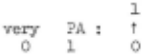
where the tags "O" and "1" indicate the relative order of the word senses in the recognizer and identify them for reference by the dependency chart; "O" means the current word. One rule for "hot" is:
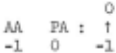
The program notices that "very" fits in the "-1" slot of the "hot" rule and verifies that "hot" fits in the "1" slot of the "very" rule. There fore, the dependency suggested by the chart can be postulated for the network:

If the rules for two adjacent word senses do not fit together, other rules are tried or more distant word senses are checked.
Whenever a dependency is postulated, it is looked up in an idiom file to see if it is an idiom or a proper name and should be restructured. Thus, the construct:

is reduced to the single concept

This idiom will be detected by the parser even if several words intervene between "make" and "up" in the sentence.
After el iminating idioms from the network, there still may be constructs that do not refl ect language-free beliefs . The most conspicuous cases are caused in English by abstract nouns. Most such nouns do not correspond to PP 's but rather are abbreviations for conceptualizations in which the concept represented is actually an ACT or a PA.
The prograJn treats an abstract noun as a PP temporarily in order to obtain its dependents , be cause abstract nouns have the syntax not of ACT 's but of PP's. After obtaining its dependents, the PP is rewritten as an entire conceptualization according to rules obtained from an abstract fi l e . These rules also specify what to do with the de pendents of the PP; they may be dependent on the entire conceptualization, dependent on the ACT only, or appear elsewhere in the conceptualization.
By way of example, the sentence:
Tom's love for Sue is beautiful.
leads to the following dependencies:
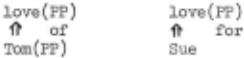
After hearing "is", the program expects no more dependents for "love" (by a heuristic in the pro gram), so it checks the abstract file and finds rules for "love" including:
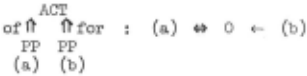
where "(a)" and "(b)" identify concepts without reference to sentential order. The network is now rewritten:

where the horizontal main link represents "is", waiting for a right-hand concept. When "beauti ful" is heard, the network is complete, giving :
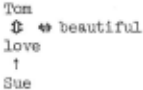
The network above may be realized alternative ly as either of the paraphrases:
That Tom loves Sue is beautiful. For Tom to love Sue is beautiful.
In conceptual dependency theory, connectives like "that", "for","to", and "of" are cues to the structure of the network and need not appear in the network at all. The network above demonstrates such a situation. Conversely, portions of the network may be absent from the sentence. For example, the sentence:
It is good to hit the ball near the fence .
is parsed as :
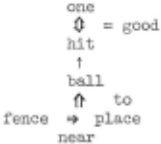
Here, "one" and "place" are not realized. Notice that the rel.evant realization rule for "it" is :
The square brackets indicate optional words . The tags "(aO)" and "(al)" indicate that "for" pre cedes the "PP" but the whole phrase may occur in any position of the construct. "(al)\one" in the dependency chart means that if "(al)", i.e., "for PP", is omitted, and the subject of the action is not obvious from context , then the concept "one" is to be assumed.
The conceptual network should reflect the be liefs inherent in the original discourse in a language-free representation. The interlinguistic file of conceptual semantics is checked to verify that the dependencies are indeed acceptable. This check is made after abstracts have been rewritten.
After the five parsing steps are completed, the program proceeds to the next word. At the end of the sentence, it outputs the final network in two dimensioRs on a printed page or on a display console.
6. Examples of Algorithm
Only a few of the relevant realization rules will be shown in the examples.
Example 1
'John saw birds flying to California.'
Words
John
birds
flying Realization Rule Patterns
(for possible
senses)
1: (all PP patterns)
1: (all PP patterns)
2(to see, past tense)IJohn~seei~PP
to
PP ACT PP:-1 ~ ~1
-1 0 1
to
PP ACT by PP:2 # ~1
-1 0 1 2
3 (to sew): ...
etc.
1: (all PP patterns) .[ see<-birdsl
l:a) PP ACT-ing:-~ I
1 0
birds # fly
Dependencies
(rectangle
around new
dependencies)
(note: "to"
means "tense" of
ACT Number 0)
I
But now there are two main links on one line. So, go back and try as object of "see":
Example 3
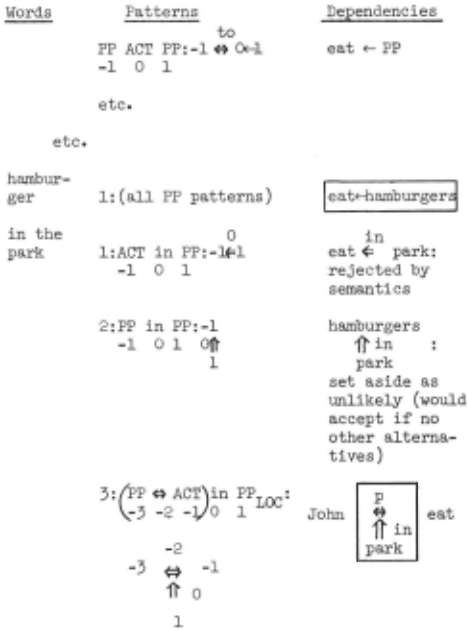
Jane ate the hamburgers in the park.
Words
Jane
ate Patterns Dependencies l:(all PP patterns) l(eat-past tense):
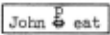
b) -3PP
- 2 l): ACT-ing:
-lACT 0
-3 # -1
- 2
tt-l
-3 # 0
California l:(all PPLOC pat
terns)
Final output:
to
fly * California
p
John # see<-birds
l):
fly
to 1l'
California
Example 2
John saw Texas flying to California
''fords
John
saw
Texas
flying Patterns l:(all PP patterns)
(as above)
l:(all PPLOC pat
terns)
(as above)
(rest as above)
Final output:
p
John f see <- Texas
p
to
John# fly~ California
Dependencies
I see <- Texas I
Texas# fly:
rejected by
semantics.
Laugh and go
back and try
(lb):
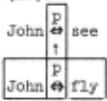
birds
see <- ~
fly
7· Examples of Parses
'Flying planes can be dangerous '
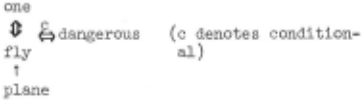
If prompted to find an alternate parse, the pro gram would produce:
c
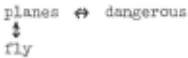
'The shooting of the hunters was terrible' Alternate parse:

t
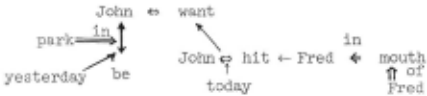
hunters 'John, who was i n the park yesterday, wanted to hit Fred in the mouth t oday '.
'John was persuaded by the do.ctor in New York to be easy to please'.
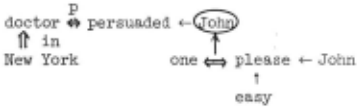
(A circle around a concept denotes that it is the conceptual subject, or topic, of the network. If there is no circle, the conceptual subject i s the item to the left of the first two-way link.)
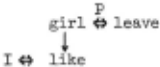
'The girl I liked left'.
8. Conclusion
Before computers can understand natural lang uage, they must be able to make a decision as to precisely what has been said. The conceptual parser described here is intended to take a natural language input and place the concepts der ivable from that input into a network that expli cates the relations between those concepts . The conceptual network that is then formed is not intended to point out the syntactic relations present and there is some question as to why any system would want this information. Although Chomsky's deep structures [1] convey a good deal more information than just syntactic relations, it is clear that a parser that uses deep structures for output would be oriented syntactically. We see no point in limiting our system by trying to test out a previously formulated gr ammar. The output of a transformational parser, while making explicit some important aspects of the meaning of the sentence, does not make explicit all the con ceptual relationships that are to be found, does not limit its parses with a check with reality, and most importantly is syntax based. The parser presented here is semantics based. We aver that the system that humans empl oy is also semantics based. It seems clear to us t hat our parser satisfies the requirement s that a pa r ser must satisfy and in so doing points out the advantages of regarding l anguage from a Conceptual Dependency point of view.
APPENDIX
- Conceptual Rules (permissible dependencies) :
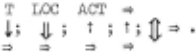
II. Realization Rules
The realization rules of the theory fall into four categories.
- Those that determine the subject and verb (or attributive) of a conceptuali zation.
- Those that attach etc. to a two-way T's LOC's, reasons, link.
- Those that attach objects to the verb.
- Those that attach line. dependents below the
These categories play somewhat different roles in parsing. In a way, the parser uses them in order: first, identifying the subject and placing the main link; next, modifying the main link; next, finding objects; last, qualifying the concepts involved in the first three steps. How ever, the processing of discourse actually pro ceeds from left to right, so some amount of guess work is necessary, for example, to attach depen dents to the subject before identifying it as such.
The categorization of rules also helps when a previously unknown word is encountered. Depen ding on whether the parser's subgoal is to com plete a category four rule, a category three rule, etc., a different rule or rules will be invoked to guess the category of the new work.
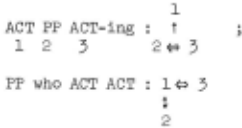
(There are about 100 of these rules, present ly. A few are shown here).
PP ACT : 1 ¢> 2 ;
1 2
PP ACT to ACT l ~ 2
1 2
PA PP
l 2
2
t
l
ACT PP PP l 2 3 1<=2<--3
PP Prep PP l 2 3 3 ; 11 2
3 PP ACT Prep PP l 2 3 4 l ~ U= 4 \ or l ~ 2 1'1'3 4
PP PP ACT ACT : l ¢> 4 l 2 3 4 ~ 2 ~3
3
t
l~ 3
III. A Sample of the Conceptual Semantics for 'ball'.
ball,
inanimate motion object
size shape color texture
elasticity any round any usually smooth bounces
<=PP
in
on
for
by
of
at
to phys obj phys obj phys obj place animal no no
=:.ACT
specific motion object concrete
any bounce roll, come, spin, fall,hit ··
begin, cause · · ·
@inproceedings{ijcai1969p49,
  title     = {A Conceptual Parser for Natural Language},
  author    = {Schank, Roger C. and Tesler, Lawrence G.},
  booktitle = {Proceedings of the First International Joint Conference on
               Artificial Intelligence, {IJCAI-69}},
  publisher = {International Joint Conferences on Artificial Intelligence},
  editor    = {Donald E. Walker and Lewis M. Norton},
  pages     = {569--578},
  year      = {1969},
  month     = {5},
  note      = {Linguistic Research Relevant to Artificial Intelligence},
  url       = {https://ijcai.org/proceedings/1969/49},
}
TY - CPAPER TI - A Conceptual Parser for Natural Language AU - Schank, Roger C. AU - Tesler, Lawrence G. T2 - Proceedings of the First International Joint Conference on Artificial Intelligence, IJCAI-69 PB - International Joint Conferences on Artificial Intelligence PY - 1969 SP - 569 EP - 578 UR - https://ijcai.org/proceedings/1969/49 ER -Copied
Machine-readable versions of this paper, for tools and AI agents:





