
Cyclic Behavior of Randomly Growing Digital Structures in Finite Random Environment
Proceedings of the First International Joint Conference on Artificial Intelligence. Self-organizing Systems. Pages 347-360.
© 1969 International Joint Conferences on Artificial Intelligence
Abstract
Computer experiments with a model of a randomly growing structure with the possibility of division are presented. In agreement with the set of conditions, the growing structures are considered as evolutionary sequences. The randomly growing digital structure could achieve unchangeable "shape" in each evolutionary generation in spite of the lack of complete predetermination of this. "shape". The effect was obtained by random supplement of creative materials from the environment. The environment was assumed as random, finite, and repetitive in a cyclic way. For this environment the only stable state of evolutionary sequence is a periodic sequence (in a particular case, the same "shape:' in each generation) _. Other sequences have either to degenerate or, after a number of nonperiodic charges, become periodic. The model, results obtained from the computer and interpretation are presented.
Full text extracted automatically from the PDF; figures, tables and equations may differ. The PDF is the version of record.
Introduction
The stability of growth and division of very simple organisms has. been considered to be a consequence of the intez:.nal organization and information content of its structure. An environ ment is able to influence the stability of growth a nd division of any given structure only in a neutral or destructive way. Mutations also belong to this category of influences, because they can be considered as a destruction of the given structure and a replacement of that structure by a new one (in some cases "better" then the former but still new). The environment is usually assumed to be purely rando~; and long cycllc changes of the environment with the periods many times longer than the one -generation lifetime are, in case of simple organisms, abandoned.
The aim of this paper is to point out the theoretical possibility of influencing the life process stability of simple organisms by cyclic changes of random environment. In this case, the organism, the growth-division process, and the "shape" of the organisms are determined not only by information contained in the organism's internal structure, but also by the environment. Moreover, under these conditions the information can tained in the internal struc ture is only the framework and determine~> not one but the whole class of organi sms. In spite of this, and on the basis of informati on received from the environment the simulated organisms have a unique and identical (wi th some infrequent random exceptions) "shape" in each generation.
This paper is the presentation of the r e sults obtained by observation of evolutionary sequences of computer models of simple organisms. The simulated models were not the image of the structure of any living organisms, but the image of behavior, i.e., the models had the possibility of growth by absorbing the "creative material substance" from the environment and the possibility of division. The model presented is very abstract. The results obtained show only the possibility of the real e.xistence of obse rved environmenta l influences upon living organisms; but in order to have any biological value, the results should be t e sted _ in biological experiments.
* These computer experiments were supported by a grant from the Ford Foundation; and computer time was granted by the Moore School of Electrical Engineering Computer Facility.
CYCLIC BEHAVIOR OF RANDOMLY GROWING DIGITAL STRUCTURES IN FINITE RANDOM ENVIRONMENT*
Konrad R. Fialkowski
University of Pennsylvania Technical University of Warsaw
Digital Structure and Growth Process
A Digital Structure (DISTRUC) is a sequence of positive, integer numbers (c . ), i=l, 2, ··· , I. The number I is called" the lengfh of DISTRUC, and the ith number is called the i-th place of DISTRUC.
A Digital Structure has the possibilty of growth and division. The growth and-division will be called a "life" process of DISTRUC. The growth is performed in the sequence of cycles numbered by i, t=O, 1, 2, ... , T. After completion of the t-th cycle, DISTR UC is denoted as:

and each place of DISTR UC can be denoted as c . .
1, t.
·DISTR UC (c . ) (for t=O) is called the Basic Structure(BASTitlJlc). If the growth of the structure is successfully fini!hed, that value of DISTRUC is called the Grown Structure (GSTRUC) and dencted as (ci)T. The number T is called the Lifetime
of Structure (LT). The Basic Structure can be chosen arbitrarily, but usually it is determined by the Grown Structure, directly preceding it.
Thct Basic Structure which is chosen arbitrarily and does not have a preceding grown structure will be called the Initial Basic Structure (IBSTRUC). Each DISTRUC has a generation number g (a positive integer). For IBSTRUC the generation number is always zero (g=O). The GSTRUC determines BASTRUC in the following
way:
where E is the En tier function (for positive numbers, .: the integral part of the number).
The DISTRUC is growing in each cycle O<t:S:T according t o the following equations:
where R is a random number, and Q a nd V are determined for each t in the following way:
where q . is given by: . J
where:
Comment
For each t as long as V = 1 and Q <I, the t t DSTRUC is growing according to (2), and the cycle t is the cycle of growth. If, in cycle t (t<T) Vt=O, the process of growth is stopped, DSTRUC "dies"; the state is called degeneration; and Td=t is called the Time of Degeneration. When .Qt =I and Vt=l, DSTRUC is grown, T=t and GSTRUC is ready for division.
Conclusion
From the above, it follows that any sequence of positive integers can be treated as an IBSTRUC but that growth is possible only for those IBSTRUCs which may satisfy the conditions of equations· (7-9).
After completion of the growth process and before division a GSTRUC may be able to change its length. The growth process (according to (2)) is applied also to the I+l-th place. From the definition of DISTR UC on the beginning of the growth process:
The GSTRUC changes its length if and only if:
P is called the expanding coefficient; A is called the stability threshold, and Sand Dare parameters determined in the beginning of the process.
If condition ( 1 0) is fulfilled
and
otherwise
Parameters of Process
The set of parameters which describe the growth and division of DISTRUCs can be divided into two subsets:
- ·parameters which describe the growth and division process of an individual DISTRUC,
- parameters common to all of· common origin. DISTRUCs
To (a) belong:
- Sequence (c)
- Length of DISTRUC-I
- Lifetime-T, or degeneration time-T d.
- Expanding coefficient - P.
The sequence (c . ) and length I will be called the "external characteristic" or "shape" of DISTRUC.
To (b) belong:
- S - basic parameter of growth ( 6)
- D - Relative interval of regular growth (9), (11)
- A - stability threshold ( 10)
- L 1 - assimilation coefficient
The assimilation coefficient determines the possible speed of-DISTRUC growth and alsolimits the growth of the larger places of DIS TR UC in each cycle according to the following relationship:
(c . 1 is described by (2)). 1+
The length coefficient determines the maximum length of the DISTR UC that can be accepted by the next generation. It does not influence single length changes of a given DISTR UC,
as this length is determined for single DISTR UC by its expanding coefficient and the stability threshold. For each cycle:
but in g+2, I =6, (does transmission of length g+2,0 exist) when c 3 , O, g+l =5 or P g+l> A.
From (f5) and (16) it follows that the 2nd and 3rd place of BASTRUC influence the possibility of growth speed and the maximum length of DISTRUC.
Environment
The environment is a finite sequence. of random pumbers (from random number tables). The random sequence is used successively in a cyclic way, starting at an arbitrary position in the sequence. The length of the random sequence N has to be:
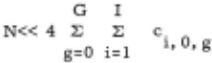
This means that N can be arbitrarily large if the number of generations G observed as an evolu tionary chain in the experiment is sufficient, i.e. , if the experiment lasts sufficiently long.
Behavior of a Single DISTR UC
The only IBSTRUC used in the experiment is:
The I of this IBSTRUC is always 3 (I=3). This IBSTRUC (and other DISTRUCs) will be denoted as:
The I value can be read directly from the notation. The DISTRUC with I=3 is the Minimal DISTRUC i.e., the minimal "living" structure. This follows from ( 15) and ( 16) as the structure with I<3 has no possibility of regular growth and division. The value I=3 can be considered as a threshold of i'life' .'·
From equations (3) through (5) it follows that the values on places i=l, 2, 3 do not depend on the ·s or D parameters. Thus, the growth of these places is exactly the same for all DISTRUCs, which could be input into "life" experiments. It underlines the assumed common base for "life" processes in all possible structures.
All parameters which characterize individual structure have the possibility of random changes during the growth process. All these changes influence the possibility of successful growth· of DISTRUC; and if the DISTRUC becomes grown (and divides), some of these parameters influence the next generation. The degeneration, which may occur as an effect of random growth, is a selecting factor. The process of changes and selections in the generation sequence of DISTRUCs will be called evolution.
Comparison of Digital Structures
The comparison methods will be introduced for BASTRUCs, as BASTRUC could b.e considered in some respects as the standard form of DISTR UC. There are four degrees of similarity:
- Origin similarity (OS)
- Similarity (SI)
- Identity (ID)
- Internal identity (II)
These degrees of similarity could be described as follows:
- Two DISTRU:::s (c.) and(C.) have OS if 1 l more than half of the places (having numbers larger than 3) if c . I 0 and ci I o 1
- Two DISTRUCs have SI if they have OS and have the same length.
- Two DISTR UCs have ID if they have SI and if
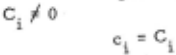
ID is the identity of "external characteristics".
- Two DISTRUCs have II if they have ID and if:
Internally identical DISTR UCs have only different generation numbers.
Experiments
As was mentioned earlier, all experiments were started for IBSTRUC: 1, 2, 4; and only descendants of the structure with this external characteristics, which came into existence in the growth process, were passed on to the further experiments. The evolution was observed for DISTRUCs with the following param:ters:
A: 0.8, 1.0 (A=l.O for S = 3,0 only)
Two different repetition sequences of random numbers were taken as environmental simulators; and, for both, N = 100. The program was written in FORTRAN PI, part of the Basic Time Sh4ring System (BTSS) II for the RCA Spectra 70/45 ~ Over two thousand single growth processes were ob served. The most interesting fragments of re sults are presented on Figures A-P.
Description of Figures
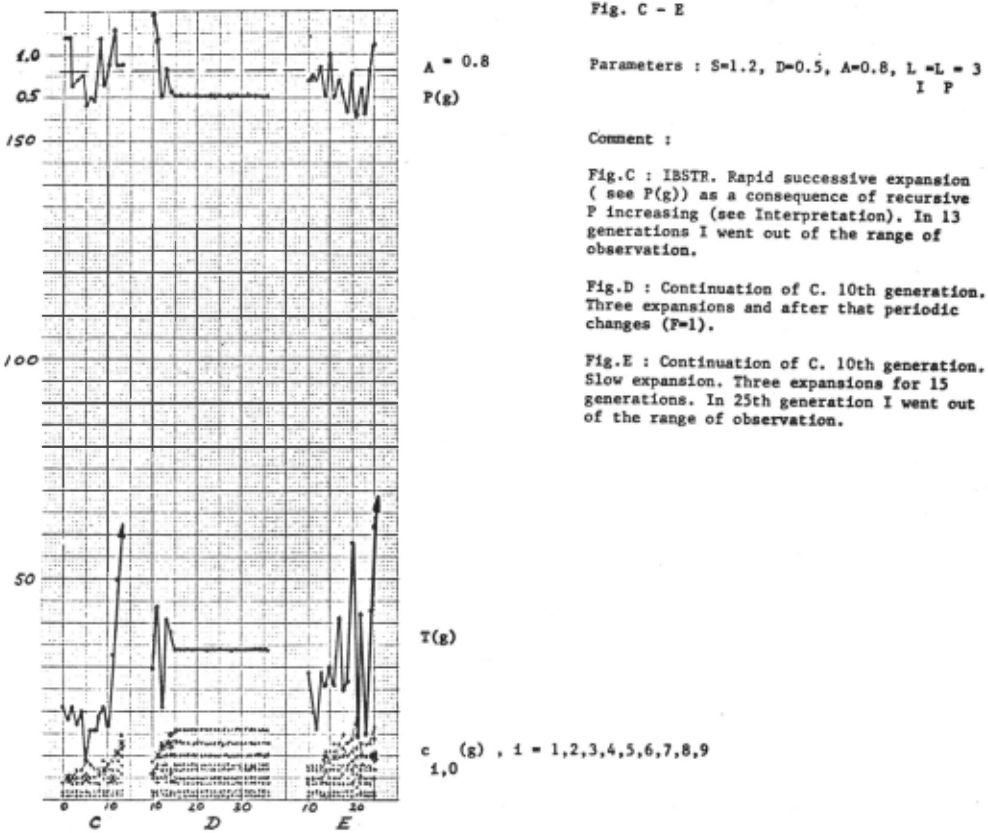
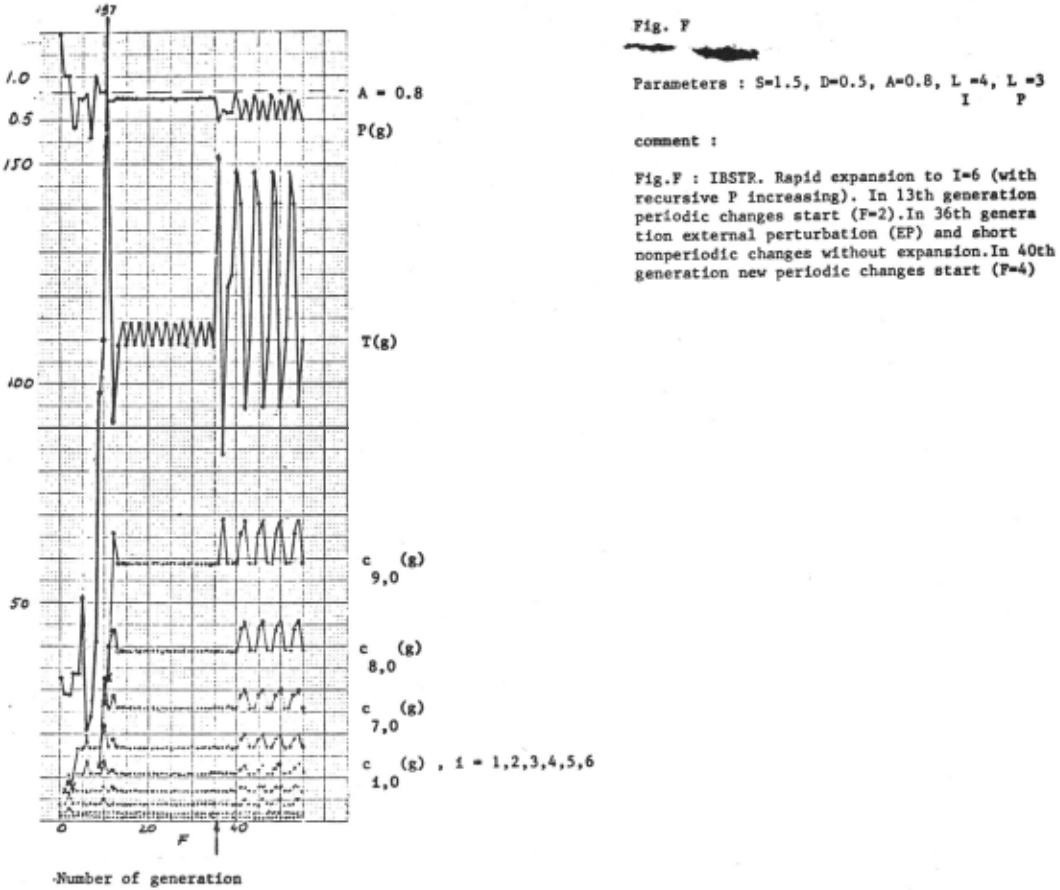
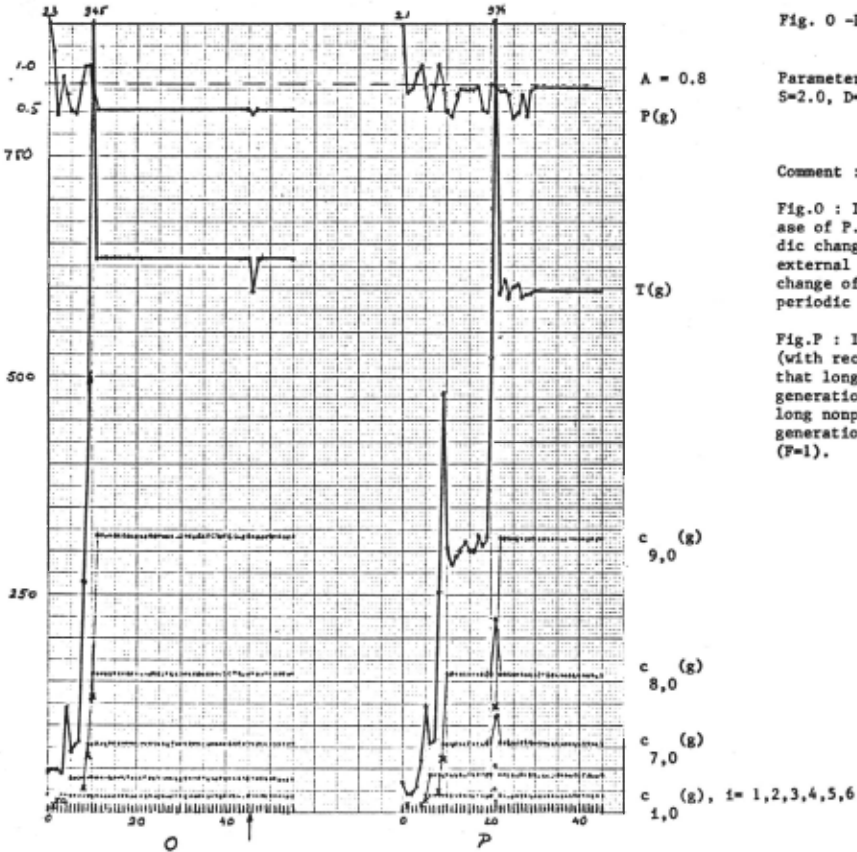
The generation numbers g are on the abscissa (g=O indicates the IBSTRUC). The parts of different evolution sequences are separated by gaps. The small arrows under the abscissa in dicate the environmental perturbation (EP) simu lated by a skip of several random numbers in random sequence. The values of P(g), T(g), and c . 0 (g) (for i=l, 2, ·.. ,I- dotted lines) are pre
s~'nted on the same scale.
The T(g) line is ended in one of three possible ways:
- With named arrow (e. g., D22), This indicates de gene ration of DISTR UC (after 22 cycles in the example).
- With arrow without a name. This is possible for DISTRUCs with 1=9, and means that DISTRUC expanded out of the range of observation (1=9 is the technical limitation caused by an enormous increase of computer time for larger structures, e specially for S> l. 5).
- Without arrow. This is only for periodic changes described further.
The P(g) (upper part of the diagrams) is pre sented in another scale and the stability threshold (dashed, constant value line) is drawn there.
If the single value P or T is out of the scale range, the line is going up out of the scale and the proper value is written for that point. In c . dia grams except dots (and short lines connectfng occasionally more distant dots) the symbols X and + are used. The X means that the I value was changed, and the new c . started. The + means that two different c . of the s 1 ame DISTRUC have the same value. l
The figures contain 16 evolution sequences denoted alphabetically as A-P. These sequences are not a representative sample of experimental data, but were selected as a set of examples.
Interpretation
In all experiments, for a sufficiently large number of generations G, one of three possible states were always achieved.
- Degeneration
- Periodic evolutim ary sequence
- Number of places I> 9 /out of the range of observations,/
The existence of state 3 is the consequence of the technical limitations of experitn!nts (enormous increase of computer time for one generation), It is possible, however, to consider the existence of only the first two states on the basis of following recursive reasoning. It is possible by limiting the value of the length coefficient (L = 1) to con duct the experiments only for I~ 6, p The evolu tionary process in this condition has the same qualitative properties as evblution with Lp= 2, or larger. ·
Working hypotheses: if the value of I is un limited, there exist only two final states of evol ution changes:
- Degeneration
- Periodic sequence.
Let us determine first the periodic sequence The evolutionary sequence can be .defined as per iodic only for a stationary environment (i.e., random numbers input to the experiment in a successive · cyclic way (without skips)).
Th'e evolutionary sequence is periodic in a stationary environment if, for certain IBSTR (c . ) 0 , there exists a positive integer F > 0, of l , g such value that:
where k = 1, 2, ....
The number F is. ~alled the evolutionary sequence period.
If the sequence is periodic, condit ion ( 18 ) is true for each DISTRUC of number g, g'<g<g'+F.
The periodical sequence could start for DISTRUCs of any ·length. The existence of cyclic behavior of evolutionary sequence is the result of cyclic character of random environment. It is important, however, that length of random sequence N does not influence this type of be havior. It follows, frcm estimation of number of random environment cycles for one evolutionary sequence period, that this number can be found as:.
·
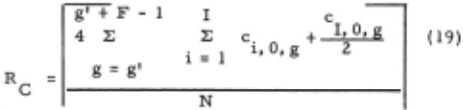
where r l means "round off to the nearest integer".
R For observed periodical sequences A-P, has the following values: c
For R > 1, the environment could be ccnsidered as thee random number sequence of length:
conta,ining the subcycles of length N.
The periodical evoluti.onary sequence lasts in a stationary environment, without perturbation, infinitely long. The external perturbance (usually phase shift of random sequence) breaks the per iodicity of the sequence. Then the elements of the evolutionary sequence are changing in a random, environmentally unoriented way. The degeneration is a selecting factor, which eliminates nonadapta ble structures. Other structures. could adapt to the environment in creating another (or the same) periodic sequence after EP. Nand 0 are the examples of finding the periodic sequence of the same period. The end of N is an example of degeneration of a periodic sequence after EP. The influence of External Perturbance can be presented schematically thus: J D·g·~rahon ------- t :::==- or>n >< "··
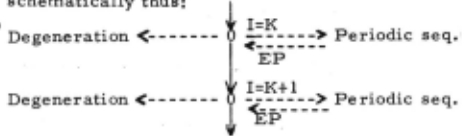
The expansion and nonperiodic changes could be considered as an unstable state. The example of a long lasting unstable state is P.
It should be noted that the assumption ( 17) con cerning the environment is weak, however, in spite of this, the periodic sequences wer'e always ob served after sufficiently long observation without degeneration. If the period sequence is treated as a stable state achieved by the evolutionary sequence it is evident that not all stable states have been founded by one sequence. After each expansion, (in the absence of degeneration) DISTRUC may find the stable state for the just-obtained I value, or may continue the expansion process. The probability of these behaviors are different for just expanded or nonexpanding DISTRUCs.
Any expansion increases the expanding co efficient in the next generation and this property is recursive. That is the reason for the rapid expansions observed in C, F, or H. If the j is a current value of I the above theorem could be formulated as follows:
Theor~m 1: for every j, expansion in g generation increases the expected value of P 1 . h . ~ 1n t e next generatlon.
This is true as well in the case of expansion limited by the L value.
The beginniRg of N is an example of this situation. Another two theorems can be proved:
Theorem 2: For S > 1 for sufficiently large I, the probability of degeneration in two DISTR UC which have OS differs arbitrarily little.
Theorem 3: For S > 1, the nonrandom part of P (j) goes to zero with the increase of j.
The conclusion from Theorem 2 is important, since it means that for DISTRUCs of sufficient length the effectiveness of selection is the same. Limitation of a DISTR UCs length (for any given
stability threshold > ~ ) is a conclusion from Theorem 3.
Conclusions and Discussions
From the experiment, it follows th<t ran domly growing digital structure could achieve unchangeable "shape" in each evolutionary gen eration. This unique "shape" achievern:nt is ob tainable in spite of the fact that the "shape" of the digital structure is not uniquely predetermined by its internal structure.
The evolutionary sequence of digital structures could behave in a regular way, i.e., the sequence is changing periodically (in the particular case each generation is exactly the same). The periodic changes of evolutionary sequence is the only stable state of an evolution ary sequence. Any non periodic changing evolu tionary sequence will achieve this state after a sufficiently large number of generations or X degenerate.
The behavior described above was obtained from a random supplement of creatiye materials ; from the environment. The only condition for the environment is that there has to be some cycle arbitrarily long, but many times shorter than the life of evolutionary sequence. From the point of view of one generation, however, (especially for F > 1), the environment could be considered as absolutely nonperiodic and random.
If the extrapolations of this observed behavior could be made to the living organisms, it could be some basis for interpretation of the beginning of life. According to the experiments, a preliving structure could have only the possibility of random (with only the "frame" determined) growth and division. The information to guaran tee stability could be achieved from environment. Such a structure would be relatively simple.
Acknowledgement
The author sincerely wishes to thank Dr. John W. Carr, III for his counsel, discussion, and the help in preparing the final version of this paper.
Abstract
Computer experiments with a model of a randomly growing structure with the possibility of division are presented. In agreement with the set of conditions, the growing structures are con sidered as evolutionary sequences.
The randomly growing digital structure could achieve unchangeable "shape" in each evolutionary generation in spite of the lack of complete pre determination of this. "shape". The effect was ob tained by random supplement of creative materials from the environment. The environment was assumed as random, finite, and repetitive in a cyclic way. For this environment the only stable state of evolutionary sequence is a periodic sequence (in a particular case, the same "shape:' in each generation)_. Other sequences have either to degenerate or, after a number of nonperiodic charges, become periodic.
The m odel, results obtained from the computer and interpretation are presented.
Parameters : S·0.9, D-0.6, A·0.8, L · 1 · 3 I p
Comment
Fig.A : IBSTR. Degeneration in several gene rations.Typical for that value of s.
Fig.B : IBSTR. The only observation of perio dical changes ( F-2 ) for 5·0.9
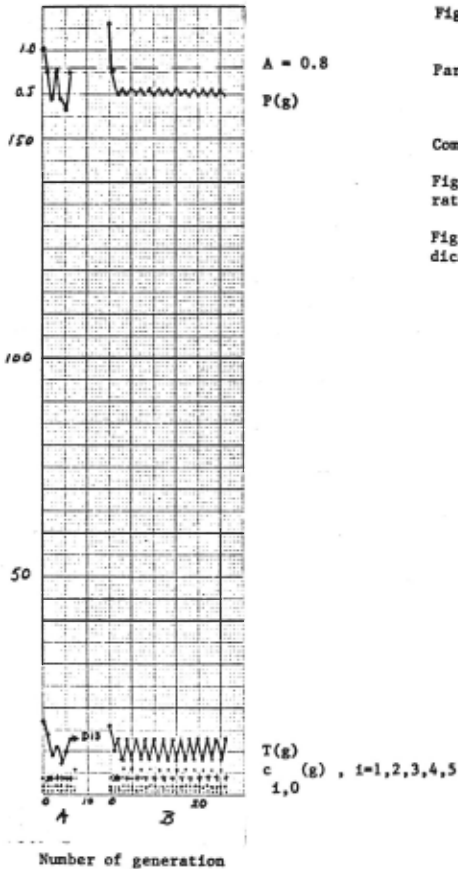
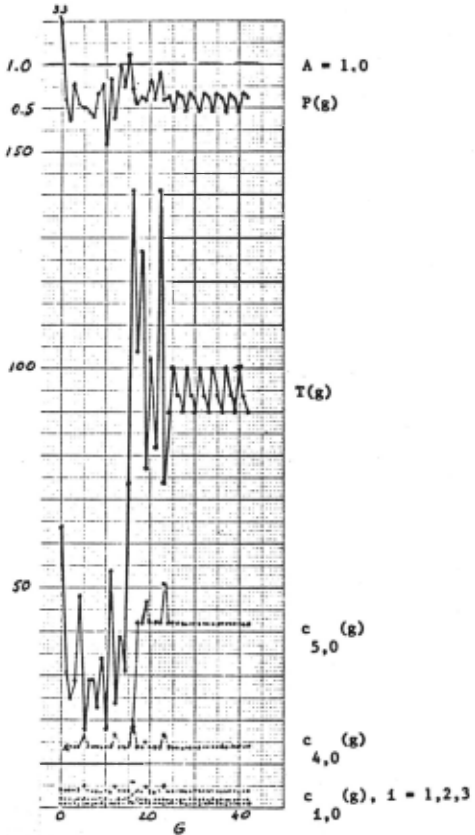
Fig. G
Parameters
Comment :
Fig. G : IBSTR.Long nonperiodic changes with two separate expansions occur( generations: 0 to 25). In 25th generation periodic changes start ( F·3 ) ·
S·3.0, D·O.S,A·l.O,L ·3, L ·1
I
p
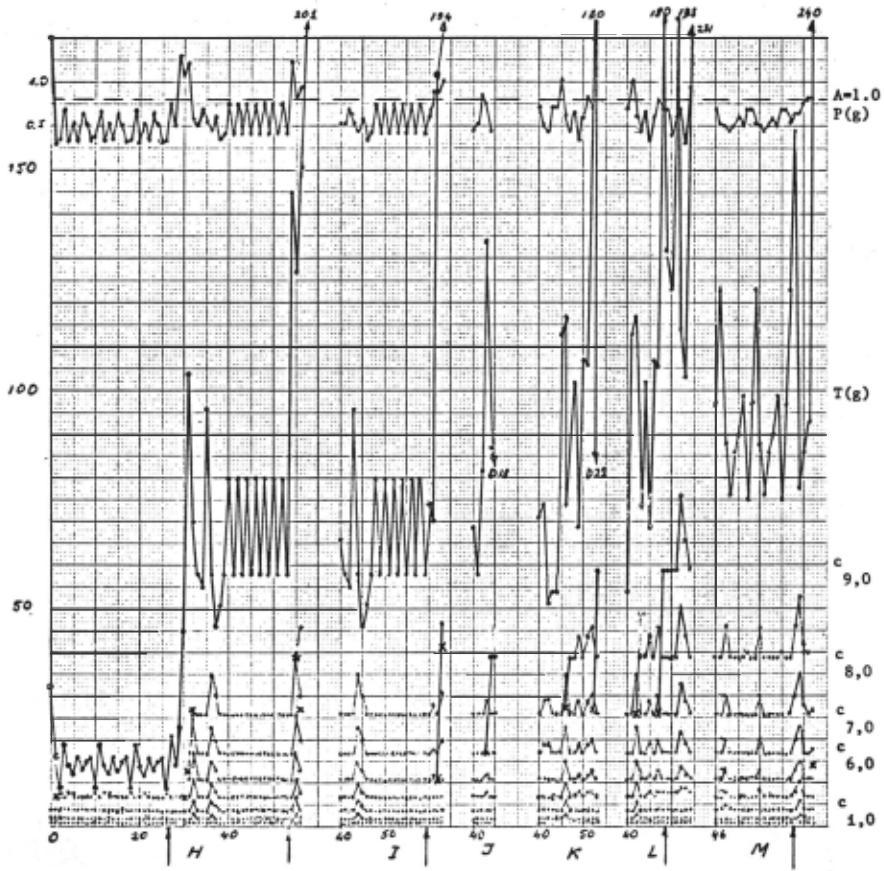
Parameters: 5·1,5, D-0,5, A·l.O,L ·4,L ·3 I , p Comment: Fig,H: IBSTR. After a single expansion periodic changes occur (F·8). In 26th genera tion EP, rapid expansion to 1·7; and from 39th generation periodic changes (F·2); in 54th generation EP, and rapid expansion out of the range of observatioDS. Fig.!: Continuation of H 40th generation; nonperiodic chan ges and from 4!nd -periodic (F·2). In 59th EP and rapid expansion out of the range. Fig.J: Continuation of B 40th generation. Degeneration in 45th. Compare uith fig.I. Fig.K: Continuation of B 40th generation; nonperiodic chan ges with two separate expaDSi) ns. Degeneratioa in 53rd. Fig.L: Continuation of B 401h generation; noaperiodic chan ges with two separate expanai) ns (compare with K ) · In 48th generation EP ; nonperiodic changes. In 54th generation out of the range. Fig.M: Continuation of L 46th generation. In 47th, periodic changes start (P-8). In 57th EP and expansioa out of the range of obaerv.ation.
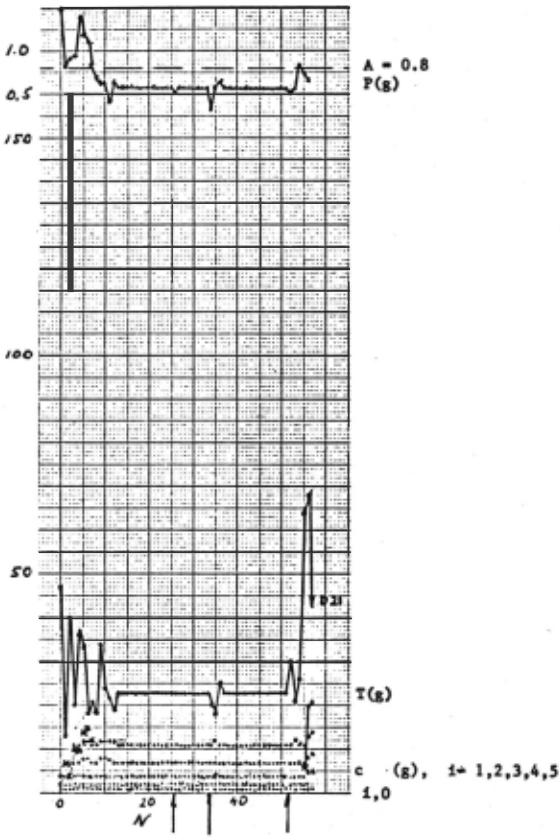
Parameters : S·l.5, D-0.5, A·0.8, L ·4, L ·1 I p
Comment ;
Fig.N : IBSTRUC. Limited expansion. The P(g) function over the stability threshold ( 8 times at the beginning ) without creation of new !placed in DSTRUCTs . In 12th generation perio die changes start (F·l).In 25th generation L p changed to two (L ·2) and EP. No effects (only p small change of P). In 33rd generation L chan p ged to one (L ·1) and EP. Return to the .... p periodic sequence in 4 generations. In Slat ge neration EP. Expansion in 55th generation (possible as c ·5) and degeneration in 57th 3 generation.
* EP - external perturbation
~ ,.,r Fig.O : IBSTR. Rapid expansion with inc~ ase of P. In 11th generation start perio die changes (F·1). In 45th generation external perturbation (EP). Only single change of P and T and return to the periodic sequence Fig.P : IBSTR. Rapid expansion to 1·8 (with recursive P increasing). After that long nonperiodic changes. In 19th generation single expansion to 1·9, long nonperiodic changes and in 30th generation starts periodic sequence (F·l).

@inproceedings{ijcai1969p34,
  title     = {Cyclic Behavior of Randomly Growing Digital Structures in Finite Random Environment},
  author    = {Fialkowski, Konrad R.},
  booktitle = {Proceedings of the First International Joint Conference on
               Artificial Intelligence, {IJCAI-69}},
  publisher = {International Joint Conferences on Artificial Intelligence},
  editor    = {Donald E. Walker and Lewis M. Norton},
  pages     = {347--360},
  year      = {1969},
  month     = {5},
  note      = {Self-organizing Systems},
  url       = {https://ijcai.org/proceedings/1969/34},
}
TY - CPAPER TI - Cyclic Behavior of Randomly Growing Digital Structures in Finite Random Environment AU - Fialkowski, Konrad R. T2 - Proceedings of the First International Joint Conference on Artificial Intelligence, IJCAI-69 PB - International Joint Conferences on Artificial Intelligence PY - 1969 SP - 347 EP - 360 UR - https://ijcai.org/proceedings/1969/34 ER -Copied
Machine-readable versions of this paper, for tools and AI agents:





