
Constrained Policy Improvement for Efficient Reinforcement Learning
Proceedings of the Twenty-Ninth International Joint Conference on Artificial Intelligence. Main track. Pages 2863-2871.
https://doi.org/10.24963/ijcai.2020/396
Keywords
- Machine Learning: Deep Reinforcement Learning
- Machine Learning: Reinforcement Learning
Abstract
We propose a policy improvement algorithm for Reinforcement Learning (RL) termed Rerouted Behavior Improvement (RBI). RBI is designed to take into account the evaluation errors of the Q-function. Such errors are common in RL when learning the Q-value from finite experience data. Greedy policies or even constrained policy optimization algorithms that ignore these errors may suffer from an improvement penalty (i.e., a policy impairment). To reduce the penalty, the idea of RBI is to attenuate rapid policy changes to actions that were rarely sampled. This approach is shown to avoid catastrophic performance degradation and reduce regret when learning from a batch of transition samples. Through a two-armed bandit example, we show that it also increases data efficiency when the optimal action has a high variance. We evaluate RBI in two tasks in the Atari Learning Environment: (1) learning from observations of multiple behavior policies and (2) iterative RL. Our results demonstrate the advantage of RBI over greedy policies and other constrained policy optimization algorithms both in learning from observations and in RL tasks.
- [Argall et al., 2009] Brenna D Argall, Sonia Chernova, Manuela Veloso, and Brett Browning. A survey of robot learning from demonstration. Robotics and autonomous systems, 57(5):469-483, 2009.
- [Auer et al., 2002] Peter Auer, Nicolo Cesa-Bianchi, and Paul Fischer. Finite-time analysis of the multiarmed bandit problem. Machine learning, 47(2-3):235-256, 2002.
- [Bellemare et al., 2016] Marc Bellemare, Sriram Srinivasan, Georg Ostrovski, Tom Schaul, David Saxton, and Remi Munos. Unifying count-based exploration and intrinsic motivation. In Advances in Neural Information Processing Systems, pages 1471-1479, 2016.
- [Dann and Brunskill, 2015] Christoph Dann and Emma Brun- skill. Sample complexity of episodic fixed-horizon rein- forcement learning. In Advances in Neural Information Processing Systems, pages 2818-2826, 2015.
- [Fruit et al., 2017] Ronan Fruit, Matteo Pirotta, Alessandro Lazaric, and Emma Brunskill. Regret minimization in mdps with options without prior knowledge. In Advances in Neural Information Processing Systems, pages 3166- 3176, 2017.
- [Fujimoto et al., 2018] Scott Fujimoto, Herke van Hoof, and Dave Meger. Addressing function approximation error in actor-critic methods. arXiv preprint arXiv:1802.09477, 2018.
- [Garcıa and Fernández, 2015] Javier Garcıa and Fernando Fernández. A comprehensive survey on safe reinforce- ment learning. Journal of Machine Learning Research, 16(1):1437-1480, 2015.
- [Haarnoja et al., 2018] Tuomas Haarnoja, Aurick Zhou, Pieter Abbeel, and Sergey Levine. Soft actor-critic: Off- policy maximum entropy deep reinforcement learning with a stochastic actor. arXiv preprint arXiv:1801.01290, 2018.
- Hado V Hasselt. Double q-learning. In Ad- vances in Neural Information Processing Systems, pages 2613-2621, 2010.
- [Hessel et al., 2017] Matteo Hessel, Joseph Modayil, Hado Van Hasselt, Tom Schaul, Georg Ostrovski, Will Dabney, Dan Horgan, Bilal Piot, Mohammad Azar, and David Silver. Rainbow: Combining improvements in deep reinforcement learning. arXiv preprint arXiv:1710.02298, 2017.
- [Hester et al., 2018] Todd Hester, Matej Vecerik, Olivier Pietquin, Marc Lanctot, Tom Schaul, Bilal Piot, Dan Hor- gan, John Quan, Andrew Sendonaris, Ian Osband, et al. Deep q-learning from demonstrations. In Thirty-Second AAAI Conference on Artificial Intelligence, 2018.
- [Horgan et al., 2018] Dan Horgan, John Quan, David Bud- den, Gabriel Barth-Maron, Matteo Hessel, Hado Van Has- selt, and David Silver. Distributed prioritized experience replay. arXiv preprint arXiv:1803.00933, 2018.
- [Kakade and Langford, 2002] Sham Kakade and John Lang- ford. Approximately optimal approximate reinforcement learning. In ICML, volume 2, pages 267-274, 2002.
- [Kearns and Singh, 2000] Michael J Kearns and Satinder P Singh. Bias-variance error bounds for temporal difference updates. In COLT, pages 142-147. Citeseer, 2000.
- [Krause and Ong, 2011] Andreas Krause and Cheng S Ong. Contextual gaussian process bandit optimization. In Ad- vances in Neural Information Processing Systems, pages 2447-2455, 2011.
- [Kurin et al., 2017] Vitaly Kurin, Sebastian Nowozin, Katja Hofmann, Lucas Beyer, and Bastian Leibe. The atari grand challenge dataset. arXiv preprint arXiv:1705.10998, 2017.
- [Metelli et al., 2018] Alberto Maria Metelli, Matteo Papini, Francesco Faccio, and Marcello Restelli. Policy optimiza- tion via importance sampling. In Advances in Neural Infor- mation Processing Systems, pages 5442-5454, 2018.
- [Mnih et al., 2015] Volodymyr Mnih, Koray Kavukcuoglu, David Silver, Andrei A Rusu, Joel Veness, Marc G Belle- mare, Alex Graves, Martin Riedmiller, Andreas K Fidje- land, Georg Ostrovski, et al. Human-level control through deep reinforcement learning. Nature, 518(7540):529-533, 2015. [
- OpenAI, 2018 accessed May 2020] OpenAI. Openai five. https://blog.openai.com/openai-five/, 2018 -accessed May 2020. Link
- [Papini et al., 2019] Matteo Papini, Matteo Pirotta, and Mar- cello Restelli. Smoothing policies and safe policy gradients. arXiv preprint arXiv:1905.03231, 2019.
- [Pirotta et al., 2013a] Matteo Pirotta, Marcello Restelli, and Luca Bascetta. Adaptive step-size for policy gradient meth- ods. In Advances in Neural Information Processing Sys- tems, pages 1394-1402, 2013.
- [Pirotta et al., 2013b] Matteo Pirotta, Marcello Restelli, Alessio Pecorino, and Daniele Calandriello. Safe policy it- eration. In International Conference on Machine Learning, pages 307-315, 2013.
- [Puterman, 2014] Martin L Puterman. Markov decision pro- cesses: discrete stochastic dynamic programming. John Wiley & Sons, 2014.
- [Schulman et al., 2015] John Schulman, Sergey Levine, Pieter Abbeel, Michael Jordan, and Philipp Moritz. Trust region policy optimization. In International Conference on Machine Learning, pages 1889-1897, 2015.
- [Schulman et al., 2017] John Schulman, Filip Wolski, Pra- fulla Dhariwal, Alec Radford, and Oleg Klimov. Prox- imal policy optimization algorithms. arXiv preprint arXiv:1707.06347, 2017.
- [Shalev-Shwartz et al., 2016] Shai Shalev-Shwartz, Shaked Shammah, and Amnon Shashua. Safe, multi-agent, rein- forcement learning for autonomous driving. arXiv preprint arXiv:1610.03295, 2016.
- [Silver et al., 2017] David Silver, Julian Schrittwieser, Karen Simonyan, Ioannis Antonoglou, Aja Huang, Arthur Guez, Thomas Hubert, Lucas Baker, Matthew Lai, Adrian Bolton, et al. Mastering the game of go without human knowledge. Nature, 550(7676):354, 2017.
- [Sutton and Barto, 2017] RS Sutton and AG Barto. Rein- forcement learning: An introduction, (complete draft), 2017.
- [Sutton et al., 2000] Richard S Sutton, David A McAllester, Satinder P Singh, and Yishay Mansour. Policy gradient methods for reinforcement learning with function approx- imation. In Advances in neural information processing systems, pages 1057-1063, 2000.
- [Thomas et al., 2015] Philip Thomas, Georgios Theocharous, and Mohammad Ghavamzadeh. High confidence policy improvement. In International Conference on Machine Learning, pages 2380-2388, 2015.
- [Van Hasselt et al., 2016] Hado Van Hasselt, Arthur Guez, and David Silver. Deep reinforcement learning with double q-learning. In AAAI, volume 2, page 5. Phoenix, AZ, 2016.
- [Vanderbei and others, 2015] Robert J Vanderbei et al. Lin- ear programming. Springer, 2015.
- [Vuong et al., 2019] Quan Vuong, Yiming Zhang, and Keith W. Ross. SUPERVISED POLICY UPDATE. In In- ternational Conference on Learning Representations, 2019.
- [Wang et al., 2015] Ziyu Wang, Tom Schaul, Matteo Hessel, Hado Van Hasselt, Marc Lanctot, and Nando De Freitas. Dueling network architectures for deep reinforcement learn- ing. arXiv preprint arXiv:1511.06581, 2015.
- [Watkins and Dayan, 1992] Christopher JCH Watkins and Pe- ter Dayan. Q-learning. Machine learning, 8(3-4):279-292, 1992.
References were extracted automatically from the PDF and may contain errors.
Full text extracted automatically from the PDF; figures, tables and equations may differ. The PDF is the version of record.
1 Introduction
While Deep Reinforcement Learning (DRL) is the backbone of many Artificial Intelligence breakthroughs [Silver et al., 2017; OpenAI, 2018 accessed May 2020], factors such as safety and data efficiency may inhibit deployment of RL systems to realworld tasks. DRL is notoriously data and time inefficient - it requires up to billions of history states [Horgan et al., 2018] or weeks of wall-clock time [Hessel et al., 2017] to train to expert level. While it is partially due to the slow training process of deep neural networks, it is also due to inefficient, yet simple to implement, policy improvement routines. For example, an ε-greedy policy improvement is known to have a higher regret than other methods such as Upper Confidence Bound (UCB) [Auer et al., 2002]. However, the latter is much more challenging to adjust to a deep learning framework [Bellemare et al., 2016]. This transformation from the countable state space of bandit and grid-world problems to the uncountable state-space in a DRL framework, calls for efficient improvement methods that fit into existing deep learning frameworks.
∗This work was supported by the Israel Innovation Authority.
For some real-world problems, like autonomous cars [Shalev-Shwartz et al., 2016], safety is a crucial factor. Randomly initialized policies and even an RL algorithm that may suffer from sudden catastrophic performance degradation are both unacceptable in such environments. While policy initialization risks may be avoided with Learning from Demonstrations (LfD) algorithms [Argall et al., 2009], changing the policy to improve performance is still a risky task, mainly since the Q-value of the current policy can only be estimated from the past data. Therefore, for safe RL, it is desirable to design improvement algorithms that model the accuracy of the Q-value evaluation and can mitigate between fast improvement and a safety level [Garcıa and Fern´andez, 2015; Thomas et al., 2015; Pirotta et al., 2013b].
In this work, we propose a policy improvement method that addresses both the sample efficiency of the learning process and the problem of safe learning from incomplete experiences. We start by analyzing the improvement penalty of an arbitrary new policy π(a|s) based on an estimated Q-function of a past behavior policy β(a|s). We find that under a simplified model of learning the Q-values from i.i.d samples, the variance of a potential improvement penalty is proportional to |β(a|s)-π(a|s)|2 β(a|s) . Therefore, we design a constraint, called reroute, which limits this term. We show that finding the optimal policy under the reroute constraint amounts to solving a simple linear program. Instead of optimizing this policy via a gradient descent optimization, we take a different approach and solve it in the non-parameterized space for every new state the actor encounters. To learn the new, improved policy with a parameterized Neural Network (NN), we store the calculated policy into a replay buffer and imitate the actor's policy with a KL regression.
RBI is designed for safe learning from a batch of experience, yet we show that it also increases data efficiency with respect to a greedy step and other constraints such as the Total Variation (TV) [Kakade and Langford, 2002] and PPO [Schulman et al., 2017]. In fact, it is akin in practice to the forward KL constraint [Vuong et al., 2019], however, unlike the KL constraint, it does not require different scaling for different reward signals, and it is much more intuitive to design. We validate our findings both in simple environments such as a two-armed bandit problem with Gaussian distributed reward and also in the Atari Learning Environment.
2 RelatedWork
Many different algorithms have been suggested to address the problems of efficiency and safety in RL. For safety, [Kakade and Langford, 2002; Pirotta et al., 2013a] introduced the concept of constrained policy optimization in RL for guaranteed monotonic improvement. TRPO [Schulman et al., 2015] adopted it to NN parametrized policies, and its successor PPO [Schulman et al., 2017] established better empirical results with a much simpler algorithm. More recent constrained policy iterations are Smoothing Policies [Papini et al., 2019] and optimization via Importance Sampling [Metelli et al., 2018]. However, these algorithms assume that the Q-function is known, and the safety issue arises due to the step size in the gradient optimization. While they provide improvement guarantees when the Q-value is known, they do not address the problem of imperfect Q-value approximation.
Another line of works, Double Q-learning [Hasselt, 2010; Van Hasselt et al., 2016], and its policy gradient variant TD3 [Fujimoto et al., 2018] addressed the errors in the Q-function from a different perspective. It is known that standard Qlearning [Watkins and Dayan, 1992] introduces a bias towards high-value actions; therefore, they use two different estimators of the Q-function to reduce this bias. Still, they do not address other error elements in the Q-value estimator, which result from learning from incomplete, imperfect data.
3 Preliminaries
We consider a model-free RL paradigm for solving Markov Decision Process (MDP) problems [Puterman, 2014] with states s ∈ S, actions a ∈ A and rewards r ∈ R. Our objective is to learn a policy π which maximizes the expected discounted return, also known as the objective function J(π) = E[∑k≥0 γ k rk|π], where 0 < γ < 1 is the discount factor. The value of a state as V π (s) = E[∑k≥0 γ k rk|s, π] is the total discounted reward followed by a visitation at s. Accordingly, the Q-value of a state-action pair is Qπ (s, a) = E[∑k≥0 γ k rk|s, a, π]. The advantage of an action Aπ is the difference between its Q-value and the state's value, i.e. Aπ (s, a) = Qπ (s, a) - V π (s). For convenience, we may simply write πi to denote π(ai|s) (omitting the state's dependency). In the paper, two important distance functions between policies are discussed. The first is the Total Variation (TV) δ(π, π′ ) = 12 ∑ai |πi - π′i | and the second is the KL divergence DKL(π||π′ ) = - ∑ai πi log π′i πi . These metrics are often used to constrain the updates of a learned policy in RL algorithms [Schulman et al., 2015; Schulman et al., 2017].
4 Rerouted Behavior Improvement
Let us start by examining a single improvement step from a batch of experience of a behavior policy. Define by β the behavior policy of a dataset D and by Qβ , and ˆQβ its exact and approximated Q-functions. Theoretically, for an infinite dataset with an infinite number of visitations in each state-action pair, one may calculate the optimal policy in an off-policy fashion [Watkins and Dayan, 1992]. However, practically, one should limit its policy improvement step over β when learning from a realistic finite dataset. To design a proper constraint, we analyze the statistics of the error of our evaluation of ˆQβ . This leads to an important observation: the Q-value has a higher error for actions that were taken less frequently, thus, to avoid the improvement penalty, we must restrict the ratio of the change in probability πβ . We will use this observation to craft the reroute constraint and show that other well-known monotonic improvement methods (e.g., PPO and TRPO) overlooked this consideration. Hence they do not guarantee improvement when learning from a finite experience.
4.1 Soft Policy Improvement
Before analyzing the error statistics, we identify a set of policies that improve β if our estimation of Qβ is exact. Out of this set, we will pick our new policy π. Recall that the most common improvement method is taking a greedy step, i.e., deterministically acting with the highest Q-value action in each state, which is known by the policy improvement theorem [Sutton and Barto, 2017] to improve the policy performance.
It can be readily shown that the policy improvement theorem may be generalized to also include stochastic policies which satisfy ∑a π(a|s)Aβ (s, a) ≥ 0 ∀s where Aβ is the advantage function of β. In other words, every policy that increases the probability of taking positive advantage actions over the probability of taking negative advantage actions achieves improvement. Later, we will use the next lemma to show that an RBI iteration improves the previous policy.
Lemma 4.1 (Rank-Based Policy Improvement). Let (Ai)|A| i=1 be an ordered list of the β advantages in a state s, s.t. Ai+1 ≥ Ai, and let ci = πi/βi. If for all states (ci)|A| i=1 is a monotonic non-decreasing sequence s.t. ci+1 ≥ ci, then π improves β (proof in the appendix).
4.2 Standard Error of the Value Estimation
To provide a statistical argument for the expected error of the Q-function, consider learning ˆQβ with a tabular representation. The Q-function is the expected value of the random variable zπ (s, a) = ∑k≥0 γ k rk|s, a, π. Therefore, the Standard Error (SE) of an approximation ˆQβ (s, a) for the Q-value with N i.i.d. MC trajectories 1 is
where Ns is the number of visitations in state s in D, s.t. N = β(a|s)Ns. Therefore σε(s,a) ∝ 1 √β(a|s) , and specifically for low frequency actions such an estimation may suffer from very large errors. 2
1 Notice that MC rollouts from s, a are indeed independent random variables when averaging only over the first occurrences of the stateaction pair s, a in each episode.
4.3 Policy Improvement in the Presence of Value Estimation Errors
We now turn to the crucial question of what happens when one applies an improvement step with respect to an inaccurate estimation of the Q-function, i.e., ˆQβ .
Theorem4.2 (The Improvement Penalty). Let ˆQβ = ˆ V β + ˆ Aβ be an estimator of Qβ with an error ε(s, a) = (Qβ - ˆQβ )(s, a) and let π be a policy that satisfies lemma 4.1 with respect to ˆ Aβ . Then the following holds
where E(s) is called the improvement penalty and ρπ (s′ |s) = ∑k≥0 γ k P(s k-→ s′ |π)) is the unnormalized discounted state distribution induced by policy π (proof in the appendix).
Since ε(s′ , a) is a random variable, it is worth considering the variance of E(s). Define each element in the sum of Eq. (2) as x(s′ , a; s) = ρπ (s′ |s)ε(s, a)(β(a|s′ ) - π(a|s′ )). The variance of each element is therefore
To see the need for the reroute constraint, we can bound the total variance of the improvement penalty
where the upper bound is due to the Cauchy-Schwarz inequality, and the lower bound follows from the fact that ε(s, a) elements have a positive correlation (as reward trajectories overlap).
Hence, it is evident that the improvement penalty can be enormous when the term |β-π|2 β is unregulated and even a single mistake along the trajectory, caused by an unregulated element, might severely hurt the performance. However, by using the reroute constraint, which tames each of these terms, we can bound the variance of the improvement penalty.
While we analyzed the error for independent MC trajectories, a similar argument also holds for Temporal Difference (TD) learning [Sutton and Barto, 2017]. [Kearns and Singh, 2000] studied "bias-variance" terms in k-steps TD learning of the value function. Here we present their results for the Q-function error with TD updates. For any 0 < δ < 1 with probability at least 1-δ, and a number t of iterations through the data for the TD calculation, the maximal error term abides
2 Note that even for deterministic environments, a stochastic policy inevitably leads to σz(s,a) > 0.
While the "bias", which is the second term in (3), depends on the number of iterations through the dataset, the "variance", which is the square of the first term in (3), is proportional to 1 β(a|s)Ns , therefore bounding the ratio |β-π|2 β also bounds the improvement penalty for TD learning.
4.4 The Reroute Constraint
In order to confine the ratio |β-π|2 β , we suggest limiting the improvement step to a set of policies based on the following constraint.
Definition 4.1 (Reroute Constraint). Given a policy β, a policy π is a reroute(cmin, cmax) of β if π(a|s) = c(s, a)β(a|s) where c(s, a) ∈ [cmin, cmax]. Further, note that reroute is a subset of the TV constraint with δ = min(1 - cmin, max( cmax-1 2 , 1-cmin 2 )) (proof in the appendix).
With reroute, each element in the sum of Eq. (2) is proportional to √β(a|s)|1 - c(s, a)| where c(s, a) ∈ [cmin, cmax]. Let us now consider other popular constraints. Clearly, with TV δ ≥ 12 ∑ai |βi -πi| the ratio |β-π|2 β is uncontrolled since actions with a zero probability may increase their probability up to δ. For the PPO constraint, we prove in the appendix that it does not force any constraint on the ratio |β-π|2 β and, moreover, its optimal solution is non-unique.
Next, there are two possible KL constraints, forward KL DKL(π||β) ≤ δ and backward KL DKL(β||π) ≤ δ. The authors in [Vuong et al., 2019] have shown that the nonparametric solution for the backward constraint, which is implemented in TRPO, is π(a|s) = β(a|s)λ(s) λ′ (s)-Aβ (s,a) where λ, λ′ are chosen such that the KL constraint is binding. However, the backward KL does not restrict the ratio |β-π|2 β simply because actions with zero behavioral probabilities, i.e. βi = 0, do not contribute to the constraint (see appendix for a simple example). On the other hand, the forward KL constraint with its non-parameteric solution of π(a|s) = β(a|s) Zλ(s) eAβ (s,a)/λ(s)
indeed bounds the |β-π|2 β ratio since βi = 0 forces πi = 0. However, this bound depends on the specific size of the advantages and it differs from state to state, hence it requires prior knowledge of the rewards or alternatively inferring λ from the stochastic data (which is another source for errors).
4.5 Maximizing the Improvement Step under the Reroute Constraint
We now turn to the problem of maximizing the objective function J(π) under the reroute constraint and whether such maximization improves the previous policy. To do so, we may maximize the advantage of π over β which equals
Algorithm 1 Max-Reroute
to J A(π, β) = Es∼π[∑a π(a|s)Aβ (s, a)] [Schulman et al., 2015]. Maximizing J A without generating new trajectories of π is a hard task since the distribution of states induced by the policy π is unknown. Therefore, one usually resorts to policy gradient techniques which optimize a surrogate off-policy objective function J OP (π, β) = Es∼β[∑a π(a|s)Aβ (s, a)]. However, to avoid large state distribution shifts, this approach can only be applied when the behavior policy is relatively closed to the new policy [Sutton et al., 2000; Schulman et al., 2015].
Here we suggest an alternative: instead of optimizing a parametrized policy that maximizes J OP , the actor (i.e., the agent that interacts with the MDP environment) may ad hoc calculate a non-parametrized policy that maximizes the improvement step ∑a π(a|s)Aβ (s, a) (i.e., the argument of the J A(π, β) objective) for each different state. This method directly maximizes the J A objective since the improvement step is independent between states. Therefore, it lifts the requirement for a small state distribution shift between β and π.
Non-parametric maximization bears another important advantage. Contrary to policy gradient methods where the optimization may fail to converge to a global maximum (due to sub-optimal optimization routines), it is possible to design algorithms that are guaranteed to maximize the objective under the constraint. For example, for the reroute constraint, solving the non-parametrized problem amounts to solving the following simple linear program for each state
where π, β and Aβ are vector representations of (π(ai|s))|A| i=1 , (β(ai|s))|A| i=1 and (Aβ (s, ai))|A| i=1 respectively. While it may be solved with the Simplex algorithm [Vanderbei and others, 2015], we present here a straightforward solution, termed Max-Reroute (Alg. 1). Max-Reroute is a special case of the extended value iteration with the Bernstein bound [Dann and Brunskill, 2015; Fruit et al., 2017]. Similar to Max-Reroute, one may derive other algorithms that maximize other constraints (see Max-TV and Max-PPO in the appendix). We will use these algorithms as baselines for the performance of the reroute constraint.
Notice that Max-Reroute, Max-TV and Max-PPO satisfy the conditions of lemma 4.1. Therefore they always improve the previous policy, and hence, at least for a perfect approximation of Qβ , they are guaranteed to improve the performance. In addition, they all use only the action ranking information to calculate the optimized policy. We postulate that this trait makes them more resilient to value estimation errors. This is in contrast to policy gradient methods, which optimize the policy according to the magnitude of the advantage function.
5 Two-armed Bandit with Gaussian Distributed Rewards
To gain some insight into the nature of the RBI step, we begin by examining it in a simplified model of a two-armed bandit with Gaussian distributed rewards [Krause and Ong, 2011]. To that end, define the reward of taking action ai as ri ∼ N(µi, σ2 i ) and let action a2 be the optimal action s.t. µ2 ≥ µ1. Let us start by considering the regret of a single improvement step from a batch of transition samples. In this case, the regret is defined as
Specifically, we are interested in the difference between the behavior policy regret and the modified policy regret, i.e. Rβ - Rπ , which is equal to
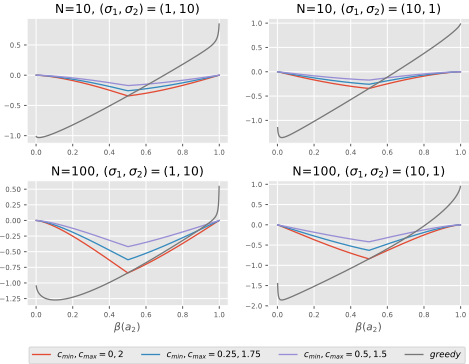
where I is an indicator of the clean event when ˆ r2 > ˆ r1 (where ˆ ri is the empirical mean of ri over the batch data). Since ˆ r1 and ˆ r2 have Gaussian distributions, we can easily calculate P (I). In Figure 1 we plot the curves for µ1 = -1 and µ2 = 1 for a different number of batch sizes and different variances. As a baseline we plot the difference in regret for a greedy step. First, we see that for poor behavior policies s.t. β(a2) ≤ β(a1), it is better to make a greedy step. This is because the suboptimal action has a sufficiently accurate estimation. However, for good behavior policies s.t. β(a2) > β(a1) (which is generally the case when learning from demonstrations and even in RL after the random initialization phase), the greedy regret grows significantly s.t. it is better to stick with the behavior policy. Intuitively, when the behavior policy reaches the optimum, an overestimation of ˆ r1 triggers a bad event ¯ I which leads to a significant degradation. On the other hand, an RBI step is safe s.t. it always has a lower regret than β. 3 In addition, its regret is lower than the greedy regret for good behavior policies.
To find out how RBI performs in an iterative RL process we continue with the bandit example, but now we consider the learning curve of off-policy learning where the behavior policy is mixed with a fixed exploration parameter, i.e. β(a) = π(a)(1 - ε) + ε na (where na is the number of actions and ε = 0.1). The Q-function is learned with Qπ (a) = (1 - α)Qπ (a) + αr, where α is a learning rate, possibly decaying over time. We evaluate several constrained policies: (1) RBI
3 Note that a choice of too large cmax is not safe, specifically cmin = 0, and cmax →∞ converges to the greedy step.
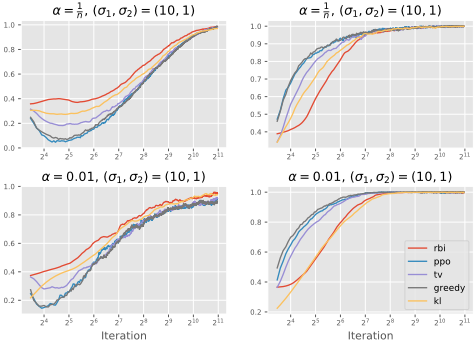
with (cmin, cmax) = (0.5, 1.5); (2) PPO with ε = 0.5; (3) TV with δ = 0.25; (4) greedy step; and (5) forward KL with λ = 1. RBI, TV and PPO were all maximized with our maximization algorithms (without gradient ascent). To avoid absolute zero probability actions, we clipped the policy such that π(ai) ≥ 10-3 . In addition we added 10 random samples at the start of the learning process. The learning curves are plotted in Figure 2.
The learning curves exhibit two different patterns. For the scenario of σ1 > σ2, rapid convergence of all policies was obtained (note the x-axis logarithmic scale). Intuitively, when better action has low variance, it is easy to discard the worse action by choosing it and rapidly improving its value estimation and then switching to the favorable action. On the other hand, for the case of σ1 < σ2, it is much harder for the policy to improve the estimation of the favorable action after committing to the worse action. We see that RBI defers early commitment, and while it slightly reduces the rate of convergence in the easier scenario, it significantly increases the data efficiency in the harder one. We postulate that the harder scenario is also more prevalent in real-world problems where, usually, one must take a risk to get a big reward (where avoiding risks significantly reduces not only the reward variance but also the expected reward).
An interesting distinction is between the ideal learning rate (LR) of α = 1n and a constant rate of α = 0.01. In the ideal LR case, the advantage of RBI and KL is reduced over time. This is obvious since an LR of α = 1n takes into account the entire history. As such, for a large history and after a large number of iterations, there is no need for a policy that learns well from a finite dataset. On the other hand, there is a stable advantage of RBI and KL for a fixed LR as a fixed LR does not correctly weight all the transition samples. Notice that in a larger than 1-step MDP, it is unusual to use an LR of 1n since the policy changes as the learning progresses, therefore, usually, the LR is fixed or decays over time (but not over statevisitations). Hence, we expect a positive advantage for RBI over greedy steps during the entire training process.
6 Learning to Play Atari by Observing Human Players
In section 4, the reroute constraint was derived for learning from a batch of transition samples of a single behavior policy β and a tabular value and policy parametrization. In this section, we empirically extend our results to a NN parametric form (both for value and policy) and a dataset generated by multiple policies {βi}. To that end, we use a crowdsourced dataset of 4 Atari games (SpaceInvaders, MsPacman, Qbert, and Montezuma's Revenge) [Kurin et al., 2017], where each game has roughly 1000 recorded episodes. Such a dataset of observations is of particular interest since it is often easier to collect observations than expert demonstrations. Therefore, it may be practically easier to initialize an RL agent with learning from observations than to generate trajectories of a single expert demonstrator.
For this purpose, we aggregated all trajectories into a single dataset and estimated the average policy β as the average behavior of the dataset. Practically, when using a policy network, this sums to minimizing the Cross-Entropy loss between the βθ(·|s) and the empirical evidence (s, a) as done in classification problems. To estimate the Q-value of β we employed a Q-network in the form of the Dueling DQN architecture [Mnih et al., 2015; Wang et al., 2015] and minimized the MSE loss between Monte-Carlo reward trajectories ∑k≥0 γ k rk and the Qβ (s, a) estimation. Note that this does not necessarily converge to the true Q-value of β (since the trajectories were generated by the behavior policies {βi}), but it empirically provides a close estimation with a small error.
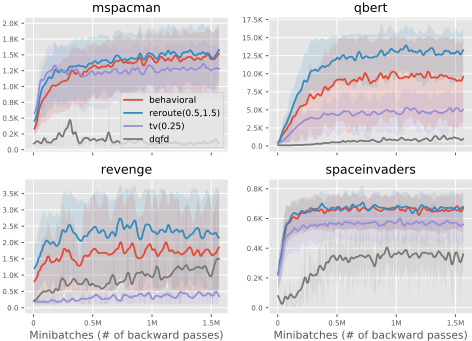
Given our estimations of β and Qβ , we applied several improvement steps and evaluated their performance. For the RBI, TV, and greedy steps, we calculated the improved policy π in the non-parametric space (i.e., during evaluation) with Max-Reroute and Max-TV. For the PPO step we applied an additional gradient ascent optimization step and calculated the PPO policy. As an additional baseline, we implemented the DQfD algorithm [Hester et al., 2018].
| Method | Pacman | Qbert | Revenge | SI |
|---|---|---|---|---|
| Humans | 3024 | 3401 | 1436 | 634 |
| Behavioral | 1519 | 8562 | 1761 | 678 |
| RBI(0.5, 1.5) | 1550 | 12123 | 2379 | 709 |
| RBI(0.25, 1.75) | 1638 | 13254 | 2431 | 682 |
| RBI(0, 2) | 1565 | 14494 | 473 | 675 |
| TV(0.25) | 1352 | 5089 | 390 | 573 |
| PPO(0.5) | 1528 | 14089 | 388 | 547 |
| DQfD | 83 | 1404 | 1315 | 402 |
First, we found out that behavioral cloning, i.e., merely playing with the calculated average behavior β, generally yielded good results with the exception of MsPacman, which is known to be a harder game (see a comparison of human and DQN scores in [Mnih et al., 2015]). For Qbert, the behavioral score was much better than the average score, and we assume that this is because good episodes tend to be longer in Qbert. Thus, their weight in the average behavior calculation is higher.
We evaluated Max-TV with δ = 0.25 since it encapsulates the reroute(0.5, 1.5) region. However, unlike reroute(0.5, 1.5), a TV constrained update obtained lower performance than the behavioral cloning in all games. At first glance, this may be surprising evidence, but it is expected after analyzing Eq. (2). Only a single state with a bad estimation along the trajectory is required to reduce the overall score significantly. On the other hand, reroute(0.5, 1.5) always increased the behavioral score and provided the overall best performance.
While PPO with ε = 0.5 generally scored better than TV, we noticed that in two games, it reduced the behavioral score. The final results (see Table 1) showed similarity between PPO(0.5) and reroute(0, 2). This indicates that PPO tends to settle negative advantage action to zero probability in order to avoid the negative PPO penalty. Empirically, this also indicates that it is important to set cmin > 0 to avoid catastrophic forgetting which occurs when the probability of a good action is reduced to zero due to value estimation errors. Finally, we observed a significantly lower score of the DQfD algorithm. DQfD uses the demonstrations data to learn a policy with an almost completely off-policy algorithm (it adds a regularization term that should tie the learned policy to the expert behavior, but its effectiveness depends on the Q-value magnitude). This strengthens our assertion that when learning from a fixed size of transition samples, the calculated policy must be constrained to the behavior policy presented in the data.
7 Iterative RL with RBI
We now turn to the implementation of RBI learning in an iterative RL setting in the Atari environment without utilizing any prior human demonstrations. We adopted a distributed learning setting with multiple actors and a single learner process, similar to the setting of Ape-X [Horgan et al., 2018]. However, contrary to the Ape-X algorithm, which learns only a single Q-value network (and infers the policy with a greedy action selection), we learned side-by-side two different networks: (1) a Q-value network, termed Q-net and denoted Qπφ ; and (2) a policy network termed π-net and denoted πθ.
In this experiment we attempt to verify: (1) whether RBI is a good method in DRL also for a better final performance (a tabular example of RL with RBI was discussed in section 5); and (2) whether our approach of solving for the optimal policy in the non-parametrized space as part of the actor's routine can be generalized to iterative RL. Recently, [Vuong et al., 2019] developed a framework of constrained RL where they generate samples with a policy πθk (where θk is the set of network parameters in the k-th learning step), and in the learner process, they calculate an improved non-parameterized policy π under a given constraint and learn the next policy πθk+1 by minimizing the KL distance DKL(πθk+1 , π).
We adopted a slightly different approach. Instead of calculating the non-parameterized policy in the learner process, each actor loads a stored policy πθk and calculates the nonparameterized optimal policy π as part of the actor routine while interacting with the environment and generating its trajectories. The optimized policy for each new state is then stored to a replay buffer and executed by the actor (after mixing with a small random exploration). The learner process learns to imitate the optimized policy by minimizing the loss DKL(π, πθk+1 ). This approach has several additional benefits:
- The learner is not required to calculate the optimized policy; therefore, the rate of processing mini-batches of transitions increases. This rate is generally the bottleneck of the wall clock time of the process.
- The Q-net estimates the value of the π-net policy (i.e., the past policy), contrary to [Vuong et al., 2019] where the Q-net estimates the value of the past policy, but the π-net is the future policy. This improves the value estimation since π-net is used to calculate the target value.
- The executed policy π is the optimal solution of the constrained optimization in Eq. (4), unlike policy gradient iteration, which gradually approaches the optimal solution.
Algorithm 2 RBI learner
Algorithm 3 RBI actor
reset the MDP and generate s0 repeat πθ = π-net(si; θ) Qπφ = Q-net(si, ·; φ) π = MaxReroute(πθ , si, Qπφ ) Add exploration: β = π(1 - ε) + ε na ai = Sample(β) executed ai and obtain a new state si+1 and reward ri Add to dataset D+ = {(si, ai, πi, ri), ...}) until terminationAs stated in the previous experiment, setting cmin > 0 is important in avoiding catastrophic forgetting, and choosing too high a cmax can lead to greedy-like improvement steps (see also Fig. 1). Following these observations, we set (cmin, cmax) = (0.1, 2), which we found to balance between safety and efficiency. We also found that it is better to mix the RBI solution with a small amount of a greedy policy for a faster recovery of actions with near-zero probability. Therefore, the actor policy was
with cgreedy = 0.1. The final algorithms for the learner and actors are presented in Algorithms 2 and 3.
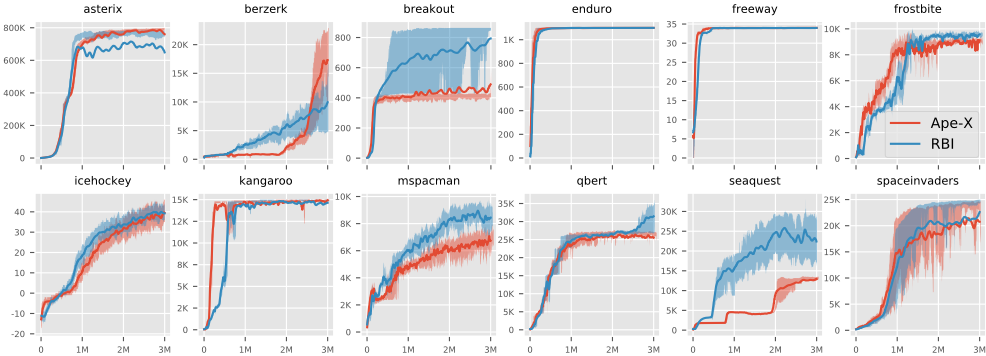
We evaluated RBI and the Ape-X baseline over a set of 12 Atari games with a varying range of difficulty. As an external baseline, we compared our results to the Rainbow score [Hessel et al., 2017]. For a fair comparison, we used a batch size of 128 and capped the learning process to 3.125M backward passes. This is identical to the number of different states that were processed by the network in Rainbow (12.5M backward passes with a batch of 32). Altogether, RBI provided better policies in 7 out of 11 environments with respect to our Ape-X implementation and in 9 out of 11 environments with respect to the Rainbow score (all tied in Freeway). See Table 2 and the extended results section in the appendix. In some games (e.g., Qbert), RBI improved its policy while Ape-X converged to a steady policy. We postulate that with NN parametrization, taking greedy steps may lead to faster convergence of the nets since the diversity of actions is much lower. Generally, high diversity, i.e., a higher entropy policy, is known to be beneficial for exploration [Haarnoja et al., 2018], and indeed, we noticed that RBI learns hard exploration tasks faster, like oxygen replenish in Seaquest. Another interesting game is Berzerk; in this game, while RBI was more efficient during the majority of the learning process and had lower regret (i.e., minus the area under the curve), the Q-learning achieved a higher final score. We found out that due to the deterministic nature of the ALE, the deterministic greedy policy found a better strategy near the end of the learning process.
8 Conclusions
We introduced a constrained policy improvement method, termed RBI, designed to generate safe policy updates in the presence of common estimation errors of the Q-function. In Learning from Observation settings, where one has no access to new samples and off-policy RL fails, the RBI update can safely improve upon naive behavioral cloning. In addition to safety, we found out that the RBI updates are more data-efficient than greedy and other constrained policies in training RL agents. We validated our findings both in a simple two-armed bandit problem and in the Atari domain. To train parametrized policies with the RBI updates, we designed a twophase method: an actor solves a non-parametrized constrained optimization problem (Eq. (4)) while a learner imitates the actor's policy with a parametrized network.
| Game | RBI | Ape-X | Rainbow |
|---|---|---|---|
| Asterix | 838,018.3 | 926,429.2 | 428,200.3 |
| Berzerk | 12,159.3 | 43,867.7 | 2545.6 |
| Breakout | 780.4 | 515.2 | 417.5 |
| Enduro | 2260.9 | 2276.1 | 2,125.9 |
| Freeway | 34.0 | 34.0 | 34.0 |
| Frostbite | 9,655.0 | 8,917.3 | 9,590.5 |
| IceHockey | 40.4 | 39.9 | 1.1 |
| Kangaroo | 14,426.7 | 14,897.5 | 14,637.5 |
| MsPacman | 8,193.9 | 6,401.8 | 5,380.4 |
| Qbert | 32,894.2 | 26,127.5 | 33,817.5 |
| Seaquest | 26,963.7 | 12,920.7 | 15,898.9 |
| SpaceInvaders | 45,155.8 | 40,923.4 | 18,729.0 |
A Appendix
The appendix and the source code for the Atari experiments are found at github.com/eladsar/rbi/tree/rbi.
@inproceedings{ijcai2020p396,
  title     = {Constrained Policy Improvement for Efficient Reinforcement Learning},
  author    = {Sarafian, Elad and Tamar, Aviv and Kraus, Sarit},
  booktitle = {Proceedings of the Twenty-Ninth International Joint Conference on
               Artificial Intelligence, {IJCAI-20}},
  publisher = {International Joint Conferences on Artificial Intelligence Organization},
  editor    = {Christian Bessiere},
  pages     = {2863--2871},
  year      = {2020},
  month     = {7},
  note      = {Main track},
  doi       = {10.24963/ijcai.2020/396},
  url       = {https://doi.org/10.24963/ijcai.2020/396},
}
TY - CPAPER TI - Constrained Policy Improvement for Efficient Reinforcement Learning AU - Sarafian, Elad AU - Tamar, Aviv AU - Kraus, Sarit T2 - Proceedings of the Twenty-Ninth International Joint Conference on Artificial Intelligence, IJCAI-20 PB - International Joint Conferences on Artificial Intelligence Organization PY - 2020 SP - 2863 EP - 2871 DO - 10.24963/ijcai.2020/396 UR - https://doi.org/10.24963/ijcai.2020/396 ER -Copied
Machine-readable versions of this paper, for tools and AI agents:





