
Smart Voting
Proceedings of the Twenty-Ninth International Joint Conference on Artificial Intelligence. Main track. Pages 1734-1740.
https://doi.org/10.24963/ijcai.2020/240
Keywords
- Knowledge Representation and Reasoning: Knowledge Representation and Game Theory; Social Choice
- Agent-based and Multi-agent Systems: Computational Social Choice
- Agent-based and Multi-agent Systems: Voting
Abstract
We propose a generalisation of liquid democracy in which a voter can either vote directly on the issues at stake, delegate her vote to another voter, or express complex delegations to a set of trusted voters. By requiring a ranking of desirable delegations and a backup vote from each voter, we are able to put forward and compare four algorithms to solve delegation cycles and obtain a final collective decision.
- [Abramowitz and Mattei, 2019] Ben Abramowitz and Nicholas Mattei. Flexible representative democracy: An introduction with binary issues. In Proc. of the 28th International Joint Conference on Artificial Intelligence (IJCAI), 2019. IJCAI
- [Auletta et al., 2018] Vincenzo Auletta, Diodato Ferraioli, and Gianluigi Greco. Reasoning about consensus when opinions diffuse through majority dynamics. In Proc. of the 27th International Joint Conference on Artificial Intel- ligence (IJCAI), 2018. IJCAI
- [Behrens et al., 2014] J. Behrens, A. Kistner, A. Nitsche, and B. Swierczek. Principles of Liquid Feedback. Interacktive Demokratie, 2014.
- [Bloembergen et al., 2019] Daan Bloembergen, Davide Grossi, and Martin Lackner. On rational delegations in liquid democracy. In Proc. of the 33rd AAAI Conference on Artificial Intelligence (AAAI), 2019.
- [Bredereck and Elkind, 2017] Robert Bredereck and Edith Elkind. Manipulating opinion diffusion in social networks. In Proc. of the 26th International Joint Conference on Ar- tificial Intelligence (IJCAI), 2017. IJCAI
- [Brill and Talmon, 2018] Markus Brill and Nimrod Talmon. Pairwise liquid democracy. In Proc. of the 27th Interna- tional Joint Conference on Artificial Intelligence (IJCAI), 2018.
- Markus Brill. Interactive democracy. In Proc. of the 17th International Conference on Autonomous Agents and MultiAgent Systems (AAMAS), 2018.
- [Caragiannis and Micha, 2019] Ioannis Caragiannis and Evi Micha. A contribution to the critique of liquid democracy. In Proc. of the 28th International Joint Conference on Ar- tificial Intelligence (IJCAI), 2019.
- [Christoff and Grossi, 2017] Zoé Christoff and Davide Grossi. Binary voting with delegable proxy: An analysis of liquid democracy. In Proc. of the 16th Conference on Theoretical Aspects of Rationality and Knowledge (TARK), 2017.
- [Cohensius et al., 2017] Gal Cohensius, Shie Mannor, Reshef Meir, Eli A. Meirom, and Ariel Orda. Proxy vot- ing for better outcomes. In Proc. of the 16th Conference on Autonomous Agents and MultiAgent Systems (AAMAS), 2017.
- [Degrave, 2014] Jonas Degrave. Resolving multi-proxy tran- sitive vote delegation. arXiv preprint arXiv:1412.4039, 2014.
- [Dhillon et al., 2019] Amrita Dhillon, Grammateia Kot- sialou, Peter McBurney, Luke Riley, et al. Introduction to voting and the blockchain: some open questions for economists. Technical report, Competitive Advantage in the Global Economy (CAGE), 2019.
- [Easley and Kleinberg, 2010] David Easley and Jon Klein- berg. Networks, Crowds, and Markets: Reasoning About a Highly Connected World. Cambridge University Press, 2010.
- [Escoffier et al., 2019] Bruno Escoffier, Hugo Gilbert, and Adèle Pass-Lanneau. The convergence of iterative dele- gations in liquid democracy in a social network. In Proc. of the 12th International Symposium on Algorithmic Game Theory (SAGT), 2019.
- [Escoffier et al., 2020] Bruno Escoffier, Hugo Gilbert, and Adèle Pass-Lanneau. Iterative delegations in liquid democracy with restricted preferences. In Proc. of the 34th AAAI Conference on Artificial Intelligence (AAAI), 2020.
- [Gölz et al., 2018] Paul Gölz, Anson Kahng, Simon Mackenzie, and Ariel D Procaccia. The fluid mechanics of liquid democracy. In International Conference on Web and Internet Economics (ICWIE), 2018.
- [Grandi et al., 2015] Umberto Grandi, Emiliano Lorini, and Laurent Perrussel. Propositional opinion diffusion. In Proc. of the 14th International Conference on Autonomous Agents and Multiagent Systems (AAMAS), 2015.
- [Green-Armytage, 2015] James Green-Armytage. Direct voting and proxy voting. Constitutional Political Econ- omy, 26(2):190-220, 2015.
- [Hardt and Lopes, 2015] Steve Hardt and Lia C. R. Lopes. Google votes: A liquid democracy experiment on a corpo- rate social network. Technical report, Technical Disclosure Commons, Google, 2015.
- [Kahng et al., 2018] Anson Kahng, Simon Mackenzie, and Ariel D Procaccia. Liquid democracy: An algorithmic per- spective. In Proc. of the 32nd AAAI Conference on Artifi- cial Intelligence (AAAI), 2018.
- [Konczak and Lang, 2005] Kathrin Konczak and Jérôme Lang. Voting procedures with incomplete preferences. In Proc. of the IJCAI-05 Multidisciplinary Workshop on Ad- vances in Preference Handling, volume 20, 2005.
- [Kotsialou and Riley, 2020] Grammateia Kotsialou and Luke Riley. Incentivising participation in liquid democ- racy with breadth-first delegation. In Proc. of the 19th International Conference on Autonomous Agents and Multi-Agent Systems (AAMAS), 2020.
- [Kotsialou et al., 2018] Grammateia Kotsialou, Luke Riley, Amrita Dhillon, Toktam Mahmoodi, Peter McBurney, Paul Massey, and Richard Pearce. Using distributed ledger technology for shareholder rights management. In Proc. of the 17th International Conference on Autonomous Agents and MultiAgent Systems (AAMAS), 2018.
- [Miller, 1969] James C Miller. A program for direct and proxy voting in the legislative process. Public choice, 7(1):107-113, 1969.
- [Moulin, 1988] Hervi Moulin. Axioms of Cooperative Deci- sion Making. Cambridge University Press, 1988.
- [Riley et al., 2019] Luke Riley, Grammateia Kotsialou, Am- rita Dhillon, Toktam Mahmoodi, Peter McBurney, and Richard Pearce. Deploying a shareholder rights manage- ment system onto a distributed ledger. In Proc. of the 18th International Conference on Autonomous Agents and Mul- tiAgent Systems (AAMAS), 2019.
References were extracted automatically from the PDF and may contain errors.
Full text extracted automatically from the PDF; figures, tables and equations may differ. The PDF is the version of record.
1 Introduction
Advances in information technology are opening up avenues for the improvement of democratic practices and collective decision-making processes (see, e.g., Brill [2018]). One of the most popular ideas is to explore the space between direct democracy-often infeasible due to the limited amount of resources decision-makers can invest in each direct vote-and representative democracy, by allowing for transitive delegations to take place among agents. This method is named liquid democracy, in contrast to proxy voting in which delegations are not transitive [Miller, 1969]. Liquid democracy has been the subject of numerous recent investigations in AI, ranging from analysing its truth-tracking power [Cohensius et al., 2017; Bloembergen et al., 2019; Kahng et al., 2018] to its adaptation for multiple issues and alternatives [Christoff and Grossi, 2017; Brill and Talmon, 2018]. In its simplest form, liquid democracy works as follows: a collective decision needs to be taken on a binary issue; agents can either vote directly or delegate their vote to a single other agent; direct votes are then weighted by the number of transitive delegations received, and a final decision is taken using a standard voting rule.
In this paper we propose to push forward the idea of liquid democracy under two aspects. First, while most implementations of liquid democracy [see, e.g., Behrens et al., 2014] introduce a platform for the elicitation of voters' delegations, we aim at a decentralised voting system in which voters' ballots and delegations can remain private. Thus, we define a language for voters to express a direct vote, or a delegation to a single other agent, or a combination of the votes of multiple other agents. Second, to tackle the issue of delegation cycles we allow voters to express a number of prioritized delegations, with a final backup vote with the lowest priority. An Figure 1: A profile of binary votes in liquid democracy on the left: voter A delegates her vote to B, who in turn delegates to C, who casts a direct vote in favour, unlike D who casts a direct vote against. On the right, a profile of smart ballots: voter A wants her vote to coincide with the majority of B, C, and D's votes, and in case this leads to a delegation cycle she gives a single delegation to B. Voter B delegates to D, who casts a direct vote against, while C votes in favour. Voters A and B abstain (*) as their final backup option.
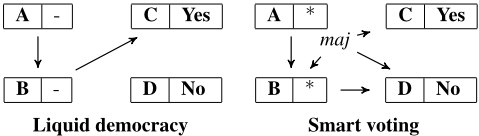
example of what we call a smart ballot can be seen on the right-hand side of Figure 1.
Two possible practical implementations can be envisaged for smart voting. The first is a fully decentralised version that might make use of smart contract technology (hence the title of this paper), where a smart ballot would be a piece of self-executable and publicly available code included in a blockchain, with full transparency and accountability of the election procedure. 1 The second, in applications where vote secrecy is crucial, is a more standard method of votes being collected by a trusted central authority-raising interesting computational questions on providing a certificate to each voter that their ballot has been taken into account.
Our contribution. We define a script language for voters to express ranked, possibly complex, delegations in collective decisions with multiple issues (Section 2). The intended application is voting in a purely preferential setting (deciding on food is a perfect example [see, e.g., Hardt and Lopes, 2015]), and delegations are seen as a way to elicit trust or influence relations among voters. To transform profiles of smart ballots into direct votes for alternatives we propose four unravelling procedures (Section 2), and we show that they terminate in polynomial time (Section 3). The final objective of smart voting is that of obtaining a collective decision from the agents'
1 Recent work by Dhillon et al. [2019] conducts a detailed analysis of smart contracts for electronic voting and liquid democracy. See also the reports of Kotsialou et al. [2018] and Riley et al. [2019].
ballots, and we assume here that a standard voting rule is applied on the outcome of the proposed unravelling procedures. We investigate further algorithmic properties of our setting in Section 3, and we conclude with a study of ranked delegations to single voters and participation axioms (Section 4). Some proofs are sketched or omitted due to space constraints.
Related work. Recent papers have analysed the efficacy of liquid democracy and proxy voting as a truth-tracking mechanism, mostly for a binary decision [Green-Armytage, 2015; Cohensius et al., 2017; Kahng et al., 2018; Caragiannis and Micha, 2019; Bloembergen et al., 2019]. We do not study truth-tracking here, and rather propose a method to elicit mutual influence from voters and infer a collective decision.
This work takes inspiration from papers trying to solve the issue of delegation cycles. As in the work of Kotsialou and Riley [2020] and Escoffier et al. [2019; 2020], we let voters express a ranking of possible delegates, to break potential cycles of delegations. 2 We also draw inspiration from Degrave [2014] and Abramowitz and Mattei [2019] in allowing a delegation to be spread to multiple voters. However, we keep the transitivity of delegations and stick to the principle of "one person, one vote" in not splitting the voting power of any individual. We also borrow from Christoff and Grossi [2017] the requirement that voters must specify a default value (i.e., a backup vote) on each issue.
Generalisations of liquid democracy have been studied by Christoff and Grossi [2017] on multiple logically connected issues, and by Brill and Talmon [2018], who consider delegations on pairwise preferences on alternatives. We assume here votes on multiple independent issues, and we also do not consider aspects of strategic voting or analysis of voters power, as done by Escoffier et al. [2019] and G¨olz et al. [2018].
In allowing voters to express complex delegations combining the votes of other agents, we follow the vast literature on social influence and opinion diffusion on networks [see, e.g., Easley and Kleinberg, 2010] and, most notably, research studying the use of aggregation functions such as majority in binary opinion diffusion [Grandi et al., 2015; Bredereck and Elkind, 2017; Auletta et al., 2018].
2 Formal Framework
We define here the components of our model for smart voting.
2.1 Smart Ballots
In smart voting we have a set N of n agents (or voters) who decide on a set I of m issues. The alternative values, or simply alternatives, for each issue i ∈ I range over a non-empty finite domain D(i), which can also include abstention.
An agent a expresses her opinion over an issue i ∈ I by submitting a (valid) smart ballot Bai defined as follows:
Definition 1 (Smart Ballot). A smart ballot of agent a for an issue i ∈ I is an ordering ((S1 , F 1 ) > · · · > (Sk , F k ) > x) where k ≥ 0 and for 1 ≤ h ≤ k we have that Sh ⊆ N is a set of agents, F h : D(i)Sh →D(i) is a resolute aggregation function and x ∈ D(i) is an alternative.
2 We note in passing that ranked delegations for collective decisions were also experimented by Google [Hardt and Lopes, 2015].
Thus, a smart ballot can be seen as a preference ordering over the agent's desired delegations, ending with a direct backup vote for an alternative in the issue's domain.
Definition 2 (Valid Smart Ballot). A valid smart ballot of agent a for an issue i ∈ I is a smart ballot such that, for all 1 ≤ s ̸= t ≤ k, (i) if Ss ∩ St ̸= ∅ then F s is not equivalent to F t , and (ii) a /∈ Ss .
The two validity requirements ensure that agents are not manipulating the election by submitting many equivalent versions of the same delegation function, and that they are not generating delegation loops by including themselves in the set of delegates. The following example shows the expressiveness of smart ballots:
Example 1. Alice, Bob, Carl, and Diana, wonder whether to try a new restaurant (1) or stay in (0). Alice knows that her friends are real foodies, and she is too tired to check online reviews. She would like to state this complex delegation: "I vote to go if and only if Bob, and at least one of Carl or Diana, think it's worth it. 3 If that creates a delegation cycle, I will copy Bob's vote. If that also creates a cycle, I will vote to go". She submits the following smart ballot:
The next ballot represents Alice wanting to delegate to Bob, then Carl, then Diana, and as a last resort voting to go:
This last ballot expresses Alice wanting to vote with the majority opinion of her friends, and otherwise voting to go:
Let Bh ai denote the hth preference level given by agent a on issue i in her smart ballot Bai-thus, Bh ai = (Sh ai , F h ai ) or Bh ai = x with x ∈ D(i). For instance, in Example 1 we have in the second case that B2Ai = (S2Ai , F 2Ai ) = ({C}, C).
Given n smart ballots for an issue i ∈ I from each agent in N, a (smart) profile for this issue i, is a vector Bi = (B1i, . . . ,Bni). A valid (smart) profile is a smart profile where each smart ballot is valid (as per Definition 2).
2.2 Unravelling Procedures
In this section we propose four procedures that transform a valid smart profile into a profile of direct votes, i.e., votes supporting a single alternative in the issue's domain, D(i).
Definition 3 (Unravelling Procedure). An unravelling procedure U for issue i ∈ I and agents in N is any function
Due to possible delegation cycles, it may be unclear how to assign direct votes to agents. We follow two principles in our definitions: use the highest preference level of voters when breaking delegation cycles (cf. Definition 4), and keep the unravelling process polynomial (cf. Section 3). Algorithm 1 outlines our general unravelling procedure UNRAVEL.
The input of UNRAVEL is a smart profile Bi. A vector X is initialised with placeholders ∆ at each position xa for a ∈ N
3 This can be expressed by propositional formula B ∧ (C ∨ D).
Algorithm 1 General unravelling procedure UNRAVEL
1: X := (∆, . . . ,∆) ▷ empty vector for direct votes 2: while X /∈ D(i)n do 3: lev := 1 ▷ reset preference level counter to 1 4: Y :=X ▷ a copy of X to compute changes 5: while X = Y do 6: procedure UPDATE({U, RU, DU, DRU}) 7: lev := lev + 1 8: return X ▷ output vector of direct votesand it is returned when a vote in D(i) is found for all agents. Counter lev is set at the first preference level of the agents and an additional vector Y is added to help computation. In line 6 a subroutine with one update procedure is executed. 4
We give four update procedures, defined by the presence or absence of two properties. Namely, direct vote priority (D), prioritising direct votes over those that can be computed from the current vector Y of votes; and random voter selection (R), randomly choosing an agent whose vote is added (or computed) next. The four procedures are thus: basic update (U), update with direct vote priority (DU), update with random voter selection (RU), update with direct vote priority and random voter selection (DRU).
Unless otherwise specified, if the condition in an if statement fails, the program skips to the next step. Moreover, Y↾S denotes the restriction of vector Y to the elements in set S.
| Algorithm 2 UPDATE(U) | |
|---|---|
| 1: 2: 3: 4: | for a ∈ N such that xa =∆ do if Blev ai ∈ D(i) then ▷ a has a direct vote at lev xa := Blev ai else if F lev ai (Y↾Slev ai ) ∈ D(i) then xa := F lev ai (Y↾Slev ai ) ▷ add a's computable |
| 5: | vote |
UPDATE(U) checks for each agent without a direct vote at lev (line 1): if their preference at lev is either a direct vote (line 3) or can be computed from the current values in Y (line 5), then vector X is updated with the new direct votes.
| Algorithm 3 UPDATE(DU) | |
|---|---|
| 1: 2: | for a ∈ N such that xa =∆ do if Blev ai ∈ D(i) then ▷ add direct votes xa := Blev ai |
| 3: | if Y =X then ▷ if no direct vote added to X |
| 4: | for a ∈ N such that xa = ∆ do if F lev ai (Y↾Slev ai ) ∈ D(i) then ▷ find |
| 5: 6: | computables |
| 7: | xa := F lev ai (Y↾Slev ai ) |
UPDATE(DU) first tries to add directs votes to X (line 2); if there are none (line 4) it tries with votes computable at lev.
At line 1 of UPDATE(RU) an empty set P is initialised to hold agents with either a direct vote or a computable vote at
4 In what follows, we simply write UNRAVEL(#) to indicate the UNRAVEL algorithm using UPDATE procedure #.
Algorithm 4 UPDATE(RU)
1: P := ∅ ▷ initialise an empty set 2: for a ∈ N such that xa =∆ do 3: if Blev ai ∈ D(i) or F lev ai (Y↾Slev ai ) ∈ D(i) then 4: P := P ∪ {a} 5: if P ̸= ∅ then ▷ there are direct/computable votes 6: select b from P uniformly at random 7: if Blev bi ∈ D(i) then 8: xb := Blev bi 9: else if F lev bi (Y↾Slev bi ) ∈ D(i) then 10: xb := F lev bi (Y↾Slev bi )lev (line 3); if P is non-empty, one agent will be randomly chosen and her direct/computable vote is added to X.
Algorithm 5 UPDATE(DRU)
1: P, P ′ := ∅ ▷ initialise an empty set 2: for a ∈ N such that xa =∆ do 3: if Blev ai ∈ D(i) then ▷ add agents with direct vote to P 4: P := P ∪ {a} 5: else if F lev ai (Y ↾Slev ai ) ∈ D(i) then 6: P ′ := P ′ ∪ {a} 7: if P ̸= ∅ then ▷ there are agents with direct votes 8: select b from P uniformly at random 9: xb := Blev bi 10: else if P ′ ̸= ∅ then ▷ there are computable votes 11: select b from P ′ uniformly at random 12: xb := F lev bi (Y ↾Slev bi )UPDATE(DRU) first selects agents with a direct vote at level lev (line 3) and chooses one randomly to update X (line 9). If not, UPDATE(DRU) will repeat this process, but it will now look for computable votes at level lev.
The following example shows how UPDATE(U) works:
Example 2. Consider a binary issue i with D(i) = {0, 1} and agents N = {A, . . . ,E}. Their valid ballots in Bi, stating their preferences for delegations or direct votes, are shown schematically in the table below and in Figure 2.
| 1st | 2nd | 3rd |
|---|---|---|
| A ({B,C},B ∧C) | ({D},D) | 1 |
| B | 1 - ({D}, D) | - |
| C | 0 | - |
| D | ({E},E) 1 | - |
| E | ({A}, A) ({B},B) | 0 |
We spell out here the unravelling UNRAVEL(U) on Bi:
- Starting at lev = 1, the direct vote of B is stored in X = (∆, 1, ∆, ∆, ∆).
- As there are no direct or computable votes at lev = 1 (using Y ), the level counter is increased to lev = 2.
- The procedure adds the direct votes of C and D, and computes the vote of E from the current Y by copying the vote of B, obtaining X = (∆, 1, 0, 1, 1).
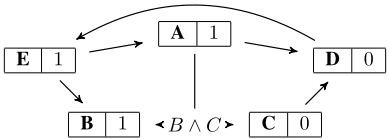
- The preference level is set back to lev = 1.
- A's vote can be computed from her first preference level, and vector X = (0, 1, 0, 1, 1) is thus returned.
An important clarification is that in all our procedures, when checking if an agent's vote can be computed from a partial profile of other agents' votes, we test the existence of a necessary winner [Konczak and Lang, 2005]. Formally, F lev ai (X↾Slev ai ) has a necessary winner y ∈ D(i) if for all a ∈ Slev ai such that xa = ∆, for all z ∈ D(i) such that xa = z we have that F lev ai (X↾Slev ai ) = y. 5
We conclude with two further definitions. The notion of vote certificate can explain to an agent which part of their ballot was used to compute the unravelled profile, without revealing the full profile:
Definition 4 (Certificates). An agent a's certificate of an unravelled profile U(Bi) is CertU (Bi, a) = (k,X↾Sk ai ), where k is a preference level and X↾Sk ai is the partial profile of direct votes used by U to compute a's vote.
We can then define the set of voters influenced by a voter a:
Definition 5 (Influence). The set of voters influenced by voter a in profile Bi using unravelling procedure U is I U (Bi, a) = {b | a ∈ Sk bi for CertU (Bi, b) = (k,X↾Sk bi )}.
Let I U ∗ (Bi, a)=I U (Bi, a)∪{c|c∈I U (Bi, b)∧b∈I U (Bi, a)} ∪. . . be the voters b indirectly influenced by a. In Example 2, we have that CertU(Bi, C) = (2, ∅) and I U(Bi, C) = {A}.
2.3 Restricting the Language of Smart Ballots
In this section, we define useful restrictions to the language of smart ballots. Firstly, we focus on binary Boolean functions compactly expressed as contingent (i.e., neither a contradiction, nor a tautology) propositional formulas in DNF:
Definition 6 (BOOL Ballots). A smart ballot Bai for agent a and binary issue i belongs to language BOOL if every F h ai in Bai is a contingent propositional formula in DNF.
Therefore, BOOL ballots can only contain Boolean functions-as, for instance, all the delegating ballots in Example 2. Atomic boolean functions are equivalent to the identity function, i.e., copying another agent's vote. The requirement for a contingent formula is to prevent agents from overriding the delegation structure by giving a direct vote for 1
5 In Example 2, in case xB = 0 then necessarily B ∧ C will be false, and thus xA = 0 (even if xC = ∆).
or 0 in disguise at multiple preference levels. When using language BOOL, we will write ϕlev ai instead of F lev ai .
Next, we define a restriction for smart ballots where all of the (possibly many) delegations must be to single agents:
Definition 7 (LIQUID Ballots). Smart ballot Bai for agent a and issue i belongs to LIQUID if every delegating Bh ai in Bai is of the form ({b}, id) for b ∈ N \ {a} and id the identity function, and if h > 1 the final vote of a is abstention (∗).
Finally, for a given language L we write Lk to indicate smart ballots in L having at most k delegations in their ordering. For instance, in Example 2 the smart ballots of all agents belong to the language BOOL2 .
2.4 Voting Rules
The final step of smart voting aggregates the vector of direct votes into an outcome. For the remainder of the paper, we will use the following rules (for a domain with abstentions ∗): the majority rule (Maj) returns the alternative in the domain having more than n/2 votes, and ∗ otherwise; the relative majority rule (RMaj) returns the plurality outcome among D(i) \ {∗}, and if there is a tie it returns ∗.
3 Algorithmic Analysis
We here analyse the unravelling procedures introduced in Section 2.2. For simplicity, in the rest of the paper we assume that I contains a single issue (thus, we drop the subscript i).
3.1 Properties of Unravelling
Given the four update procedures, our first result shows that for any valid smart profile the general unravelling procedure UNRAVEL always terminates:
Proposition 1. Algorithms UNRAVEL(U), UNRAVEL(DU), UNRAVEL(RU) and UNRAVEL(DRU) always terminate on a valid smart profile B.
Proof (sketch). The proof (omitted in the interest of space) rests on the fact that the two while loops in UNRAVEL cannot be in an infinite cycle due to each Ba having a finite number of preference levels, 6 the final preference being a direct vote, and each procedure updating at least one agent's direct vote in X at each iteration (and removing none).
In the next proposition we prove that the four update procedures actually give different results.
Proposition 2. There exists a valid smart profile B for which UNRAVEL(U), UNRAVEL(DU), UNRAVEL(RU), and UNRAVEL(DRU) give different outputs.
Proof. Consider the smart profile of Example 2: the outcomes of the four unravelling procedures are shown in Table 1. It is clear that procedures U and DU lead to different outcomes than the others. Although procedures RU and DRU give the same profiles of direct votes, these outcomes occur at different rates.
6 Recall that since D(i) and the possible sets of delegates are finite, and since all functions given in an agent's valid ballot must differ, the possible number of functions must also be finite.
| UNRAVEL | Output X ∈ D(i)n | Random voter |
|---|---|---|
| U | (0, 1, 0, 1, 1) | - |
| DU | (0, 1, 0, 1, 0) | - |
| RU | (0, 1, 0, 0, 0) | C |
| (1, 1, 1, 1, 1) | D | |
| (1, 1, 1, 1, 1) | E | |
| DRU | (0, 1, 0, 0, 0) | C |
| (1, 1, 1, 1, 1) | D |
Observe that the proof above implies that the collective decision can be different depending on the unravelling used, and on the randomly chosen voter. The majority outcome would be 1 in two thirds of the cases with procedure RU, whereas only in half of the cases when using procedure DRU.
3.2 Computational Complexity
The first problem we study is how hard it is to verify that a smart ballot is valid with respect to language L. The VALIDB(L) problem takes as input a smart ballot Ba in L and agents N, and it asks if Ba is valid for L.
Proof. For membership, observe that for Ba to be a valid BOOLk ballot, it needs to verify the following properties (for 1 ≤ h, ℓ ≤ k), that can either be checked in polynomial time by reading Ba, or require a (polynomial) certificate. The properties are: there are ≤ k top preferences of the form (Sh a , ϕha ); there is one direct vote in {0, 1} as final preference; each ϕha is in DNF; each Sh a is such that a /∈ Sh a ; and each ϕha is such that V ar(ϕha ) ⊆ Sh a ⊆ N. For the final three properties, we have to guess certificates: at most k to check that each ϕha is not a tautology (¬ϕha is satisfiable); at most k to check that each ϕha is not a contradiction (ϕha is satisfiable); at most k2 (k-1) to check that for all ϕha and ϕℓa such that h ̸= ℓ, ϕha and ϕℓa are not logically equivalent (i.e., ¬(ϕha ↔ ϕℓa ) is satisfiable). All this requires at most k2 (k +3) certificates for constant k. Thus, VALIDB(BOOLk ) is in NP.
For hardness, we reduce from the NP-complete problem DNF-FALSIFIABLE, 7 whose input is a formula ϕ in DNF. We create an instance of VALIDB(BOOLk ) where N = V ar(ϕ) ∪ {a, b}, for fresh variables a and b, D(i) = {0, 1} and Ba = ((N\{a}, ϕ ∨ b) > 1). We now show that DNFFALSIFIABLE has a positive answer if and only if the answer to VALIDB(BOOLk ) on our instance is also positive.
Assume that ϕ is falsifiable. By construction of Ba, we only need to check that ϕ ∨ b is neither a contradiction nor a tautology: this follows from ϕ being falsifiable and b being a fresh variable. Assume that ϕ is not falsifiable, i.e., ϕ is a tautology. Thus, agent a provides a function ϕ ∨ b which is a tautology, and hence Ba is not valid. Therefore, VALIDB(BOOLk ) is NP-complete.
7 Since SAT-CNF is NP-hard, by the duality principle DNFFALSIFIABLE is also NP-hard; for membership in NP it suffices to verify a falsifying truth assignment in polynomial time.
Although checking if a BOOLk smart ballot is valid is not a tractable problem, it is as hard as the SAT problem for propositional formulas, for which efficient solvers exist.
Next, we show that our unravelling procedures terminate in polynomial time given BOOL ballots. We refer to this problem as UNRAVEL(#)L for # ∈ {U, DU, RU, DRU}. Observe that the size of the input for UNRAVEL(#) BOOL is in O(maxp(B) · n · maxϕ(B)), where maxp(B) is the highest preference level of any ballot in B and maxϕ(B) is the maximum length of any formula from an agent in B.
Proposition 3. UNRAVEL(#) BOOL terminates in at most O(n2 · maxp(B) · 2maxϕ(B)) time steps, for # ∈ {U, DU, RU, DRU}.
Proof. The while loop from line 2 in UNRAVEL can be repeated at most n times (in case just one direct vote is added to X at each iteration). Moreover, the while loop from line 5 can be repeated at most maxp(B) times, in case all smart ballots are of the same length and no vote is computable in the first maxp(B) - 1 positions for any agent.
The following is executed at most n ·maxp(B) times: UPDATE(#) checks that for each agent a such that xa = ∆ (at most n) either Blev a ∈ D(i) or ϕlev a has a necessary winner (depending on the # used). As each ϕlev a is in DNF, i.e., a disjunction of conjunctions of literals (called cubes), to verify if it has a necessary winner we check if either:
- all literals of a cube of ϕlev a are made true by X↾Slev a ,
- one literal in each cube is made false by X↾Slev a ,
returning a direct vote of 1 or 0, respectively. The use of UPDATE(#) takes at most O(n · 2maxϕ(B)) steps. Hence, in O(n2 · maxp(B) · 2maxϕ(B)) time steps a profile X of direct votes is output by UNRAVEL(#) BOOL .
4 Ranked Singleton Delegations
In this section we focus on the language LIQUIDk from Definition 7. Agents are restricted to express either a direct vote or a (partial) ranking of single-agent delegations.
4.1 Liquid Democracy
We begin by showing that our unravelling procedures yield the same result on the language LIQUID1 , corresponding to the simplest setting of liquid democracy:
Proposition 4. If B ∈ LIQUID1 then UNRAVEL(#) outputs the same result for # ∈ {U,DU,RU,DRU}.
Proof (sketch). At the first iteration step, all direct votes are added to the vector X. Each unravelling procedure then computes the votes of those agents who are delegating but are not in a delegation cycle (possibly not in the same order, but with the same result). Cycles are broken by looking at backup votes of possibly different agents, which are all abstentions by the definition of LIQUID1 .
Now, consider an example of liquid democracy. By creating a profile of smart ballots with Ba = (({b}, id) > ∗) if agent a was delegating her decision to agent b ∈ N\{a} and Ba = (x) with x ̸= ∗ if agent a was voting directly, we obtain the following result:
Proposition 5. Liquid Democracy can be translated into a smart voting election with LIQUID1 ballots and UNRAVEL(#) for # ∈ {U, DU, RU, DRU}.
The proof of Proposition 5 is omitted for lack of space.
4.2 Participation Axioms
In this section we study two properties of unravelling procedures, focussing on a binary domain (with abstentions). The first, proposed by Kotsialou and Riley [2020], was inspired by the classical participation axiom from social choice [Moulin, 1988]. Both properties focus on a voter's incentive to participate in the election, either by voting directly or by delegating. Thus, we assume that an agent a expressing a direct vote for alternative x ∈ {0, 1} prefers x over 1 - x, denoted by x >a 1 - x, and that a prefers x over abstention, x >a ∗.
Definition 8 (Cast-Participation). A voting rule r and unravelling procedure U satisfy cast-participation if for all valid smart profiles B and agents a ∈ N such that Ba ∈ D(i)\{∗}
for all B′a ̸= Ba, and B-a is equal to B without a's ballot.
Cast-participation implies that agents who vote directly have an incentive to do so, rather than to express any other ballot (recall our restriction to ranked singleton delegations).
A voting rule r on the domain {0, 1, ∗}N satisfies monotonicity if for any profile X, if r(X) = x with x ∈ {0, 1} then r(X+x) = x, where profile X+x is obtained from X by having one voter switch from an initial vote of 1 - x to x or ∗, or from an initial vote of ∗ to x. Observe that all rules introduced in Section 2.4 satisfy this property. Due to this definition we can now show the following:
Theorem 2. Any monotonic rule r with unravelling procedure UNRAVEL(#) for # ∈ {U,DU,RU,DRU} satisfies cast-participation for LIQUID.
Proof (sketch). Without loss of generality, assume that for agent a ∈ N we have Ba = (1); thus for a it is the case that 1>a0. To falsify cast-participation, we need to construct a profile B such that r(UNRAVEL(#)(B))=0 or ∗, and a smart ballot B′a such that r(UNRAVEL(#)(B-a,B′a ))=1.
If a now delegates to an agent with a direct vote for 1, the outcome does not change. Therefore, all voters c ∈ I # ∗ (a,B) vote for 1 in B, but vote for either 0 or ∗ in B′ (i.e., the final votes of B′ can be obtained from those of B by switching 1s to 0s or ∗s). Moreover, all c ̸∈ I # ∗ (a,B) do not change their vote from B to B′ . Thus, this contradicts the monotonicity assumption of voting rule r.
The theorem above does not hold for non-singleton delegations-we omit the proof in the interest of space.
We now focus on the incentive that a voter has to receive and accept delegations. Recall that I # ∗ (B, a) is the set of agents who are directly or indirectly influenced by a's vote.
Definition 9 (Guru-participation). A voting rule r and unravelling procedure U satisfy the guru-participation property if and only if for all profiles B and all agents a ∈ N such that Ba = (x) with x ∈ D(i) \ {∗} we have that
for any b ∈ I # ∗ (B, a), and B-b is B without b's ballot.
We now show that all four unravelling procedures we propose do not satisfy this property for a specific rule r:
Theorem 3. RMaj and UNRAVEL(#) do not satisfy guruparticipation for # ∈ {U, DU, RU, DRU} for LIQUID.
Proof. Consider a smart profile B with Ba = (1), Bb = (({c}, id)>({a}, id)>∗), Bc = (({d}, id)>({f}, id)>∗), Bd = (({b}, id) > ({f}, id) > ∗), Be = (1) and Bf = (0) and profile B′ = (B-b, (∗)) obtained from B by switching b's vote to B′b = (∗).
The outcomes of the four procedures are shown here:
| # | B | B′ |
|---|---|---|
| U/ DU | X1 = (1, 1, 0, 0, 1, 0) | X2 = (1, ∗, ∗, ∗, 1, 0) |
| RU/ | X3 = (1, 1, 1, 1, 1, 0) | |
| DRU | X4 = (1, 0, 0, 0, 1, 0) X5 = (1, 0, 0, 0, 1, 0) |
By applying unravelling procedures U and DU, agent a prefers the outcome fromB′ to B, since RMaj(X1) = ∗ and RMaj(X2) = 1. For procedures RU and DRU, the outcome on B′ is RMaj(X2) = 1. However, their outcome on B can be either RMaj(X4) = RMaj(X5) = 0 or RMaj(X3) = 1. Agent a strictly prefers the outcome from B′ , which is certainly 1, over profile B which leads to an outcome of 0 for two thirds of the cases.
Observe that the profile in the above proof shows that our unravelling procedures differ from those of Kotsialou and Riley [2020], as their depth-first procedure on B would output (1, 0, 1, 0, 1, 0), while their breadth-first procedure on B′ would give (1, ∗, 0, 0, 1, 0). The breadth-first procedure does satisfy guru-participation, but at the price of using delegations that are quite low in the voters' rankings.
5 Conclusion
In this paper we propose and study an extension of liquid democracy that accounts for ranked and multi-voter delegations. We introduce four unravelling procedures to transform voters' ballots into profiles of direct votes, on which a collective decision is taken using a standard voting rule. Our procedures are polynomial, and aim at making use of the highestranked delegations when breaking delegation cycles.
With our proposal we want to put forward a general framework to study delegative voting, with notable examples being the classical settings of liquid democracy. Future work will include the investigation of further axiomatic properties for unravelling procedures and delegative voting, in line with the participation axioms, and a more fine-grained analysis of restricted languages for smart ballots.
Acknowledgments
The authors acknowledge the support of the ANR JCJC project SCONE (ANR 18-CE23-0009-01). This paper developed from ideas discussed at the Dagstuhl Seminar 19381 (Application-Oriented Computational Social Choice), 2019.
@inproceedings{ijcai2020p240,
  title     = {Smart Voting},
  author    = {Colley, Rachael and Grandi, Umberto and Novaro, Arianna},
  booktitle = {Proceedings of the Twenty-Ninth International Joint Conference on
               Artificial Intelligence, {IJCAI-20}},
  publisher = {International Joint Conferences on Artificial Intelligence Organization},
  editor    = {Christian Bessiere},
  pages     = {1734--1740},
  year      = {2020},
  month     = {7},
  note      = {Main track},
  doi       = {10.24963/ijcai.2020/240},
  url       = {https://doi.org/10.24963/ijcai.2020/240},
}
TY - CPAPER TI - Smart Voting AU - Colley, Rachael AU - Grandi, Umberto AU - Novaro, Arianna T2 - Proceedings of the Twenty-Ninth International Joint Conference on Artificial Intelligence, IJCAI-20 PB - International Joint Conferences on Artificial Intelligence Organization PY - 2020 SP - 1734 EP - 1740 DO - 10.24963/ijcai.2020/240 UR - https://doi.org/10.24963/ijcai.2020/240 ER -Copied
Machine-readable versions of this paper, for tools and AI agents:





