
MLRDA: A Multi-Task Semi-Supervised Learning Framework for Drug-Drug Interaction Prediction
Proceedings of the Twenty-Eighth International Joint Conference on Artificial Intelligence. Main track. Pages 4518-4524.
https://doi.org/10.24963/ijcai.2019/628
Keywords
- Machine Learning: Classification
- Machine Learning: Semi-Supervised Learning
- Machine Learning Applications: Bio;Medicine
- Machine Learning: Deep Learning
- Machine Learning: Data Mining
Abstract
Drug-drug interactions (DDIs) are a major cause of preventable hospitalizations and deaths. Recently, researchers in the AI community try to improve DDI prediction in two directions, incorporating multiple drug features to better model the pharmacodynamics and adopting multi-task learning to exploit associations among DDI types. However, these two directions are challenging to reconcile due to the sparse nature of the DDI labels which inflates the risk of overfitting of multi-task learning models when incorporating multiple drug features. In this paper, we propose a multi-task semi-supervised learning framework MLRDA for DDI prediction. MLRDA effectively exploits information that is beneficial for DDI prediction in unlabeled drug data by leveraging a novel unsupervised disentangling loss CuXCov. The CuXCov loss cooperates with the classification loss to disentangle the DDI prediction relevant part from the irrelevant part in a representation learnt by an autoencoder, which helps to ease the difficulty in mining useful information for DDI prediction in both labeled and unlabeled drug data. Moreover, MLRDA adopts a multi-task learning framework to exploit associations among DDI types. Experimental results on real-world datasets demonstrate that MLRDA significantly outperforms state-of-the-art DDI prediction methods by up to 10.3% in AUPR.
- [Abdelaziz et al., 2017] Ibrahim Abdelaziz, Achille Fok- oue, Oktie Hassanzadeh, Ping Zhang, and Mohammad Sadoghi. Large-scale structural and textual similarity- based mining of knowledge graph to predict drugdrug in- teractions. Web Semant., 44(C):104-117, May 2017.
- [Bahdanau et al., 2015] Dzmitry Bahdanau, Kyunghyun Cho, and Yoshua Bengio. Neural machine translation by jointly learning to align and translate. In ICLR, 2015.
- [Caruana, 1997] Rich Caruana. Multitask learning. Machine learning, 28(1):41-75, 1997.
- [Chang et al., 2018] Xiaobin Chang, Tao Xiang, and Timo- thy M Hospedales. Scalable and effective deep cca via soft decorrelation. In CVPR, 2018.
- [Cheng and Zhao, 2014] Feixiong Cheng and Zhongming Zhao. Machine learning-based prediction of drug-drug interactions by integrating drug phenotypic, therapeutic, chemical, and genomic properties. Journal of the Ameri- can Medical Informatics Association Jamia, 21(2), 2014.
- [Cheung et al., 2015] Brian Cheung, Jesse A Livezey, Ar- jun K Bansal, and Bruno A Olshausen. Discovering hid- den factors of variation in deep networks. ICLR workshop, 2015.
- [Gao et al., 2019] Jingyue Gao, Xiting Wang, Yasha Wang, and Xing Xie. Explainable recommendation through at- tentive multi-view learning. In AAAI, 2019.
- [Jin et al., 2017] Bo Jin, Haoyu Yang, Cao Xiao, Ping Zhang, Xiaopeng Wei, and Fei Wang. Multitask dyadic prediction and its application in prediction of adverse drug-drug interaction. In AAAI, 2017.
- [Kastrin et al., 2018] A. Kastrin, P. Ferk, and B. Leskošek. Predicting potential drug-drug interactions on topological and semantic similarity features using statistical learning. Plos One, 13(5):e0196865, 2018.
- [Keskar et al., 2017] Nitish Shirish Keskar, Dheevatsa Mudigere, Jorge Nocedal, Mikhail Smelyanskiy, and Ping Tak Peter Tang. On large-batch training for deep learning: Generalization gap and sharp minima. In ICLR, 2017.
- [Kingma and Ba, 2014] Diederik P Kingma and Jimmy Ba. Adam: A method for stochastic optimization. arXiv preprint arXiv:1412.6980, 2014.
- [Kipf and Welling, 2017] Thomas N. Kipf and Max Welling. Semi-supervised classification with graph convolutional networks. In ICLR, 2017.
- [Ma et al., 2018] Tengfei Ma, Cao Xiao, Jiayu Zhou, and Fei Wang. Drug similarity integration through attentive multi- view graph auto-encoders. In IJCAI, 2018.
- [Miyato et al., 2017] Takeru Miyato, Shin Ichi Maeda, Masanori Koyama, and Shin Ishii. Virtual adversarial training: a regularization method for supervised and semi- supervised learning. arXiv preprint arXiv:1704.03976, 2017.
- [Percha and Altman, 2013] B Percha and R. B. Altman. In- formatics confronts drug-drug interactions. Trends in Pharmacological Sciences, 34(3):178-184, 2013.
- [Qato et al., 2016] D. M. Qato, J Wilder, L. P. Schumm, V Gillet, and G. C. Alexander. Changes in prescription and over-the-counter medication and dietary supplement use among older adults in the united states, 2005 vs 2011. Jama Internal Medicine, 176(4):473, 2016.
- [Rasmus et al., 2015] Antti Rasmus, Mathias Berglund, Mikko Honkala, Harri Valpola, and Tapani Raiko. Semi- supervised learning with ladder networks. In NeurlPS, 2015.
- [Ryu et al., 2018] Jae Yong Ryu, Hyun Uk Kim, and Sang Yup Lee. Deep learning improves predic- tion of drug-drug and drug-food interactions. PNAS, 115(18):E4304-E4311, 2018.
- [Sun, 2013] Shiliang Sun. A survey of multi-view ma- chine learning. Neural Computing and Applications, 23(7- 8):2031-2038, 2013.
- [Takeda et al., 2017] T Takeda, M. Hao, T. Cheng, S. H. Bryant, and Y. Wang. Predicting drug-drug interactions through drug structural similarities and interaction net- works incorporating pharmacokinetics and pharmacody- namics knowledge. Journal of Cheminformatics, 9(1):16, 2017.
- [Tarvainen and Valpola, 2017] Antti Tarvainen and Harri Valpola. Mean teachers are better role models: Weight- averaged consistency targets improve semi-supervised deep learning results. In NeurlPS, 2017.
- [Tatonetti et al., 2012] Nicholas P Tatonetti, P Ye Patrick, Roxana Daneshjou, and Russ B Altman. Data-driven pre- diction of drug effects and interactions. Science transla- tional medicine, 4(125):125ra31-125ra31, 2012.
- [Vilar et al., 2012] Santiago Vilar, Rave Harpaz, Eugenio Uriarte, Lourdes Santana, Raul Rabadan, and Carol Fried- man. Drug-drug interaction through molecular structure similarity analysis. Journal of the American Medical In- formatics Association Jamia, 19(6):1066, 2012.
- [Vilar et al., 2017] S Vilar, C Friedman, and G Hripcsak. De- tection of drug-drug interactions through data mining stud- ies using clinical sources, scientific literature and social media. Briefings in Bioinformatics, 2017.
- [Zhang et al., 2015] P. Zhang, F. Wang, J. Hu, and R Sor- rentino. Label propagation prediction of drug-drug inter- actions based on clinical side effects. Scientific Reports, 5:12339, 2015.
- [Zhang et al., 2017] Wen Zhang, Yanlin Chen, Feng Liu, Fei Luo, Gang Tian, and Xiaohong Li. Predicting potential drug-drug interactions by integrating chemical, biologi- cal, phenotypic and network data. Bmc Bioinformatics, 18(1):18, 2017.
- [Zitnik et al., 2018] Marinka Zitnik, Monica Agrawal, and Jure Leskovec. Modeling polypharmacy side effects with graph convolutional networks. Bioinformatics, 34(13):i457-i466, 2018.
References were extracted automatically from the PDF and may contain errors.
Full text extracted automatically from the PDF; figures, tables and equations may differ. The PDF is the version of record.
1 Introduction
Drug-drug interactions (DDIs) are modification effects of a drug when administered with another drug, resulting in many adverse drug reactions (ADRs) that may cause injuries or deaths [Qato et al., 2016]. Most DDIs are discovered by accident once a drug is already on the market [Percha and Altman, 2013]. Early detection of DDIs based on drug features helps drug safety professionals allocate investigative resources and take regulatory action [Zhang et al., 2015]. Since ADRs (e.g., Nausea, Asthenia, Kidney Failure, etc.) associated with DDIs are important for both clinical and pharmaceutical decisions [Vilar et al., 2017], researchers classify DDIs into different types according to different ADRs in DDI prediction [Jin et al., 2017; Ryu et al., 2018; Ma et al., 2018]. The DDI prediction studied in this paper is defined as: For a pair of drugs with some known drug features, predicting the occurrence of all different DDI types based on the drug features.
∗Corresponding author
The pioneering work for DDI prediction [Vilar et al., 2012] computes similarities between drug pairs with drug chemical structures and predicts DDIs with a nearest neighbor method. The research works done to improve DDI prediction in recent years can be summarized in two directions: (a) Integrating multiple drug features (e.g., chemical structures, indications, etc) to calculate the similarities among drugs more comprehensively (compared to a single feature), and then predict DDIs more accurately based on the fused similarity [Zhang et al., 2015; Abdelaziz et al., 2017; Ma et al., 2018]. (b) Adopting multi-task learning to exploit associations among DDI types [Jin et al., 2017; Ryu et al., 2018; Zitnik et al., 2018]. Considering the prediction of a certain type of DDI as a task, the correlation between DDI types can be utilized in a multi-task learning framework to improve the overall predictive accuracy.
However, the methods of the two directions are challenging to reconcile. Not all drugs have complete data of all features [Ryu et al., 2018]. Considering more features would lead to fewer drugs with known data of all considered features as well as a sparser labeled dataset. For example, in the widely utilized DDI label resource Twosides database [Tatonetti et al., 2012], considering one single feature the drug chemical structures, there are 645 drugs and 63473 drug pairs with positive DDI labels. Nevertheless, considering two more features the drug indications and drug side effects, there would be only 318 drugs with complete feature data of three features 1 and corresponding 16775 drug pairs with positive DDI labels left. Thus a multi-task learning model with an excessive quantity of parameters would tend to overfit.
Actually, there are a large number of unlabeled drug pairs that contain not only information of multiple drug features explicitly, but also instructive information for DDI prediction implicitly, yet existing multi-task learning methods fail to incorporate the unlabeled DDI data. Indeed, it is not trivial to effectively take advantage of both labeled and unlabeled drug data simultaneously for better DDI prediction. On one hand, the state-of-the-art deep semi-supervised learning models (such as Ladder Network [Rasmus et al., 2015], Mean Teacher [Tarvainen and Valpola, 2017], and Virtual Adversarial Training [Miyato et al., 2017], etc.) construct unsupervised consistency regularization losses that rely on an underlying assumption: the classes are well-separated. While for DDI prediction, the classes, i.e., the DDI types, are strongly associated, resulting in nebulous boundaries for each class. On the other hand, although unsupervised algorithms such as autoencoders allow us to exploit information hidden in the unlabeled data by learning a compact representation that explains the variations of drug features, the representations learnt by unsupervised methods would, in general, entangle the factors relevant to DDI predictions with factors accounting for remaining variations of drug features [Cheung et al., 2015]. The irrelevant factors for DDI prediction in the complex representation would introduce undesired bias that depresses the performance of DDI prediction. If we manage to disentangle the DDI prediction relevant part from the irrelevant part in the representation, then we may exclude the disturbance from irrelevant part and leverage beneficial information from both unlabeled and labeled data in the DDI prediction relevant part, and thereby enhance the generalization of a model by restraining overfitting.
1 Please see Section 5.1 for drug feature data sources.
Inspired by the above insights, we propose Multi-Label Robust Disentangling Autoencoders (MLRDA) for DDI prediction. Our contributions are summarized as follows:
- We propose a multi-task semi-supervised learning framework MLRDA for DDI prediction. MLRDA reconciles integrating multiple drug features and multi-task learning, thus is able to better describe pharmacodynamics and exploit the associations among DDI types.
- The MLRDA framework has three distinct technical highlights. (a) MLRDA exploits information in unlabeled data that is beneficial for DDI prediction. (b) MLRDA leverages a novel robust unsupervised loss CuXCov to help disentangling the DDI prediction relevant part from the irrelevant part in the representation, lessening the feature complexity of the representation and reducing the risk of overfitting. (c) MLRDA adopts a multi-task learning framework compatible with (a) and (b) to exploit associations among DDI types.
- Experimental results on real-world datasets demonstrate that MLRDA significantly outperforms state-of-the-art DDI prediction methods by up to 10.3% in AUPR.
2 RelatedWork
The pioneering computational work for DDI prediction [Vilar et al., 2012] is based on a simple but effective idea. They first calculate the similarities between drug pairs with drug chemical structure fingerprints, then they predict DDIs based on a similarity based idea, i.e., if drug A is similar to drug B, then the drugs that have the i-th type of DDI with drug A are likely to have the i-th type of DDI with drug B.
Lately, researchers show that the prediction could be improved by incorporating more drug features to better describe pharmacodynamics[Cheng and Zhao, 2014; Takeda et al., 2017; Zhang et al., 2017]. [Zhang et al., 2015] propose an integrative framework to fuse the similarities of different views of drug features with proper weights and predict DDIs by label propagation method. [Abdelaziz et al., 2017; Kastrin et al., 2018] model the DDIs and drug features as edges and nodes and predict DDIs with link prediction method. A semi-supervised Graph autoencoder method is proposed by [Ma et al., 2018] that employs graph convolutional networks (GCN)[Kipf and Welling, 2017]. Compared with traditional graph methods, the GCN model not only encodes the graph structure, but also encode the node features. However, those methods fail to exploit the task associations among DDI types. Actually, different types of DDI events are related. For example, if a specific drug pair causes Nausea/High blood pressure, then the specific drug pair is likely to cause Emesis/Difficulty breathing.
Recently, efforts leveraging multi-task learning attempts to exploit the associations among DDI types. Researchers take pairwise chemical structure features as input to model interactions between drug pairs and predict different DDIs simultaneously [Jin et al., 2017; Ryu et al., 2018]. [Zitnik et al., 2018] proposes a multi-modal graph of drug-protein target interaction and protein-protein interaction to predict DDIs simultaneously. However, it is challenging to integrate multiple drug features in multi-task learning models for better predictive performance because of the trade-off between information gain from additional features and better immunity against overfitting. In this paper, we propose a multi-task semisupervised learning DDI prediction framework MLRDA that reconciles integrating multiple drug features and multi-task learning.
3 Preliminaries
We define some notations to prepare our method in Table 1.
| Symbol | Definition |
|---|---|
| v n ri ej dj B Pi Ni LCls LRcnst LCuXCov | Number of different DDI types Number of different drug features The i-th type of DDI The j-th single drug feature vector The j-th pairwise drug feature vector Set of drug pairs with known features Set of positive samples of the ith DDI Set of negative samples of the ith DDI Classification loss Reconstruction loss Cumulative cross-covariance loss |
For the j-th drug feature, j = 1, · · · , n, the pairwise drug feature vector djs are associated with drug pairs, and the single drug feature vectors ejs are associated with single drugs. The dj s are constructed by simply concatenating a pair of ej s. For example, omitting the subscript j for simplicity, suppose eA denotes the single feature vector of drug A, so does eB of drug B. The pairwise drug feature vectors dAB and dBA associated with drug pair {A, B} are concatenations of eA and eB, i.e., dAB = (eA, eB) and dBA = (eB, eA).
Problem Statement
The problem of DDI prediction is formulated as follows. Suppose we have a set of drug pairs B. For each drug pair in B, we know n different pairwise drug feature vector dj, j = 1, · · · , n. Considering v DDI types, for each DDI type ri, suppose we know the positive sample set Pi (containing drug pairs that causing ri) and the negative sample set Ni (containing drug pairs that not causing ri empirically). Our goal is to estimate the occurrence probabilities of DDI type ri of drug pairs in B-Pi∪Ni for all DDI types ri, i = 1, · · · , v.
4 The ProposedMLRDA
4.1 Framework Overview
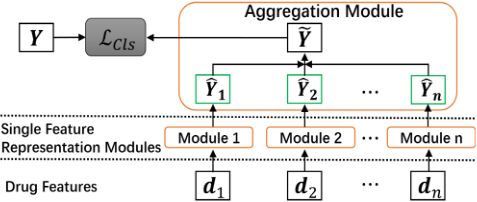
The framework of our proposed MLRDA is shown in Figure 1. Suppose we want to predict v DDI types based on n drug features, then MLRDA consists of n Single Feature Representation Modules (See more details in section 4.2) and one Aggregation Module (See more details in section 4.4). For each drug pair, the j-th Single Feature Representation Module takes in the j-th pairwise feature dj as input and outputs a binary vector ˆ Yj ∈ Rv , with each bit encoding the occurrence probability of each DDI type ri predicted by j-th feature. The Aggregation module collects prediction vectors ˆ Yjs given by different features and calculates a weighted prediction vector ˜Y with attention mechanism. In MLRDA, all representation modules and aggregation module are jointly optimized in an end-to-end way (See training objective in section 4.5). In the following subsections, we give more technical details.
4.2 Single Feature RepresentationModule
To exploit the beneficial information for DDI prediction and to reduce the undesired bias caused by irrelevant information in both labeled and unlabeled data, we design the Single Feature Representation Module (SFRM), of which the architecture is illustrated in Figure 2. For ease of illustration, we omit the subscript j indexing different drug features. The overall neural network is built with an autoencoder structure. The network consists of H +1 layers where H is an even number. The first H/2 + 1 hidden layers are encoders to learn a representation of each input and the last H/2 hidden layers are decoders to reconstruct the input.
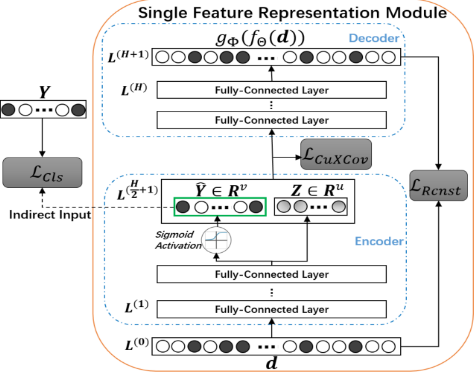
be the output of the h-th layer, h = 1, · · · ,H,H + 1. bh denotes the dimension of the output at the h-th layer and t(h) s are activation functions, which we take Rectified Linear Unit (ReLU) for all hidden layers except the high-level representation layer (the last layer of the encoder), i.e., h = H/2+1,
We define the function of the encoder as fΘ and the function of the decoder as gΦ (Θ and Φ denote the parameter space of encoder and decoder respectively), i.e.,
Given inputs ds, fΘ(d)s are abstract representations learnt by the encoder. In the learnt representation, without some explicit means, the latent factors relevant for DDI predictions would be entangled with other latent factors explaining the remaining variations of B. Our goal is partitioning fΘ(d) into two part ˆY ∈ Rv and Z ∈ Ru . ˆY = (ˆ y1, · · · , ˆ yv)T encodes the DDI-prediction-relevant factors with ˆ yi the occurrence of the i-th event ri and Z encodes the factors that are irrelevant with DDI prediction. To achieve the above idea, (a) we introduce a robust unsupervised disentangling loss CuXCov (See more details in section 4.3) that make ˆY as uncorrelated with Z as possible, (b) at the same time endowing ˆ yi with semantic meaning of the occurrence probability by DDI label vectors Ys that provide indirect supervised learning signals.
The learning of ˆ yi can be viewed as a binary classification task ri. In DDI prediction, each ˆ yi is corresponding to DDI type. Actually, each SFRM reformulates the DDI prediction problem as a multi-label classification problem, and the class label vector ˆY is given by learning the dimerous representation fΘ(d) of pairwise drug feature d. The class labels in ˆYs and ˜Ys are learnt simultaneously with shared parameters in layers L(h) , h = 1, · · · ,H/2, thus MLRDA is a multi-task learning framework [Caruana, 1997] in nature.
In addition, when drug pair {A,B} is in validation/test set, its predicted DDI label is the arithmetic average of two predicted label vectors w.r.t. inputs dAB and dBA since dAB and dBA should share the same DDI label.
4.3 CuXCov Loss
To identify the DDI-prediction-relevant part ˆY from the irrelevant part Z in the representation fΘ(d) of each SFRM, we wish ˆY as uncorrelated with Z as possible. [Cheung et al., 2015] proposed an unsupervised loss called XCov loss aimed at decorrelating ˆY with Z by minimizing the covariance of each dimension in ˆY and each dimension in Z.
Let Y = ( ˆ Y1 , ˆ Y2 , · · · , ˆ YN ), and Z = (Z1 , Z2 , · · · , ZN ) denote the matrices of high-level representations over a minibatch with size N. The XCov loss takes the form:
Where e ∈ RN is a column vector with all entries being 1, I is the identity matrix.
However, XCov loss estimates the cross-covariance matrix in each mini-batch separately. The mini-batch limits the sample size involved in estimating the cross-covariance matrix, and could result in inaccurate estimation and gradient descent directions with a large variance, which may disturb decorrelating ˆY with Z and bring about undesired bias for DDI prediction. Better estimation of the cross-covariance matrix is possible by enlarging sample size, yet simply enlarging the mini-batch size would not achieve a monotone increasing gain in predictive performance. Large batch size method tends to converge to sharp minimizers of the training function and result in worse generalizability [Keskar et al., 2017].
Utilizing all samples in B, i.e., the full batch to estimate the cross-covariance would result in a lower estimation variance. But it is challenging to calculate a full-batch estimation in mini-batch based deep learning models. Inspired by [Chang et al., 2018], we propose a robust cumulative loss CuXCov that approximates the full-batch cross-covariance matrix. The approximation is achieved by stochastic incremental learning. Let Σkf , Σka , Σkc , Σkm denote the full, approximate, cumulative, mini-batch cross-covariance estimator at the k-th training step respectively. The approximation works as follows:
Where α ∈ [0, 1] is the decay rate, and p is a normalizing factor computed accumulatively to estimate the cross-covariance matrix more accurately. Then let
and Σka approximates Σkf better than Σkm does as k gets larger for accumulating statistics collected for previous minibatches. To calculate The CuXCov loss, we rewrite (3) as:
where H = (I - eeT /N)(I - eeT /N)T ∈ RN×N .
From (4), (5) and (6), we have
Our goal is to minimize all entries in Σka . We define CuXCov loss as:
4.4 AggregationModule
We follow the common paradigm of multi-view learning [Sun, 2013; Gao et al., 2019] to take advantages of complementary information in multiple drug features. We seek help from the well-known attention mechanism [Bahdanau et al., 2015] to aggregate the results from single views and learn a weighted prediction vector ˜Y = (˜ y1, · · · , ˜ yv) adaptively. The details of the attention mechanism work as follows. Suppose we have n drug features and the SFRM give predictions ˆ Yj ∈ Rv , j = 1, 2, · · · , n. The final prediction vector ˜Y is the weighted average of ˆ Yjs, where the softmax weights ajs are determined by parameters Bj ∈ Rv and cj ∈ R. Specifically,
The parameters Bj , cj , as well as all other parameters in MLRDA are learnt in the end-to-end optimization process.
4.5 Loss Functions
Classification Loss and Reconstruction Loss
The Classification loss is defined as:
Where s indexes examples and i indexes DDI tasks. ys i is the label of s-th sample in labeled set Pi ∪Ni with 1 coding the occurrence of DDI ri and 0 otherwise.
The architecture of autoencoder allows introducing the unsupervised reconstruction loss to leverage information in both labeled and unlabeled data. For j-th drug feature, we define reconstruction loss over all drug pairs in B:
Training Objective
The training objective of the MLRDA network is to minimize the weighted integration of three losses:
Where hyperparameters β > 0 and γ > 0 control relative weights of n∑ j=1 LjCuXCov and n∑ j=1 LjRcnst over LCls, j indexes
for the j-th drug feature.
5 Experiments
5.1 Datasets
Drug Features
The drug features considered are from the following sources. Drug chemical structure data I: The first chemical structure data are extracted from Pubchem 2 substructure fingerprint. The chemical structure of each drug are binary coded as an 881-bit feature vector, each bit representing a Boolean determination of the presence of a substructure in a drug molecule. Drug chemical structure data II: The second chemical structure features are extended-connectivity fingerprints with diameter 6 (ECFP6) generated by R package "rcdk" 3 , and are hashed binary coded as a 1024-bit feature vector.
Drug indication data: The drug indication data is from SIDER 4 , and are binary coded as a 2714-bit feature vector, each bit representing a Boolean determination if the drug is clinically significant for an indication.
Drug targets data: The drug target data is from Therapeutic Target Database 5 , and are binary coded as a 2150-bit feature vector, each bit representing a Boolean determination if a protein or a nucleic acid is a target of the drug.
Drug side effect data: The drug indication data is also from SIDER, and are binary coded as a 5868-bit feature vector, each bit representing a Boolean determination if the drug is clinically significant for an side effect.
DDI Data
The labeled DDI data is from Twosides database 6 [Tatonetti et al., 2012]. It contains 645 drugs and 1318 types of DDIs, and in total 63473 drug pairs associated with DDI reports.
Datasets for DDI Prediction
We consider two sets of drug features for DDI prediction.
- C1IT: Drug chemical structure data I, Drug indication data, Drug targets data;
- C2IS: Drug chemical structure data II, Drug indication data, Drug side effect data.
The sets of drugs associated with various drug features in two datasets are different, we take the two intersections of drug sets in two datasets as the considered drug sets. In the two datasets, a simple filtering process is operated by keeping only informational bits of drug features, for example, if a bit in the original 2714-bit indication vector is 0 for all considered drugs, then this bit is omitted. In our study, in agreement with [Jin et al., 2017], we consider the top 100 frequent types of DDIs associated with drugs in C1IT and C2IS respectively. The DDI interactions from TWOSIDES are used as positive drug pair samples. The complement set of positive samples in TWOSIDES are utilized as negative samples. The drug pairs not included in TWOSIDES are used as the unlabeled dataset. Some basic statistics are shown in Table 2.
2 https://pubchem.ncbi.nlm.nih.gov/
3 https://cran.r-project.org/web/packages/rcdk/index.html
4 http://sideeffects.embl.de/download/
5 https://db.idrblab.org/ttd/full-data-download
6 http://tatonettilab.org/resources/tatonetti-stm.html
| Dataset | C1IT | C2IS |
|---|---|---|
| Number of considered drugs | 309 | 317 |
| Bits number of chemical structures | 563 | 1024 |
| Bits number of indications | 1457 | 1510 |
| Bits number of targets | 190 | Null |
| Bits number of side effects | Null | 3908 |
| Average positive samples count | 4757.6 | 4756.0 |
| Average negative samples count | 11946.4 | 12019.0 |
| Unlabeled samples count | 30882 | 33311 |
5.2 Methods for Comparison
Baselines
MLRDA is compared with following DDI prediction models.
- Nearest Neighbor method in [Vilar et al., 2012].
- Label Propagation method in [Zhang et al., 2015].
- Dyadic Prediction method in [Jin et al., 2017].
- Graph AutoEncoders method in [Ma et al., 2018].
- DeepDDI method in [Ryu et al., 2018].
- Other than above 5 state-of-the-art methods designed for DDI prediction. We also studied the well known semisupervised Ladder Network [Rasmus et al., 2015] as a baseline, regarding DDI prediction as a multi-label classification problem in a multi-task learning framework.
Ablation Study
We studied the effects of different components in MLRDA.
- MLRDA-Un: The MLRDA model trained with only labeled data.
- MLRDA-X: The MLRDA model without considering the cross-covariance penalty.
- MLRDA-X+: The MLRDA model without Z in highlevel representation layer, leading to no cross-covariance penalty as well.
- concateMLRDA: A simplified version of MLRDA that concatenates multiple drug features into one input vector d and predicts DDIs with one SFRM.
Evaluations and Implementations
We randomly select 10% of drugs and mask all DDIs associated with these drugs for testing. DDIs associated with drugs not in the testing set are used for training all models and we use 10-fold cross-validation to tune all hyperparameters of different methods. We optimized the hyperparameters for MLRDA and fix them for all MLRDA variants. The hyperparameters are shown in Table 4. The models are trained by Adam optimizer[Kingma and Ba, 2014] with a learning rate of 0.0001 and a dropout rate of 0.1. We consider decaying learning rate after 10 epochs.
For testing data, we evaluate all methods on different collections of DDIs. For a given collection of DDIs, we randomly select 50% of the testing set for evaluation and repeated the selection-evaluation process for 50 times. We report the mean and standard deviation of the Area Under Precision-Recall Curve(AUPR) and the area under Receiver Operating Characteristic curve (AUROC) over 50 repetitions. The AUPR and AUROC are averaged over 100 DDI tasks.
| C1IT | C2IS | ||||
|---|---|---|---|---|---|
| Method | AUPR | AUROC | AUPR | AUROC | |
| Baselines | Nearest Neighbor Label Propagation Dyadic Prediction Graph AutoEncoder Deep DDI | 0.320±0.0042 0.399±0.0057 0.352±0.0043 0.394±0.0044 | 0.564±0.0035 0.649±0.0027 0.604±0.0031 0.651±0.0027 0.639±0.0032 | 0.389±0.0048 0.434±0.0050 0.438±0.0057 0.426±0.0046 0.454±0.0051 | 0.635±0.0037 0.659±0.0035 0.655±0.0035 0.676±0.0024 0.683±0.0028 |
| 0.429±0.0048 | |||||
| 0.390±0.0055 | |||||
| Ladder Network | 0.378±0.0046 | 0.629±0.0030 | 0.462±0.0048 | 0.688±0.0026 | |
| Proposed | MLRDA | 0.440 ± 0.0058 | 0.667 ± 0.0027 | 0.483 ± 0.0053 | 0.697 ± 0.0029 |
| Ablation Study | MLRDA-Un | 0.397±0.0053 | 0.620±0.0033 | 0.656±0.0031 | |
| MLRDA-X | 0.377±0.0049 | 0.622±0.0029 | 0.433±0.0042 | 0.663±0.0027 | |
| MLRDA-X+ | 0.354±0.0046 | 0.606±0.0033 | 0.395±0.0038 | 0.631±0.0026 | |
| concateMLRDA | 0.419±0.0048 | 0.653±0.0026 | 0.471±0.0047 | 0.683±0.0025 | |
| Hyperparameters | Values |
|---|---|
| Number of layers H + 1 | 5 (2+1+2) |
| Number of neurons in encoders | 2048, 1024 |
| Number of neurons in decoders | 1024, 2048 |
| Dimension of Zs | 256 |
| Activation function t(·) | ReLU |
| (β, γ) of C1IT | (125,0.25) |
| (β, γ) of C2IS | (50,0.25) |
| Decay rate αs of C1IT | (0.2, 0.6, 0.2) |
| Decay rate αs of C2IS | (0.3, 0.2, 0.6) |
| Mini-batch size | 1024 |
5.3 Results and Analysis
Table 3 compares the performance of the proposed MLRDA against its variants and competing baseline methods. The table shows that MLRDA and concateMLRDA consistently achieve higher AUPRs and AUROCs for better exploiting the associations among DDI events and leveraging hidden information in unlabeled DDI data. MLRDA-Un achieves worse performance for failing to leverage hidden information in the unlabeled data. Though MLRDA-X and MLRDA-X+ consider unlabeled data in reconstruction loss, they suffer from overfitting and achieve even worse results for failing to disentangle the class-relevant factors, and as a result, incorporating the unlabeled data will introduce undesired bias for DDI prediction instead of revealing hidden information. MLRDAX outperforms MLRDA-X+ by reserving Z for better reconstruction of drug features, and the reconstruction losses regularize classification. The better performance of MLRDA over concateMLRDA demonstrates the advantage of isolating features first and learn adaptive weights to fuse features by adopting multiple SFRM.
5.4 CuXCov Loss vs XCov Loss
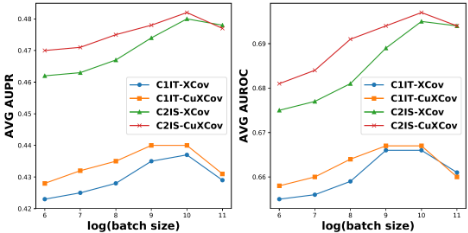
In this subsection we study the performances of CuXCov loss against XCov loss [Cheung et al., 2015]. Note that the cumulative CuXCov loss degenerates to XCov loss when the decay rate parameter α = 0. For CuXCov loss, αs are set as in Table 4. Fixing other hyperparameters as in Table 4, we study the performances of models leveraging two losses with variant batch sizes ranging from 64 to 2048. The results in Figure 3 demonstrates that CuXCov model outperforms XCov model consistently for better approximating the full-batch statistics. The performances of two models are increasing as batch size getting larger at first for better estimation of cross-covariance with smaller estimation variance. As the batch size continually getting larger, performances decay because of the degradation of generalization caused by convergence to sharp minimizers of the training function [Keskar et al., 2017].
6 Conclusion
In this paper, we propose a multi-task semi-supervised learning framework MLRDA for DDI prediction. MLRDA effectively exploits information that is beneficial for DDI prediction in both labeled and unlabeled drug data by leveraging a novel unsupervised disentangling loss CuXCov. Moreover, MLRDA adopts a multi-task learning framework to exploit associations among DDI types. Experimental results on realworld datasets demonstrate that MLRDA significantly outperforms state-of-the-art DDI prediction methods by up to 10.3% in AUPR.
Acknowledgements
This work is supported by the National Natural Science Foundation of China (No.61772045). We thank the anonymous reviewers for their helpful comments and suggestions.
@inproceedings{ijcai2019p628,
  title     = {MLRDA: A Multi-Task Semi-Supervised Learning Framework for Drug-Drug Interaction Prediction},
  author    = {Chu, Xu and Lin, Yang and Wang, Yasha and Wang, Leye and Wang, Jiangtao and Gao, Jingyue},
  booktitle = {Proceedings of the Twenty-Eighth International Joint Conference on
               Artificial Intelligence, {IJCAI-19}},
  publisher = {International Joint Conferences on Artificial Intelligence Organization},
  editor    = {Sarit Kraus},
  pages     = {4518--4524},
  year      = {2019},
  month     = {8},
  note      = {Main track},
  doi       = {10.24963/ijcai.2019/628},
  url       = {https://doi.org/10.24963/ijcai.2019/628},
}
TY - CPAPER TI - MLRDA: A Multi-Task Semi-Supervised Learning Framework for Drug-Drug Interaction Prediction AU - Chu, Xu AU - Lin, Yang AU - Wang, Yasha AU - Wang, Leye AU - Wang, Jiangtao AU - Gao, Jingyue T2 - Proceedings of the Twenty-Eighth International Joint Conference on Artificial Intelligence, IJCAI-19 PB - International Joint Conferences on Artificial Intelligence Organization PY - 2019 SP - 4518 EP - 4524 DO - 10.24963/ijcai.2019/628 UR - https://doi.org/10.24963/ijcai.2019/628 ER -Copied
Machine-readable versions of this paper, for tools and AI agents:





